
25 Best AI SEO Tools in 2026 to Boost Visibility & Ranking
 Gursharan Singh
Published: July 6
Gursharan Singh
Published: July 6
A practitioner-level breakdown of the 25 best AI-SEO tools shaping how brands stay visible across Google and generative AI engines, and what each one does, who it's for, and what it actually costs.
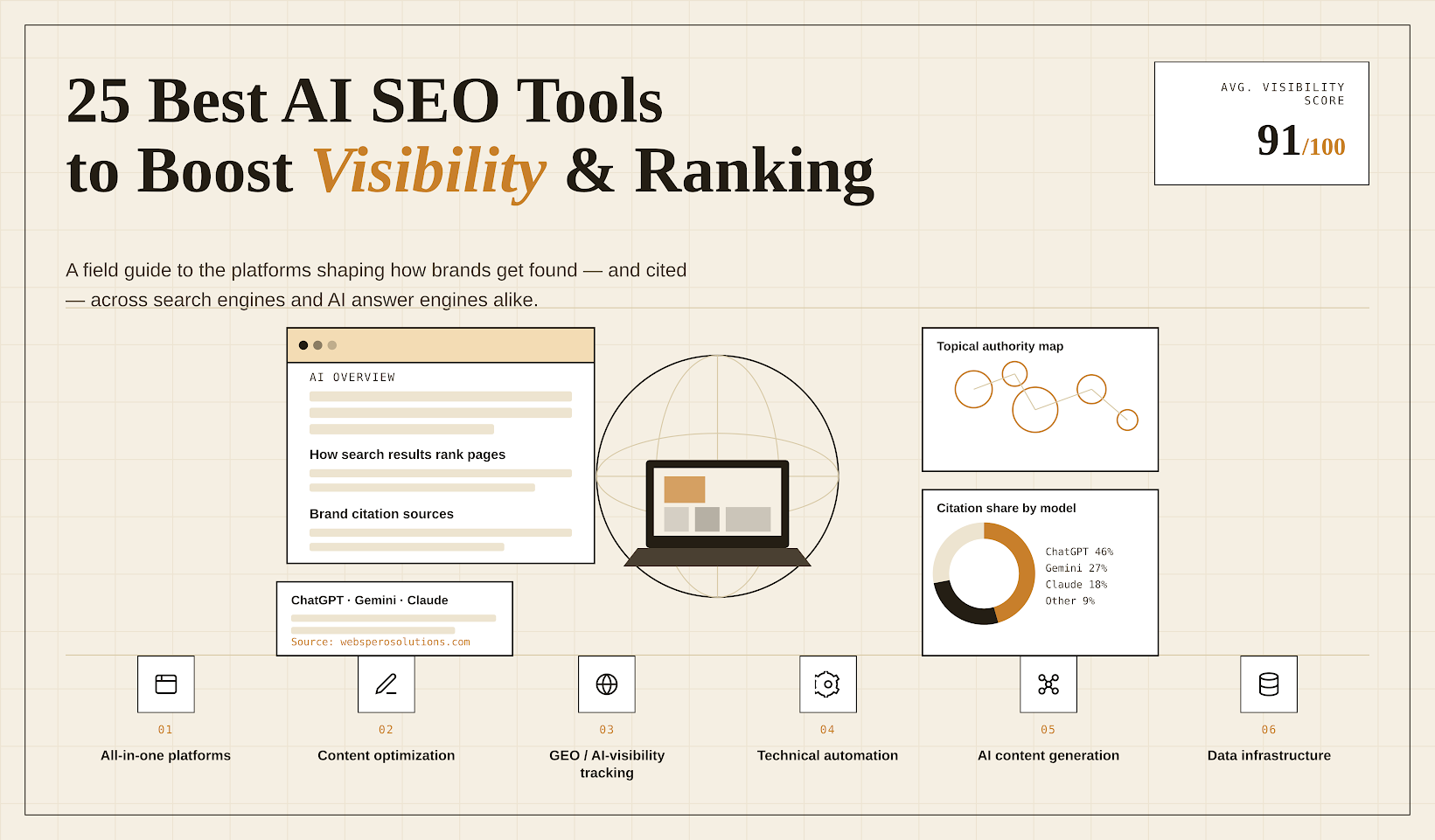
Five years ago, "AI SEO tool" mostly meant a content editor that told you to add three more keywords. That category still exists, but it's no longer the interesting part of the stack. In 2026, SEO software has to do two jobs at once: keep you visible in Google's blue links and get you cited inside ChatGPT, Perplexity, Gemini, and AI Overviews.
The term "AI-powered SEO tool" gets used loosely, so it's worth being precise. An AI-powered SEO tool uses machine learning or large language models to do one or more of the following: analyze ranking content at scale and generate optimization guidance, monitor technical site health and flag issues automatically, track whether a brand is being mentioned or cited inside AI-generated answers, or generate and optimize content drafts based on live SERP and competitor data.
The practitioner filter is worth applying to any tool in this category: does it generate genuinely new insight from data, or is it repackaging numbers you already had with a chatbot wrapper on top? What follows is a survey of the category in 2026, covering all-in-one platforms, content optimization, dedicated GEO/AI-visibility tracking, technical automation, AI content generation, and raw data infrastructure.
These 25 were selected for covering six distinct functions:
Here is a quick overview of the tools covered, with category, pricing, and best-fit use case at a glance. The list that follows is not ranked by preference — it is ordered alphabetically.
| # | Tool | Category | Pricing | Best For |
|---|---|---|---|---|
| 01 | Ahrefs | All-in-One | $129+/mo | Backlink-heavy research + brand-mention tracking |
| 02 | AIclicks | GEO Tracking | $59–499/mo | Real-UI prompt querying with action lists |
| 03 | AirOps | Technical Automation | Free–Custom | No-code content ops pipelines at scale |
| 04 | Alli AI | Technical Automation | Custom | Large sites with high technical debt |
| 05 | AthenaHQ | GEO Tracking | $270–545+/mo | Enterprise AEO with revenue attribution |
| 06 | Clearscope | Content Optimization | $129–399/mo | Optimizing human-written drafts |
| 07 | DataForSEO | Data Infrastructure | PAYG, $50 min | Custom-built proprietary tooling |
| 08 | Frase.io | Content Optimization | $39+/mo | Budget SERP briefs with GEO bundled in |
| 09 | GrackerAI | GEO Tracking | $99–499/mo | Cybersecurity & B2B SaaS citation authority |
| 10 | Indexly | Technical Automation | $99–499/mo | Instant indexing to AI crawlers |
| 11 | Jasper AI | AI Content Generation | $59+/mo | Brand-voice-consistent marketing content |
| 12 | KIME | GEO Tracking | €149–499/mo | Transparent pricing, generous seats |
| 13 | LLMrefs | GEO Tracking | Free–Custom | Prompt discovery from real user data |
| 14 | Mangools AI Grader | GEO Tracking | Free | Free one-time AI visibility snapshot |
| 15 | MarketMuse | Content Optimization | Free–$499/mo | Site-wide topical authority modeling |
| 16 | Otterly AI | GEO Tracking | $29–189/mo | Budget entry point to mention tracking |
| 17 | Peec AI | GEO Tracking | $94–210/mo | Focused, non-overloaded AI tracking |
| 18 | Profound | GEO Tracking | $99–499/mo | Enterprise GEO tied to revenue attribution |
| 19 | Rankscale.ai | GEO Tracking | $99–780/mo | Granular term, engine & regional drill-downs |
| 20 | SE Ranking | All-in-One | $92–279/mo | Traditional SEO + AI tracking, no add-ons |
| 21 | Search Atlas | All-in-One | $99–199+/mo | Unified content, audit & link platform |
| 22 | Semrush | All-in-One | $120–200/mo | Agencies wanting one platform for all |
| 23 | Surfer SEO | Content Optimization | $49–299/mo | Optimizing for Google rank + AI citation |
| 24 | WorkDuo.ai | GEO Tracking | $269+/mo | Product-level AI shopping visibility |
| 25 | Writesonic | AI Content Generation | $79–399/mo | Writing + SEO + AI tracking combined |
Pricing reflects publicly listed vendor tiers as of July 2026 and is subject to change without notice. Verify current pricing directly with each vendor before purchase.
Ahrefs built its reputation on backlink indexing and has layered AI features on top of that 15-plus-year data set rather than starting from scratch. Brand Radar extends the platform's existing crawl and link data into citation tracking across major AI engines.
Tracks over 243 million real-prompt brand mentions across six major AI engines (ChatGPT, Google's AI Overview, Claude, Gemini, Perplexity, Microsoft's Copilot), combining content and AI-visibility tracking in one account.
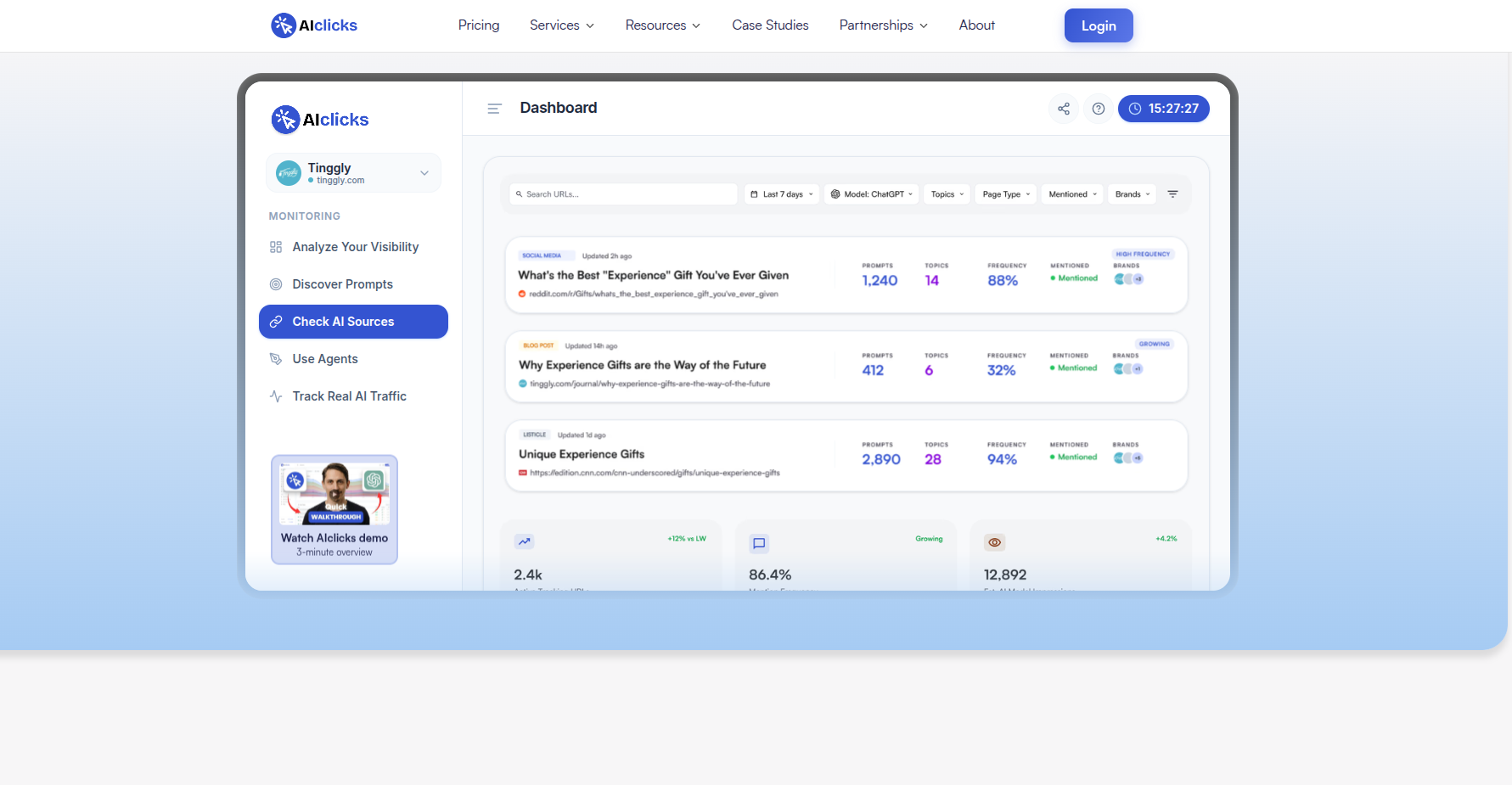
Most GEO trackers query LLMs through backend API calls, which don't always match what a real user sees. AIclicks instead replicates live user interfaces when querying conversational platforms, then converts findings into a prioritized action list rather than a static report.
Live UI-replication querying, closing the gap between visibility data and what action to take on it.
AirOps is built for teams that need to automate the production pipeline itself — briefs, drafts, and audits, and not just analyze content. It connects to a wide range of underlying models rather than locking users into a single LLM.
Connects 30-plus models to build custom, no-code automated brief and audit pipelines.
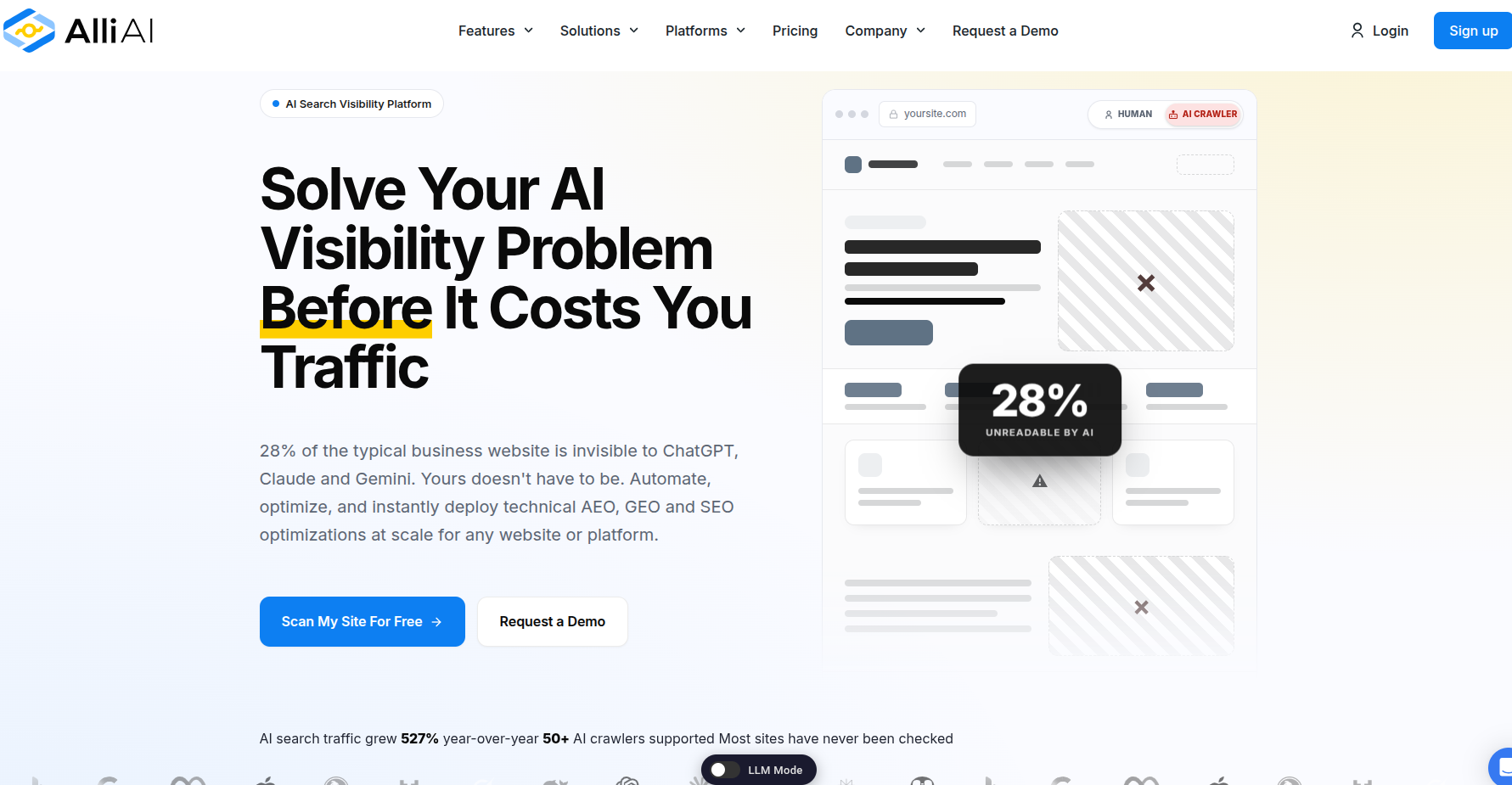
Alli AI sits on top of a site's CMS and applies technical fixes directly rather than just flagging them for a human to action manually. This matters most for sites in the thousands-of-pages range, where ticket-by-ticket technical maintenance stops scaling.
Site-wide automated schema markup, meta tag updates, and broken-link repair across an entire domain.
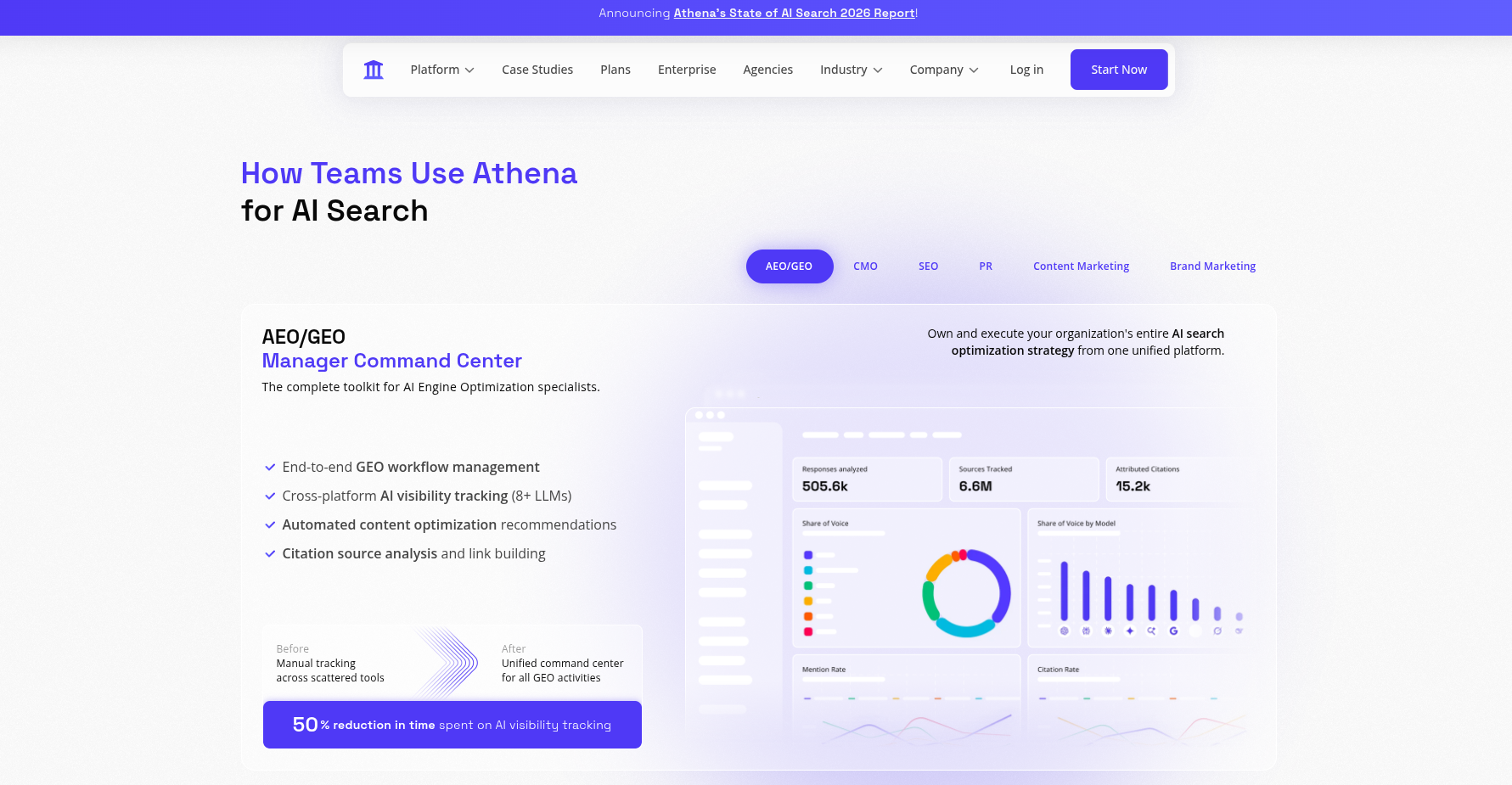
AthenaHQ pairs cross-platform AI citation monitoring with a prescriptive recommendation engine, then ties both back to business outcomes through direct GA4 and Shopify integrations rather than stopping at a visibility score. Pricing runs on a credit system, so cost scales with how many prompts, engines, and fan-out queries a team enables.
Action Center maps content and outreach recommendations directly to the passages and sources AI models cite in a given category, and connects citation data to GA4/Shopify revenue.
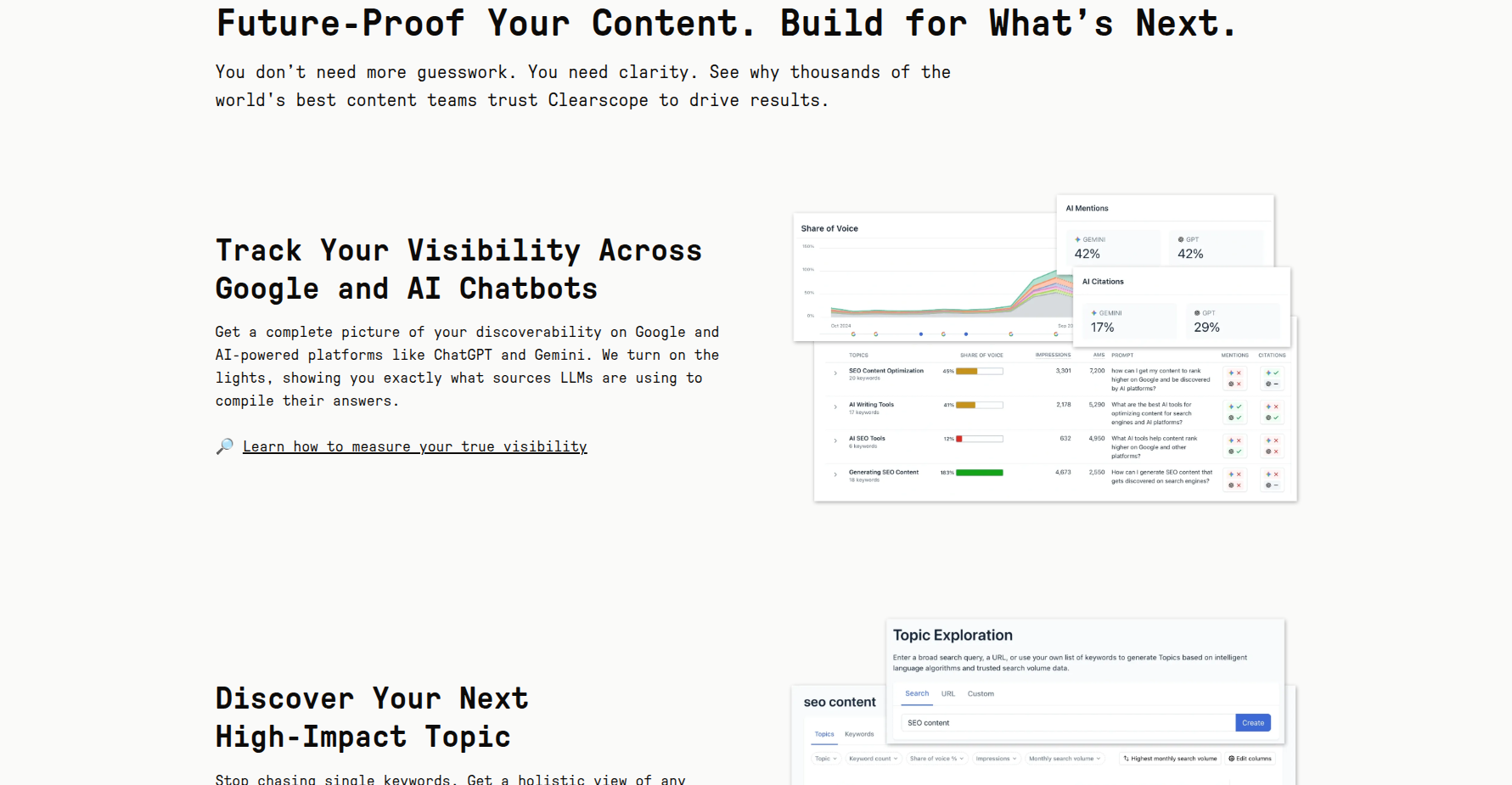
Clearscope is built specifically for teams that write content themselves and want a precise semantic map of what's already ranking, rather than a tool that generates the draft for them. It deliberately avoids synthetic content generation in favor of guidance.
Real-time Content Score combining keyword density with topical relevance, scored against live top-ranking competitors.
DataForSEO is the build-your-own-stack option: rather than a packaged dashboard, it provides raw search and LLM citation data via API with no monthly retainer required. It suits teams with their own engineering resources who want to build proprietary tooling on top.
Direct API access to raw search and LLM citation data, billed on usage rather than subscription.
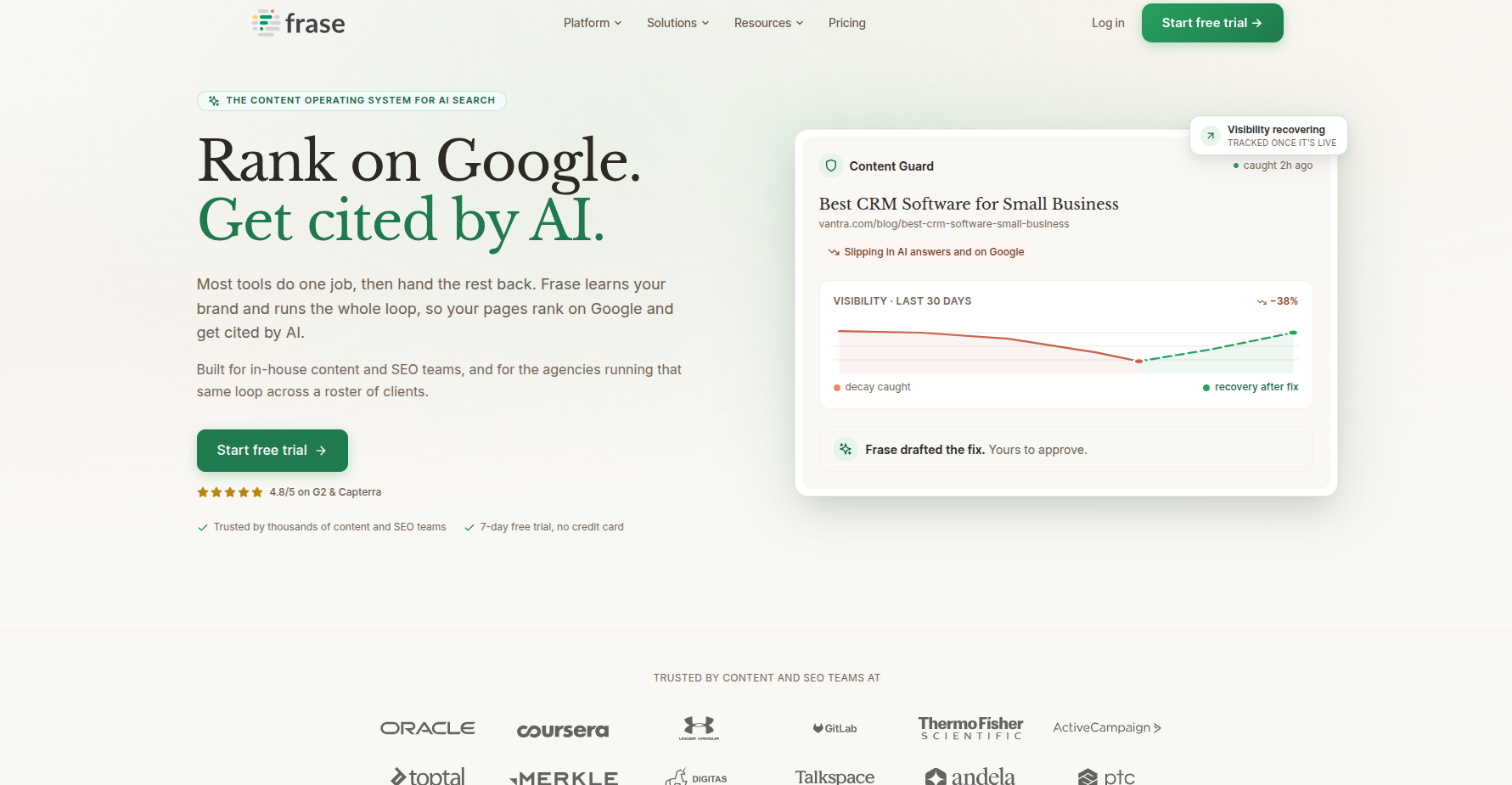
Frase built its name on fast SERP-based content briefs and has since folded AI Search Tracking into every plan rather than selling it as a separate add-on, which keeps entry pricing competitive relative to Surfer or Clearscope. The AI writer remains a secondary feature; the brief and research layer is still the core draw.
Real-time dual SEO and GEO scoring inside the editor, with AI Search Tracking across ChatGPT, Perplexity, and Gemini included on the base plan.
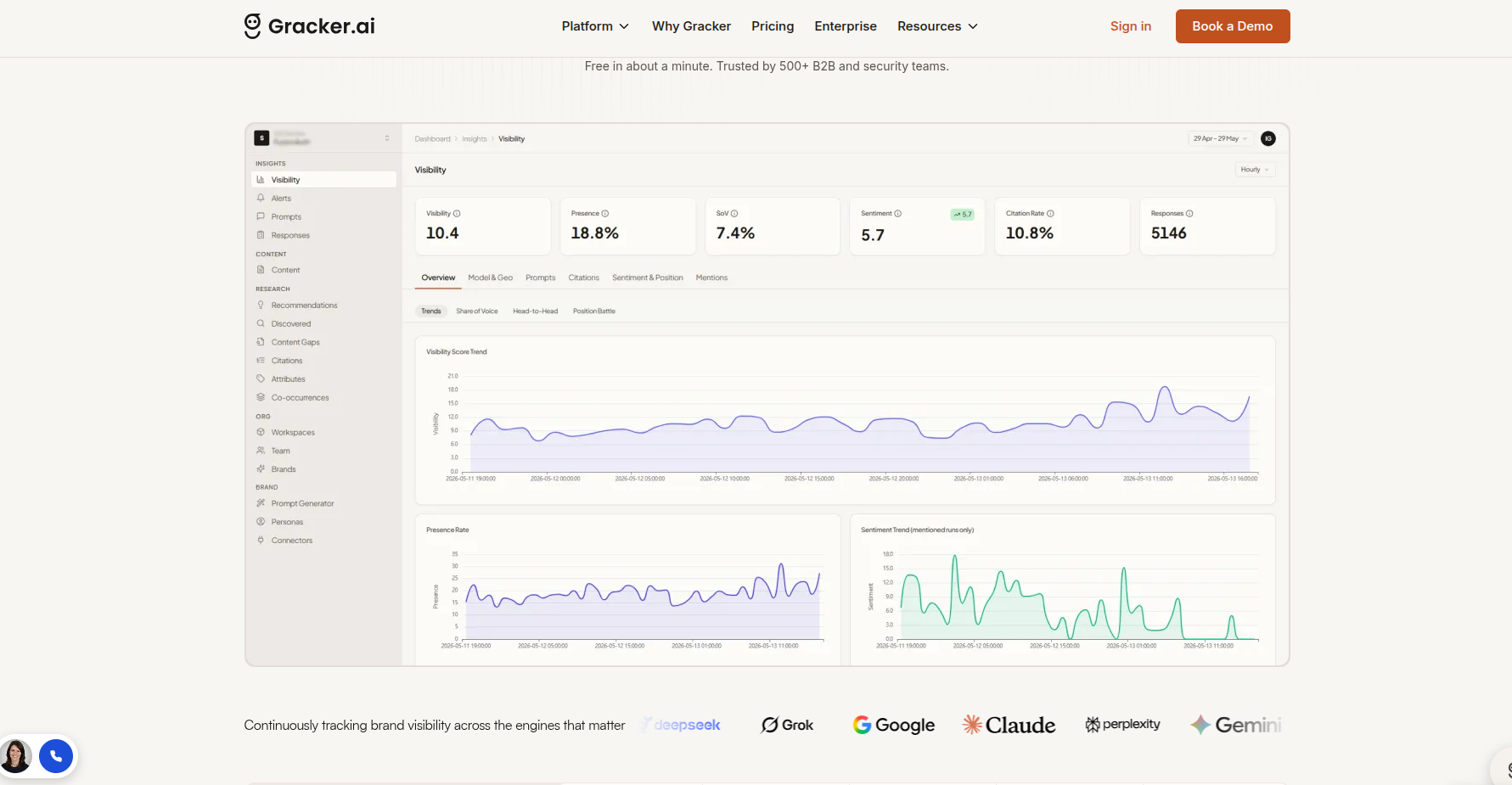
GrackerAI narrows its focus to a specific buyer category — security and B2B SaaS teams — and pairs AI citation monitoring with automated production of the comparison pages, glossaries, and pSEO portals that tend to earn citations in that space, rather than serving as a general-purpose tracker.
Autopilot generation of programmatic SEO portals (CVE hubs, compliance libraries, comparison pages) engineered to match how AI engines evaluate and cite sources.
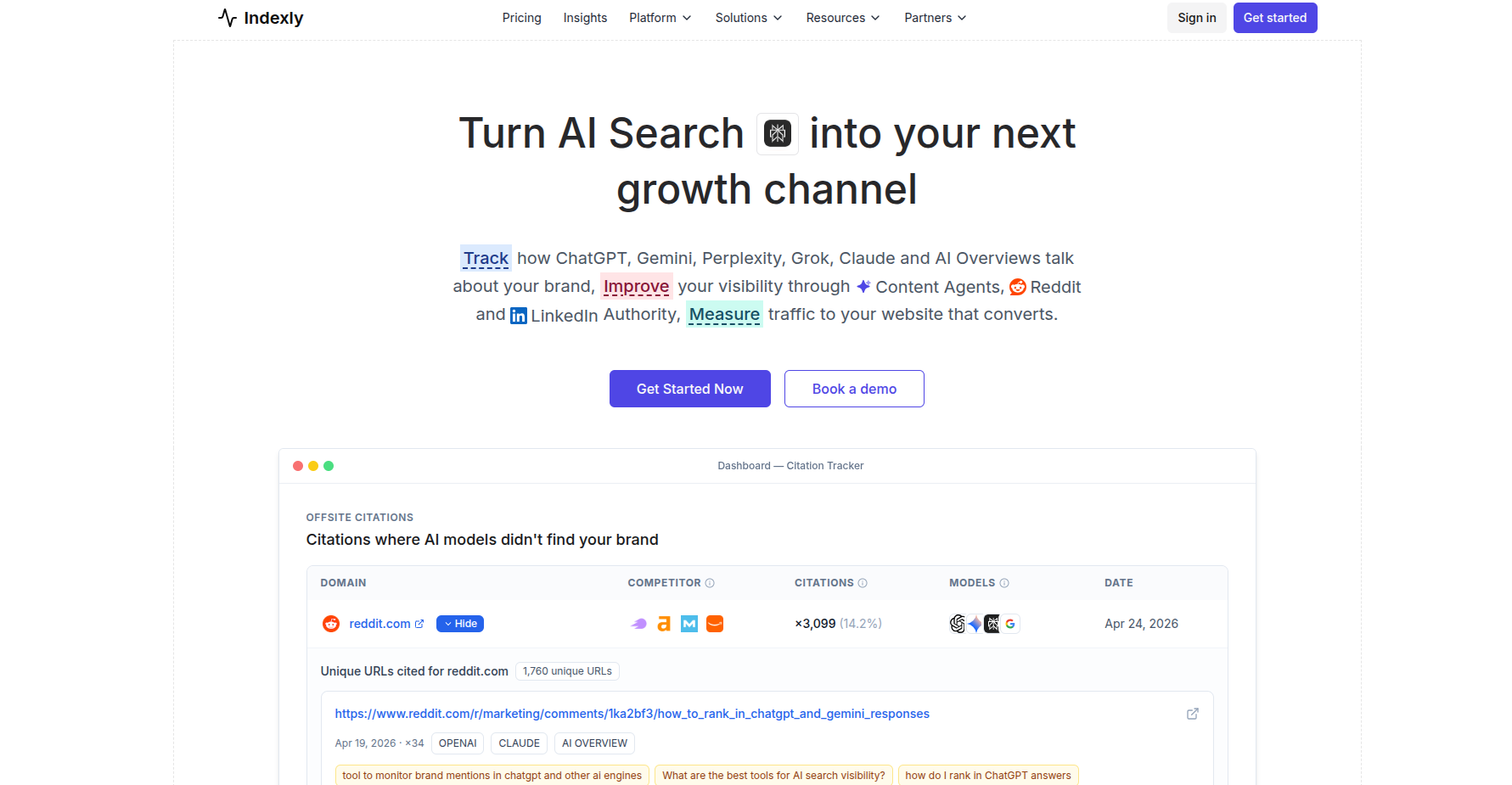
Indexly addresses a narrower but increasingly relevant problem: getting new content discovered quickly by both traditional and AI crawlers. It leans on deep Bing and indexing-API integrations rather than waiting for organic crawl cycles.
Forces near-immediate discovery of new or updated pages by AI crawlers via direct indexing API submission.
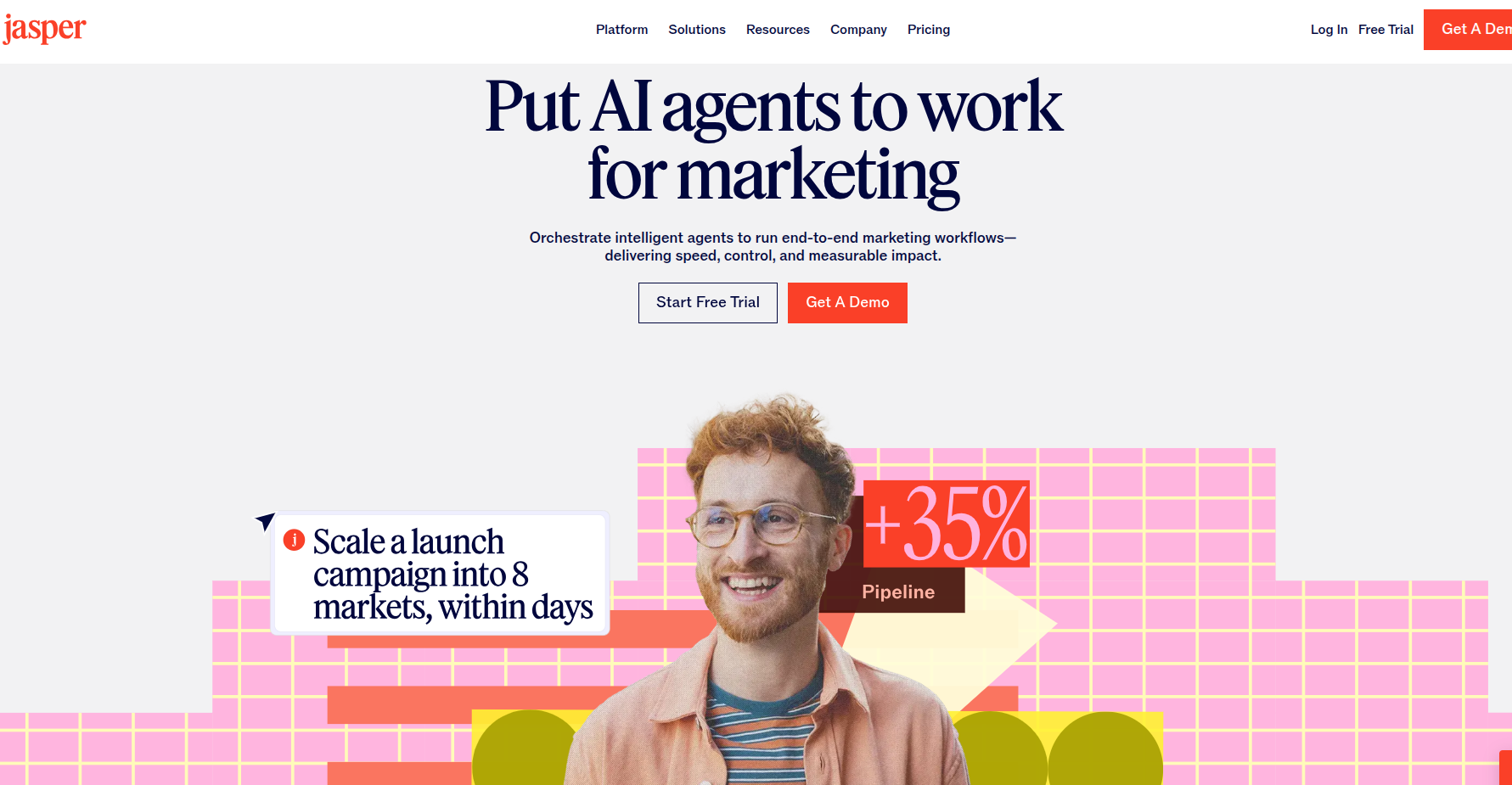
Jasper is primarily a generalist AI writing platform rather than an SEO analysis tool — its differentiator is training on a brand's specific voice and style so output stays consistent across writers and channels. SEO Mode leans on a bundled Surfer SEO integration rather than native optimization data.
Brand Voice training paired with SEO Mode (Surfer integration), so multi-brand or multi-client teams keep tone consistent while optimizing for SERP data.
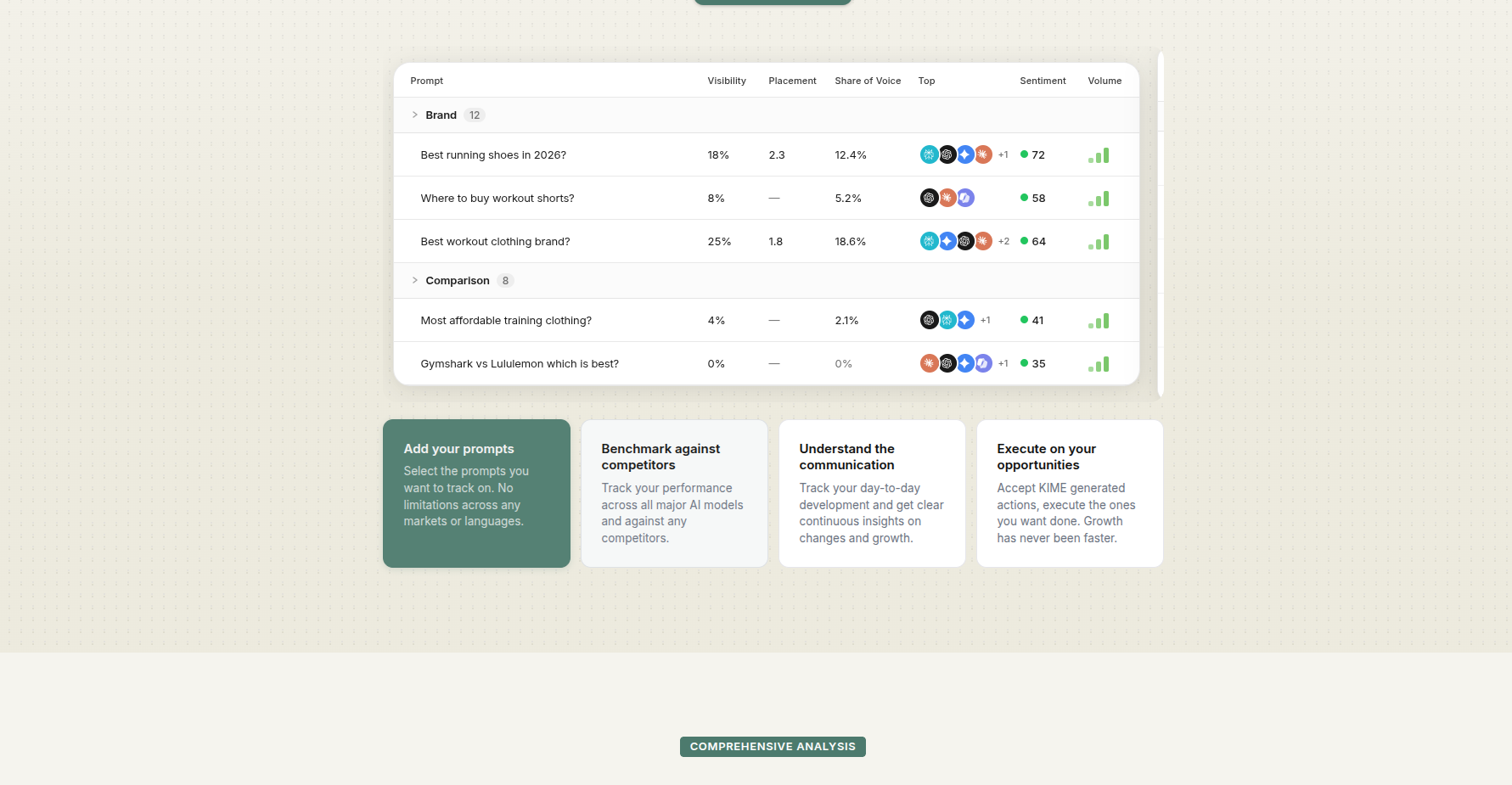
KIME positions itself against enterprise-priced GEO platforms by publishing clear tiered pricing and including a generous number of team seats on every plan, rather than charging per seat. It leans on an Action tab to turn monitoring data into suggested fixes and tracks an unlimited number of competitors.
Real-time tracking across up to ten LLMs with unlimited competitor tracking and a built-in Action Center for prioritized optimization tasks.
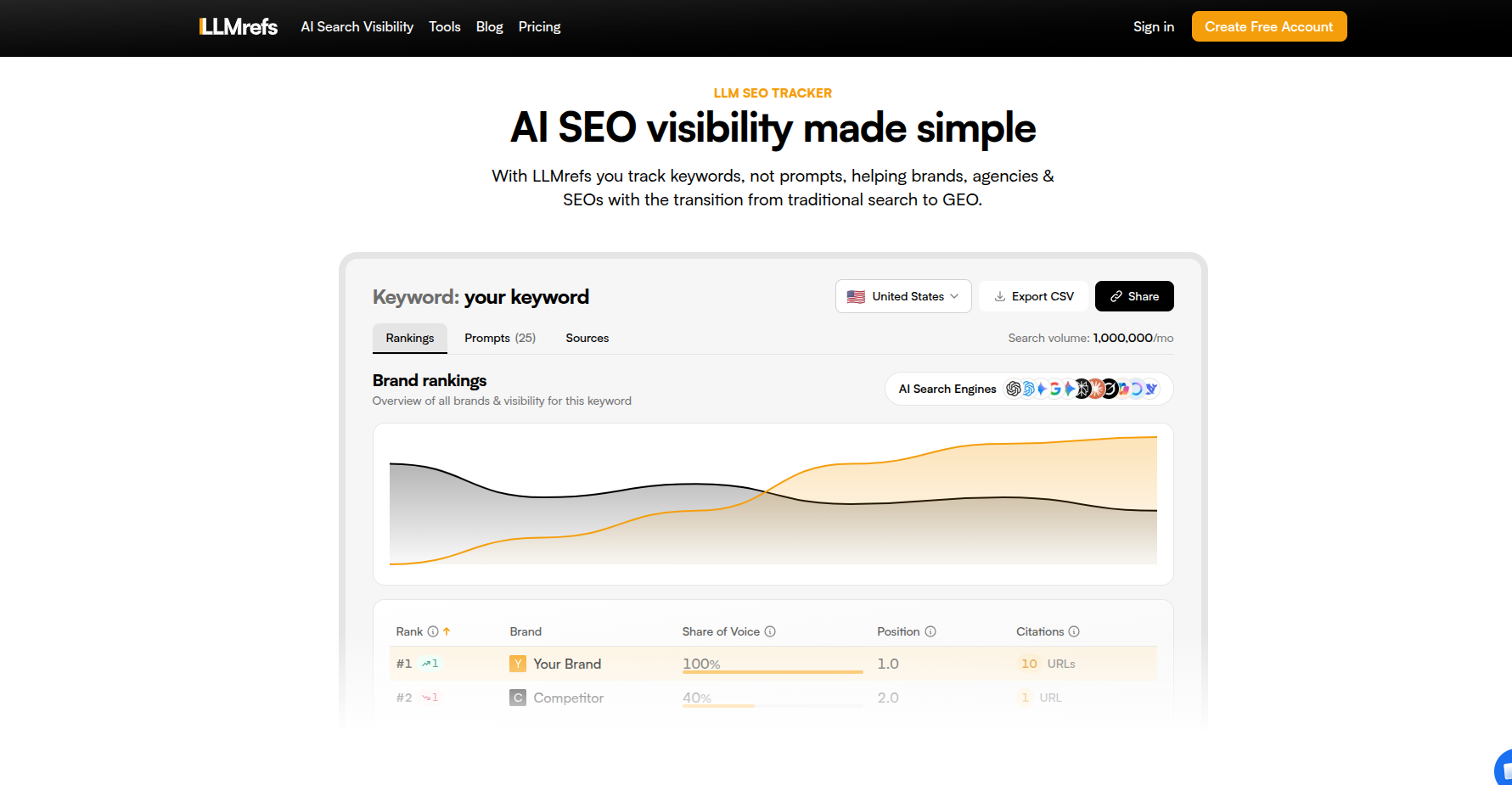
LLMrefs differs from most GEO trackers by not asking users to write their own prompts. Instead, it generates prompts from a large dataset of real ChatGPT conversations, aiming to reduce the bias introduced when a marketing team guesses how customers actually phrase questions to a large language model.
Automatic prompt generation sourced from a 4.5-million-conversation ChatGPT dataset, plus free supporting tools like an llms.txt generator and AI crawl checker.
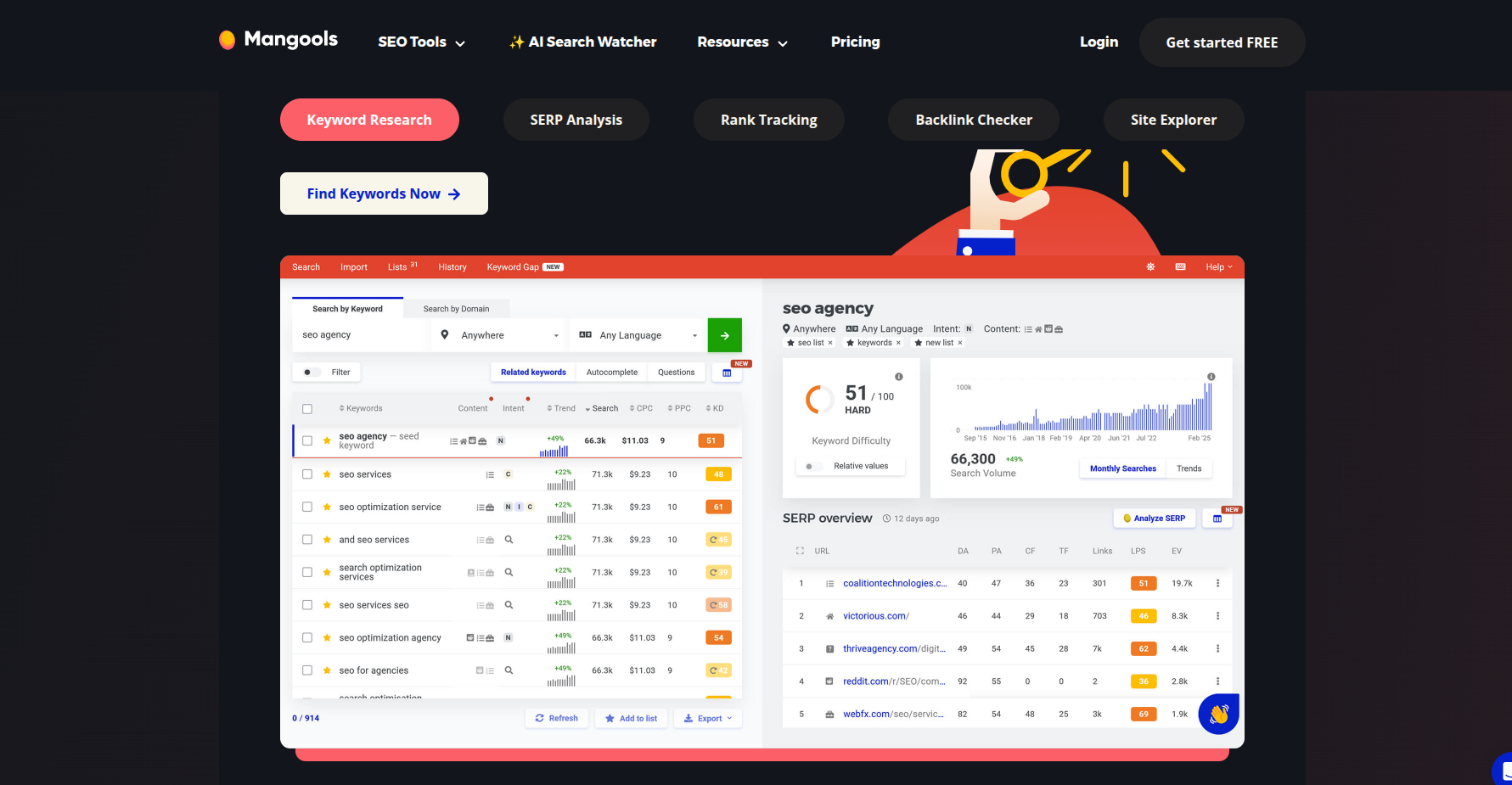
Mangools AI Search Grader is a free one-time check rather than a continuous monitoring subscription — useful as an entry point for a team that hasn't started tracking AI visibility at all. Ongoing tracking sits in a separate, low-cost add-on rather than in the free tool itself.
Free visibility and ranking snapshot across eight LLMs with a proprietary weighted AI Search Score, no credit card required.
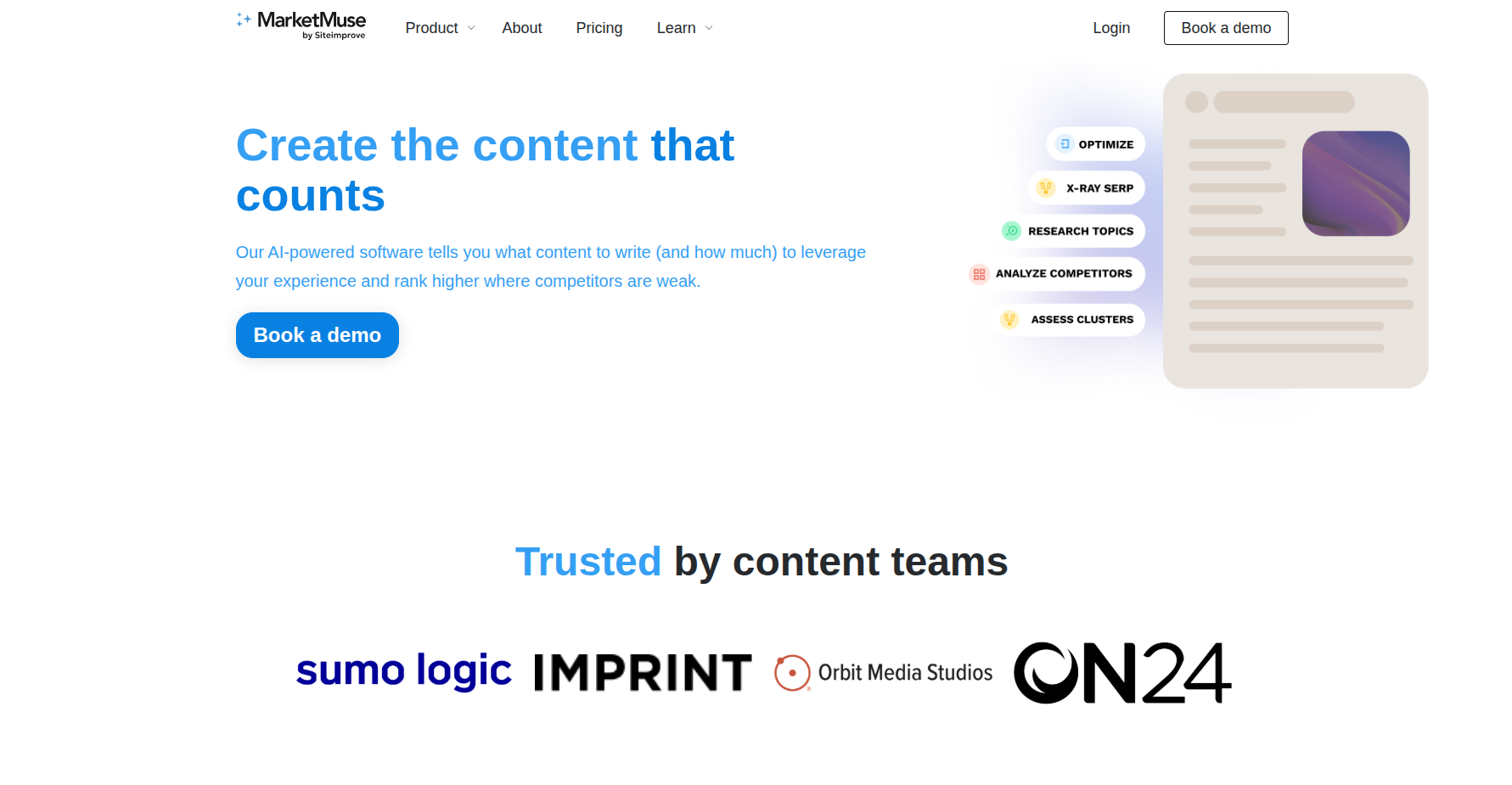
MarketMuse treats content decisions as a strategic, site-wide inventory problem rather than a single-article optimization task. Its patented topic modeling maps an entire domain's coverage against competitors, aimed at teams planning which pages to build or refresh rather than teams optimizing one draft at a time.
Personalized difficulty scoring that adjusts keyword difficulty based on a site's existing topical authority, paired with full-site content inventory analysis.
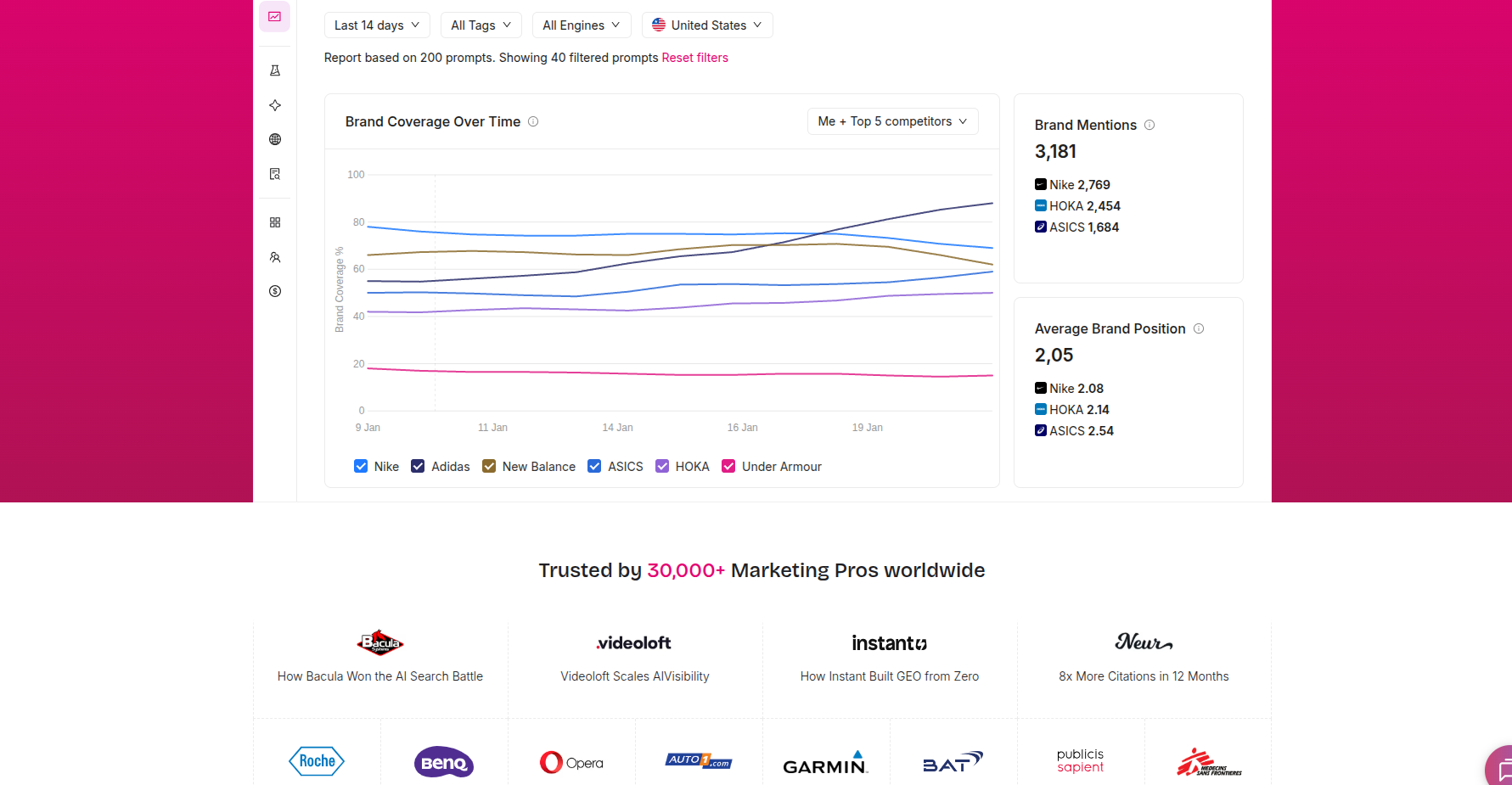
Otterly AI is a pure-play GEO tracker without the broader feature set (or price tag) of an all-in-one platform. It's a reasonable starting point for teams that want to begin monitoring AI visibility before committing to a larger tool.
Tracks brand mentions, citations, and sentiment across core conversational AI platforms.
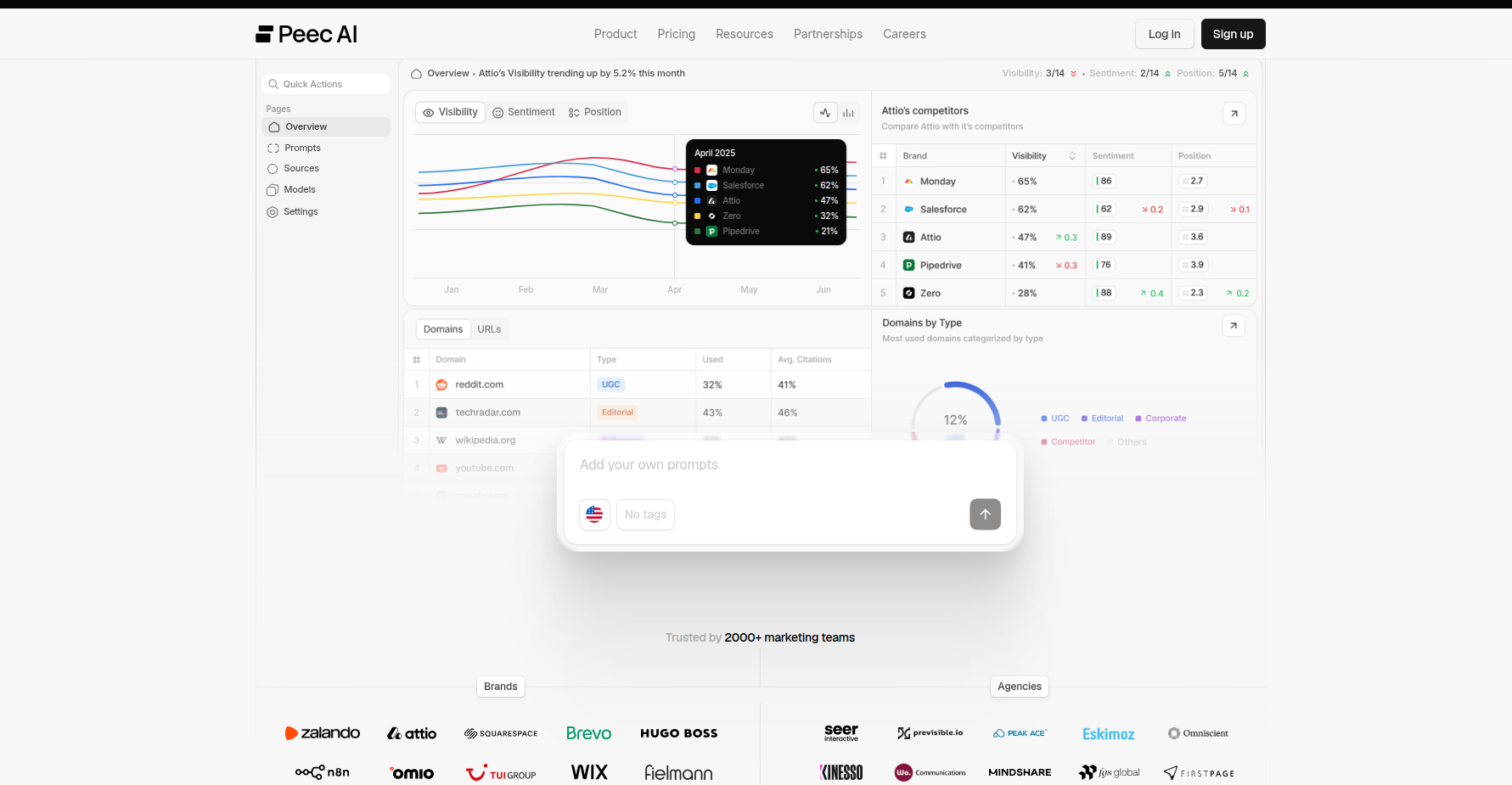
Peec AI occupies similar territory to Otterly — a dedicated GEO tracker rather than an all-in-one suite — with a narrower interface aimed at teams who want visibility data without a sprawling feature set to learn.
Pure-play AI visibility tracking focused on primary LLM platforms.
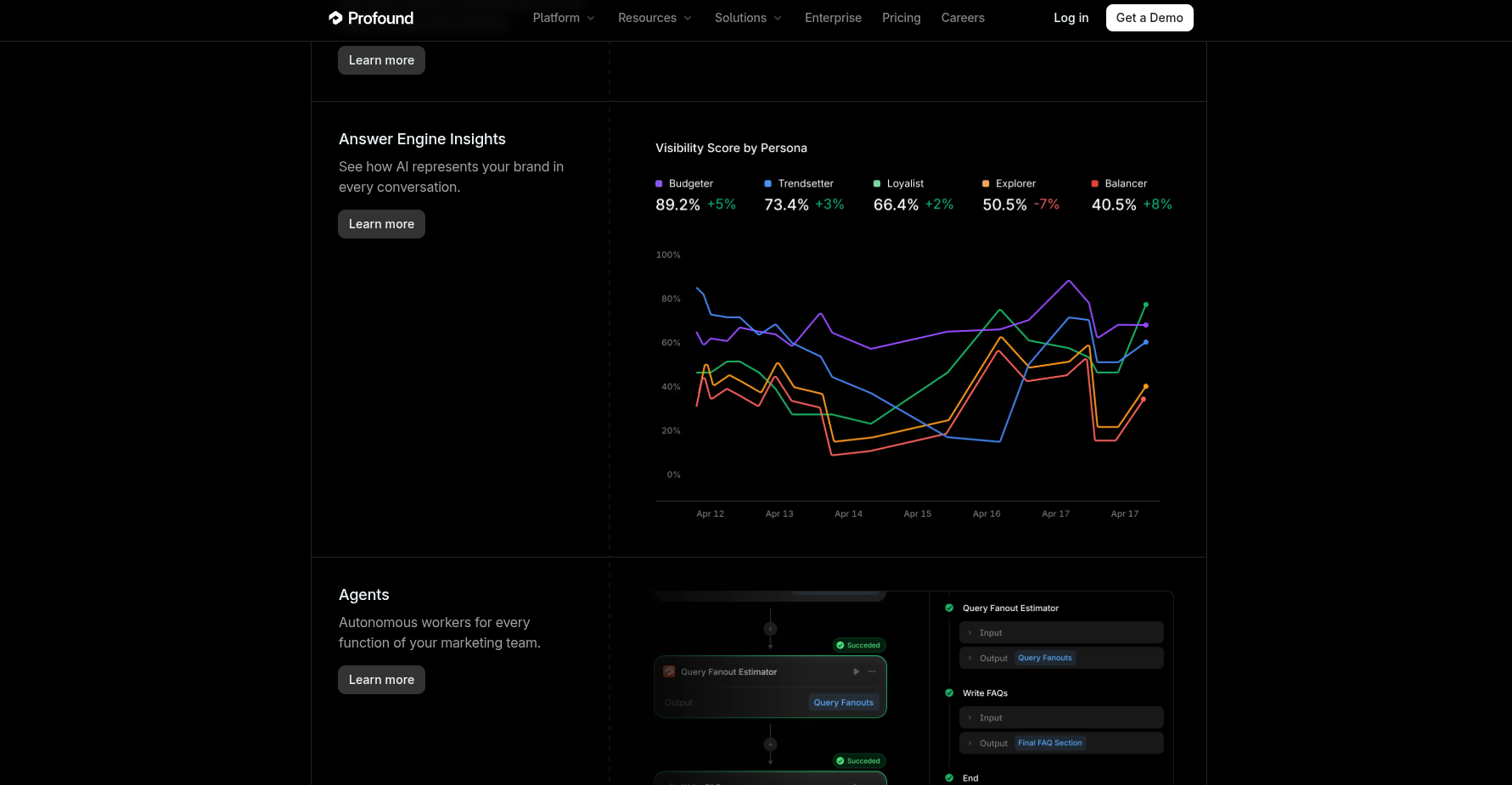
Profound is positioned for organizations that need to justify GEO spend to stakeholders with hard numbers, not just visibility trends. It ties citation data to downstream business outcomes rather than treating mentions as an end in themselves.
Captures front-end empirical citation data across ten-plus LLMs to measure pipeline and revenue influence.
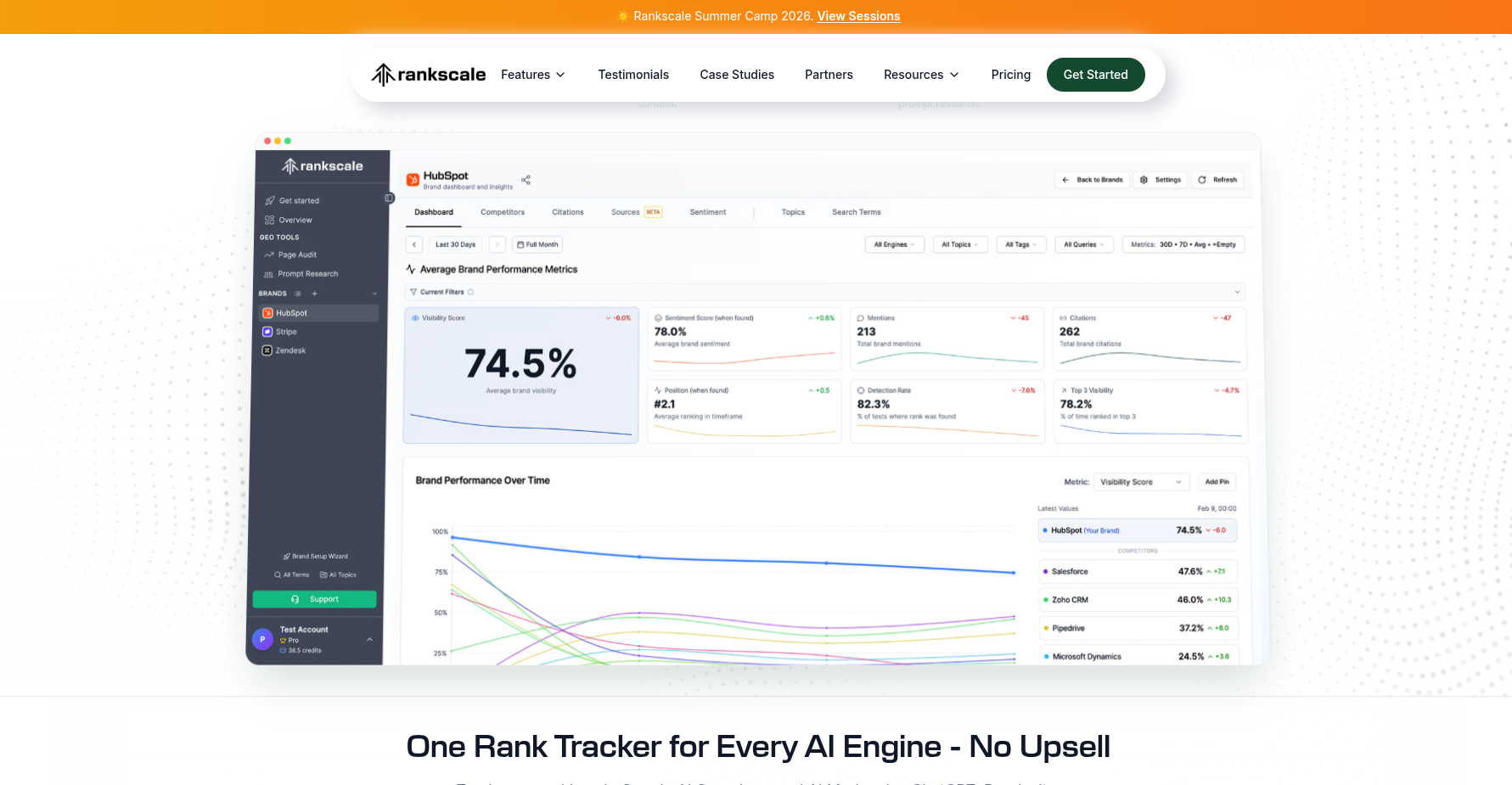
Rankscale.ai is built for technically minded teams who want to isolate exactly how an LLM's response shifts based on regional prompt variation or a specific model update, rather than a single aggregate visibility score.
Regional and engine-level breakdown grids showing how citation results vary by geography and model version.
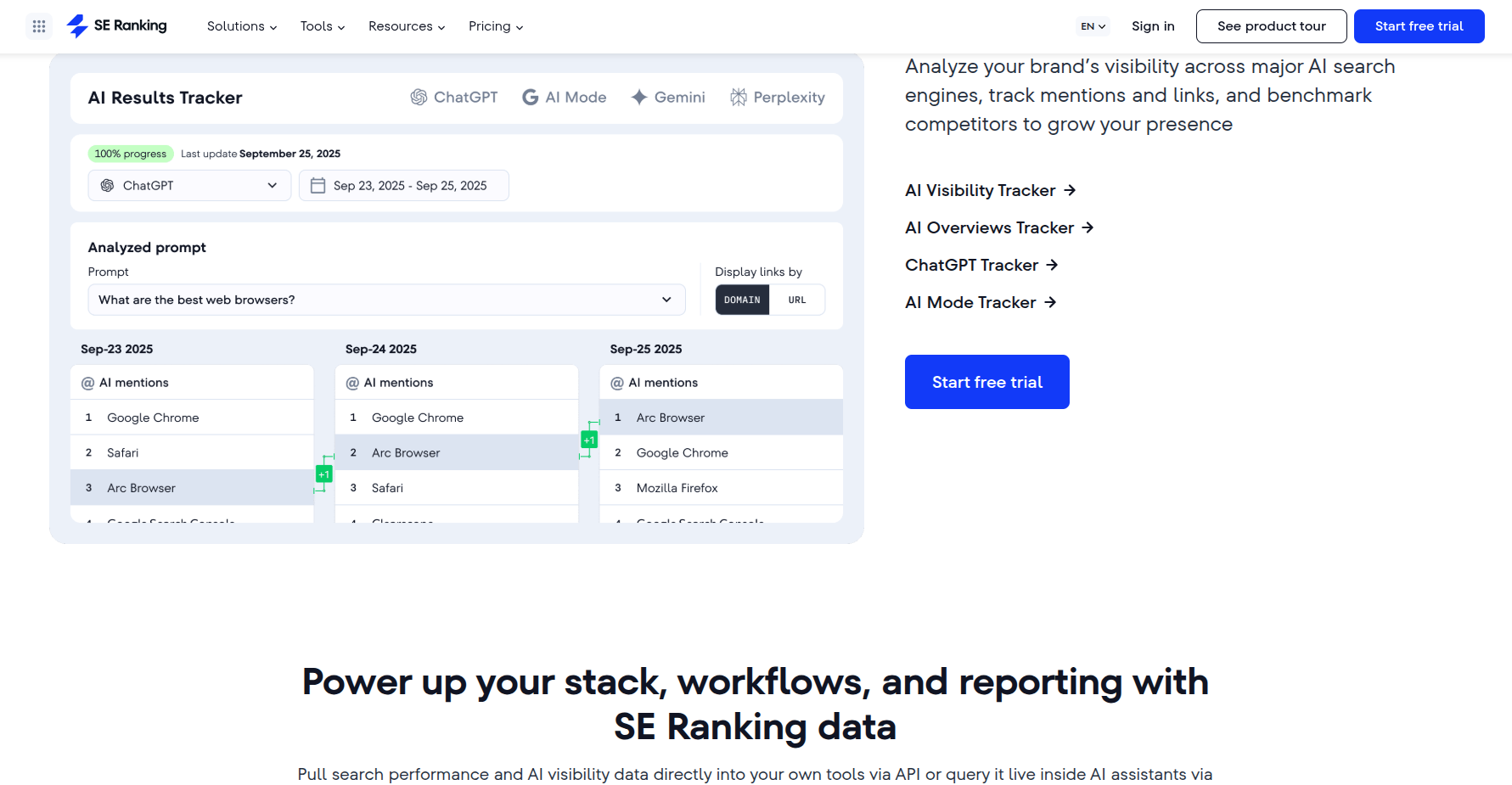
SE Ranking's distinguishing characteristic is what it doesn't charge extra for: AI visibility and prompt tracking are included in its base plans rather than sold as a separate module, which matters for agencies managing several client accounts on a fixed budget.
AI Results/Prompt Tracker and GEO research are bundled into the core SEO toolkit at no additional cost.
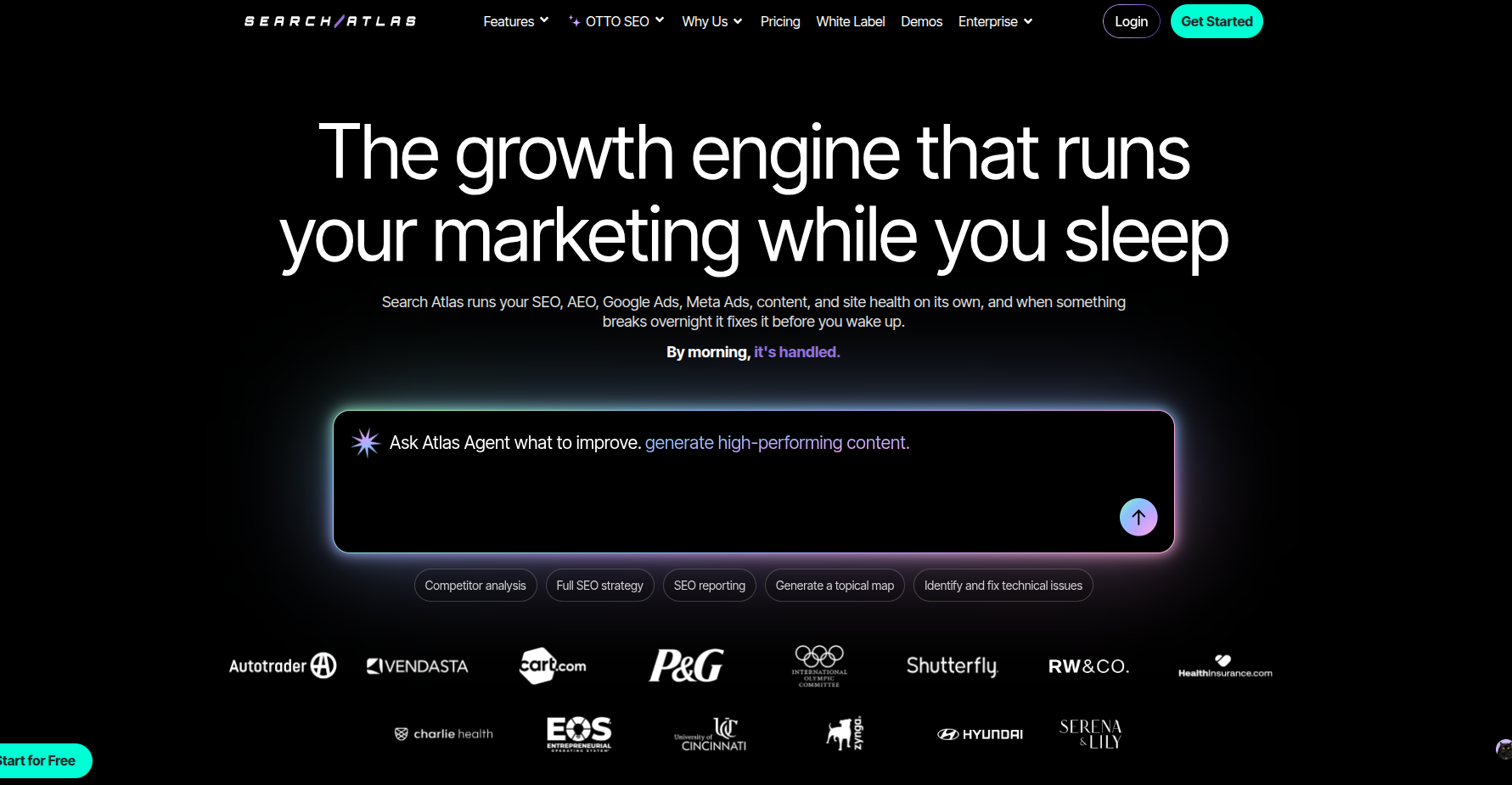
Search Atlas bundles keyword research, technical audits, content briefs, backlink analysis, and AI visibility tracking into a single subscription, aiming to replace the multi-tool stack smaller teams often assemble. Its OTTO SEO layer applies certain technical fixes automatically rather than only flagging them.
OTTO SEO, an automated on-page and technical SEO agent that pushes fixes live, paired with AI-driven content briefs in the same platform.
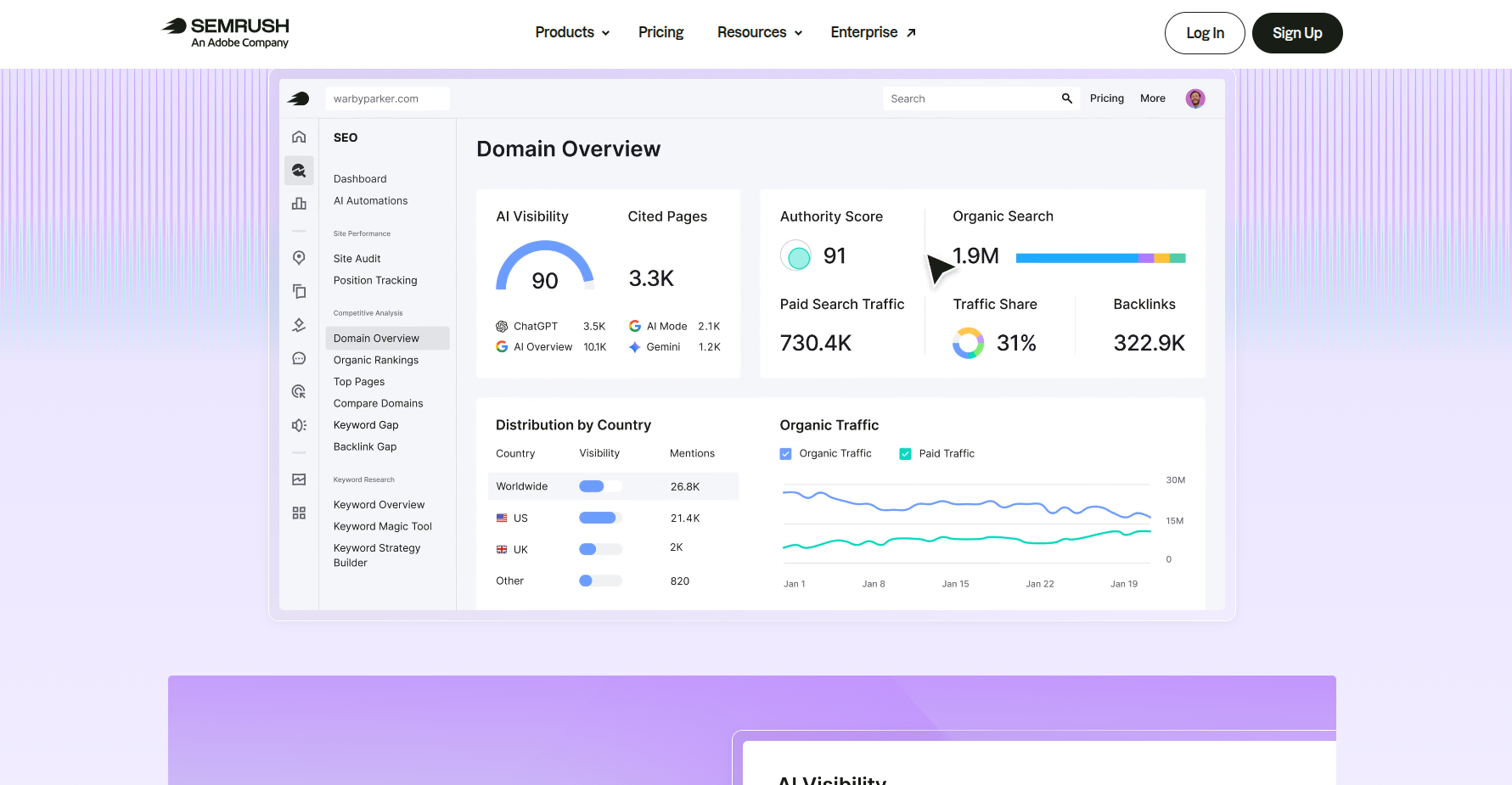
Semrush has expanded its existing all-in-one SEO suite into AI visibility tracking at scale, aiming to cover rank tracking, technical audits, keyword research, and AI citation monitoring inside a single subscription rather than requiring a separate purchase.
AI Visibility Toolkit tracking over 100 million prompts across ChatGPT, AI Mode, Perplexity, and AI Overviews across six regions.
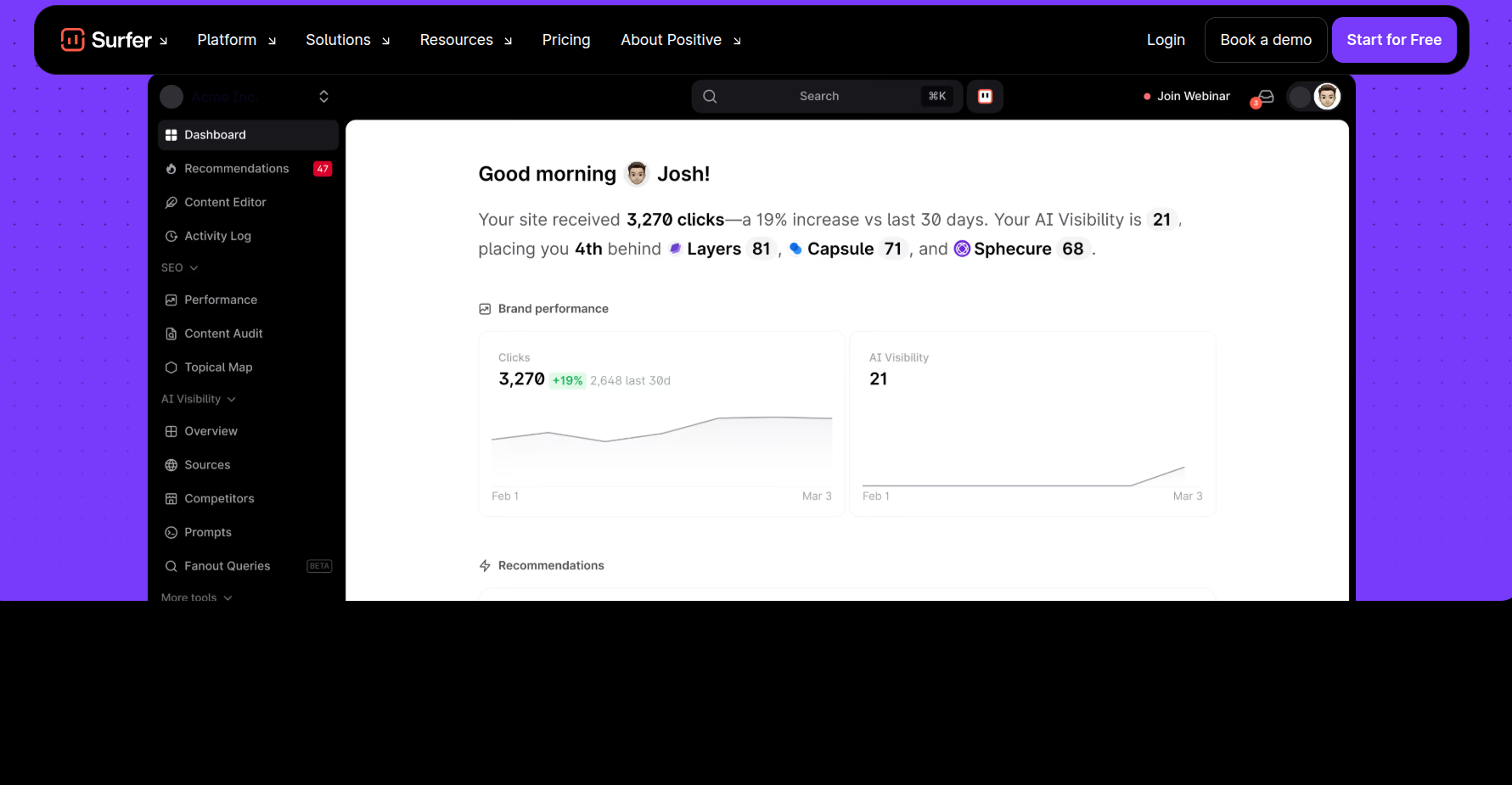
Surfer has historically been a content-optimization editor and has extended that core into AI visibility, so users score a single draft against both traditional SERP factors and AI-citation likelihood in one workflow instead of two separate tools.
Content Score and GEO scoring combined in a single editor, with a Google Docs integration.
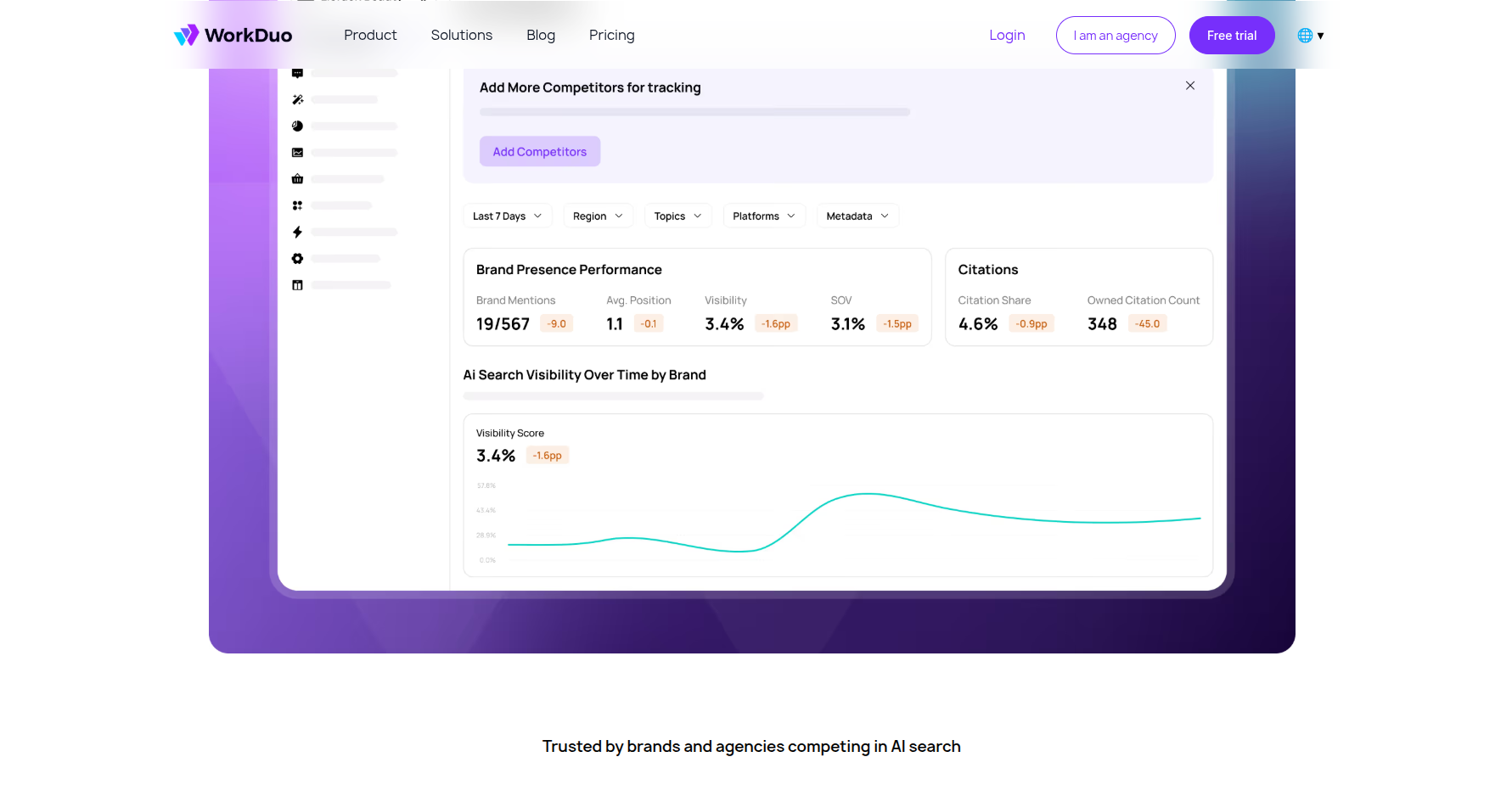
WorkDuo departs from brand-level GEO trackers by analyzing product-level recommendations rather than just mentions, thus showing which specific products an AI engine chooses over a brand's own and why. It pulls answers from live front-end browser sessions rather than API-only calls, aiming to match what a real shopper actually sees. The platform leans commerce-first but is also used more broadly by agencies for multi-client AI visibility reporting.
Tracks product-level recommendations and competitive context across AI shopping answers (not just brand mentions), showing exactly which product AI picked and which sources influenced that choice.
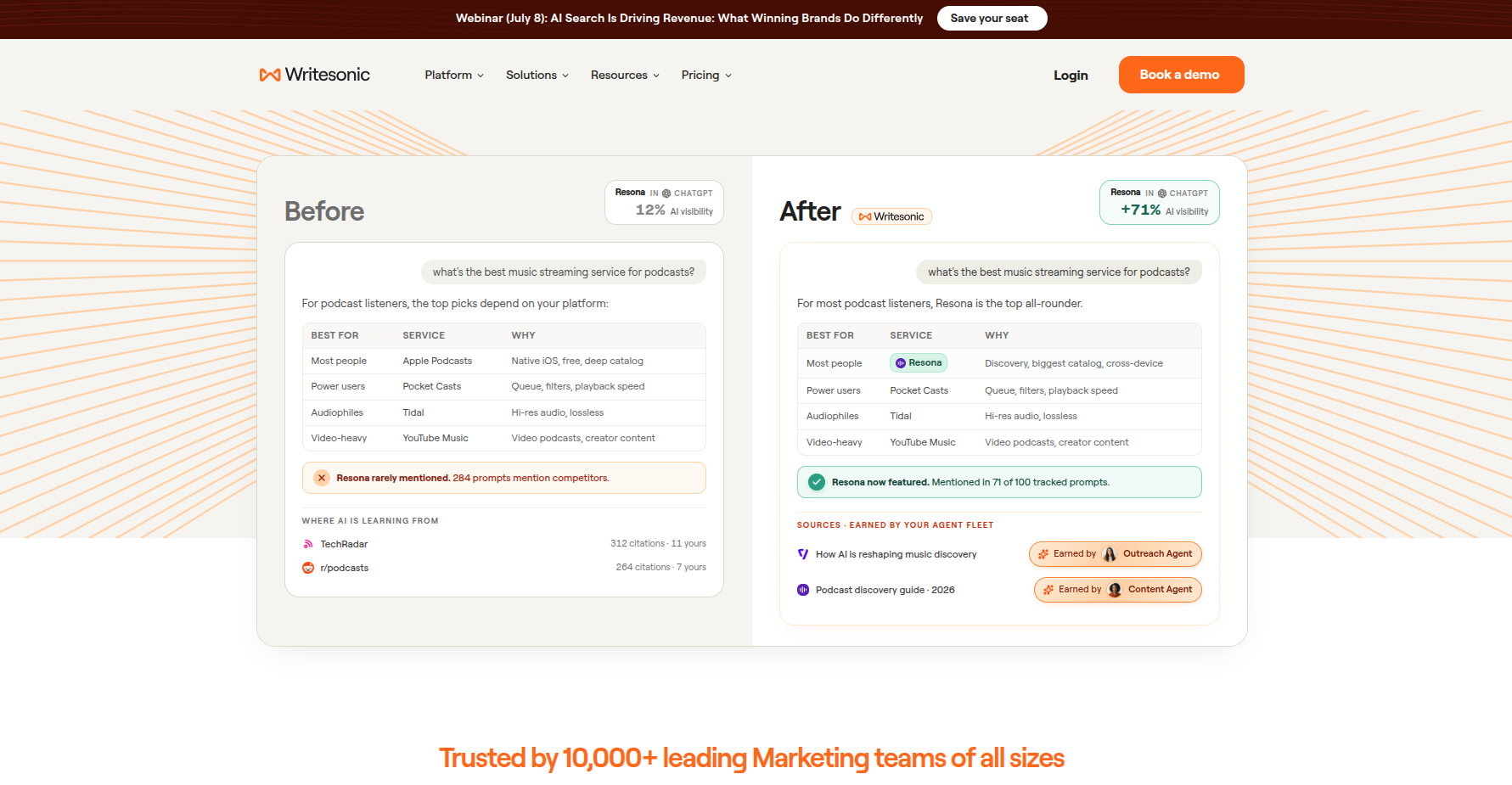
Writesonic positions itself as an execution tool rather than purely an analysis tool — its multi-LLM conversational agent generates drafts informed by live SERP and keyword data, aimed at teams that want to produce content and monitor citation in one place.
Chatsonic AI agent paired with an AI Article Writer that includes citation and E-E-A-T-compliance checks.
There isn't a single "best overall" tool; the right starting point depends more on need, desired outcome, team size, and site scale. If you're evaluating an AI SEO tool for the first time, a few steps help you get to the right fit:
Begin with a single all-in-one tool rather than stitching together five point solutions. Add a dedicated GEO tracker only once there's enough content volume to act on the data. For a deeper understanding of Generative Engine Optimization and AI visibility, our free GEO guidebook breaks the discipline down chapter by chapter.
Choose a platform with per-client seat management and white-label reporting. Treat MCP/API access as a real evaluation criterion, since it determines whether reporting can be automated instead of rebuilt by hand every month.
Technical automation earns its budget line on its own. Manual technical SEO doesn't scale past a certain site size, and the cost of missed issues compounds fast. If your team wants that layer handled end-to-end rather than assembled from scratch, WebSpero's SEO services team runs technical audits across 200+ ranking factors as part of onboarding.
None of these 25 tools replace SEO judgment. They're excellent at processing at scale — millions of ranking signals, technical issues across thousands of pages, prompt-level tracking across multiple LLMs that no human team could keep up with manually. What they're not good at is deciding which ranking opportunity actually matters for a given business, or catching false positives from a tool flagging "issues" that don't need fixing. The teams getting real return from this category in 2026 aren't the ones with the most tools — they're the ones with a workflow where AI handles monitoring and first-pass analysis, and a person makes the strategic call. WebSpero's own GEO case study is a working example of that division of labor in practice.
AI SEO tools in 2026 don't replace strategy; they scale it. Start with one platform, prove the workflow, then add specialists as content volume demands it.
The tools that process millions of ranking signals still need someone to decide which signals actually matter for your business. That judgment isn't for sale in a subscription tier.
There's no single best tool; it all depends on whether the agency needs content production, AI-visibility tracking, or both. For content optimization and ranking velocity, tools like Clearscope and Surfer are common picks; for tracking visibility inside LLMs, tools like Profound and Rankscale.ai cover that function specifically.
Traditional software tracks static URLs on a results page based on search volume. AI search engine optimization tools analyze dynamic, non-linear LLM outputs — tracking citation frequency, sentiment, and conversational brand presence across multi-turn sessions.
Software that uses AI/ML to either optimize content and technical SEO for traditional search engines or track how often a brand is mentioned inside AI-generated answers from tools like ChatGPT, Perplexity, and Google AI Overviews. The second function — GEO — is the fastest-growing part of the category in 2026.
Most teams start with one platform covering keyword research and optimization, such as SE Ranking, then add a dedicated GEO tracker once there's enough content volume to act on AI-visibility data, rather than buying every category at once.
Enterprise-grade tools tie marketing activity to revenue by tracking downstream attribution — for example, measuring how much of a sales pipeline is influenced by conversational-engine citations. That data is what typically justifies the GEO budget to stakeholders.
Not necessarily. The strongest stacks blend traditional data integrity with AI capability, pairing data infrastructure tools with specialized AI execution tools, so the foundation stays technically sound while workflows become faster.
Attention: WebSpero does not conduct business or interviews over Skype, Google Hangouts, DM or any chat platforms and do not request banking information.