
12+
Years Managing Paid Media Campaigns
1,000+
Projects Delivered Across Google, Meta & Beyond
55–60%
Average Lift in ROAS Across Paid Campaigns
95%
Client Retention Rate
Launch and Scale Campaign for:
- ChatGPT

800+ REVIEWS

800+ REVIEWS

800+ REVIEWS

800+ REVIEWS

800+ REVIEWS
What Are ChatGPT Ads?
They are paid, clearly labeled placements that OpenAI began opening to businesses through a self-serve manager in early 2026, after an earlier invite-only pilot phase that carried a minimum spend commitment. Rather than sitting on a results page, an ad here appears as a compact card next to, and visually separated from — ChatGPT’s own generated response inside a conversation. OpenAI states that ads are served by a separate system and do not influence what the model itself says.
A few mechanics define how the format actually behaves, and most of them change how a campaign should be planned and written:
- Ads currently show only to logged-in users on ChatGPT’s Free and Go tiers. Plus, Pro, Business, Enterprise, and Education accounts stay ad-free, which sets a real ceiling on who you’ll reach today.
- Targeting runs on conversational context rather than typed keywords: advertisers write “context hints” describing the situations and questions where their offer is relevant, and OpenAI matches these against signals from the current thread, opted-in chat history, and past ad interactions.
- Advertisers never see the actual text of a user’s conversation. Matching happens inside OpenAI’s own systems on anonymized signals, not on raw chat content handed to the advertiser.
- Bidding runs on cost-per-click, cost-per-impression, or Conversion-Optimized (oCPC / Bid Cap) inside a relevance-weighted auction, so a well-targeted, well-written ad can outperform a larger budget attached to generic context hints.
- Opening an account requires business verification, and OpenAI currently restricts or excludes certain sensitive categories, including health, finance, and political advertising.
Objective:
“Earn the placement next to the answer. Don’t just outbid for it.”
WebSpero vs. In-House Marketer vs. Typical Email Marketing Agency
| Category | ChatGPT Ads | Google Search Ads | Meta Ads |
| Primary trigger | Conversational context and intent inside a chat | Typed keywords on a results page | Demographic and behavioral signals during passive scrolling |
| Ad placement | A labeled card next to ChatGPT’s own answer | Positions above or below organic results | Native placement inside the feed |
| What you supply | Context hints describing relevant situations | Keywords and match types | Audience definitions and creative assets |
| Buyer’s state of mind | Actively defining or exploring a problem | Actively searching for a known solution | Passively browsing, not yet searching |
| Who sees it today | Free and Go tier users only | Anyone running the search | Anyone matching the audience |
| Core lever | Context-hint and creative relevance vs. bid | Keyword relevance and Quality Score vs. bid | Audience precision and creative vs. bid |
Why ChatGPT Ads Are Worth Testing Now
ChatGPT Ads still runs on the same discipline that makes any paid channel work: a clear offer, a defined audience, and tracking that ties spend back to revenue. It doesn’t replace core PPC management; it adds a channel on top of it.
The spend floor is gone: The pilot’s minimum commitment has been removed as the platform opened to self-serve, so a real test no longer requires an enterprise budget to get started.
Competition is still thin: Auctions get more expensive as more advertisers show up; testing while relevance still outweighs raw budget is when early movers get the cheapest learning.
Reach is currently the free-tier audience: Because Plus, Pro, and Business users stay ad-free, this channel favors offers and price points that work with a broader, more price-sensitive audience rather than enterprise deals.
Context hints reward specificity, not spend: Because targeting is built on described intent rather than a keyword auction, the quality of the context hint and the creative genuinely changes who sees the ad and what it costs.
Sponsored placements buy the exact attention your ChatGPT SEO is working to earn, letting you capture conversational demand immediately while organic citations compound in the background.
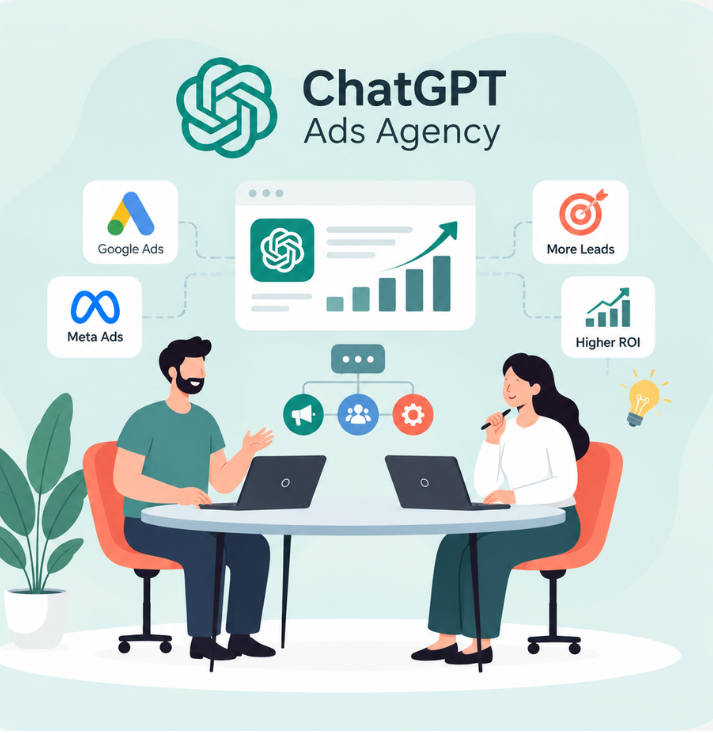
WebSpero’s ChatGPT Ads Management Framework
We built this framework around how these ads actually target, bid, and place — not adapted from a generic Google or Meta playbook.
We run all six steps as one engagement instead of billing them as separate line items.
Step 1
Channel Readiness & Opportunity Assessment
- We check whether your buyers already use ChatGPT to research, compare, or ask for recommendations in your category, since this channel underperforms for offers that assume a keyword-driven, comparison-shopping buyer.
- We map the specific problems and questions where a sponsored placement could plausibly appear, not a list of keyword equivalents copied from a search campaign.
- We set a pilot budget and a short list of things the test needs to prove before any spend commits.
Step 02
Ads Manager Setup & Verification
- We complete business verification and account setup inside ChatGPT Ads Manager, then structure campaigns and ad groups around the use cases identified in Step 1.
- Budgets and pacing get set deliberately based on the pilot’s goal, not left on the platform’s defaults.
- Conversion tracking gets installed and tested before spend goes live, so day-one data is actually usable.
Step 03
Conversational Creative & Context-Hint Architecture
- We write concise, conversational ad copy built for a discovery moment, not a repurposed search headline or a display banner shrunk to fit.
- We build the context hints that describe the buyer situations and conversation types where the offer is genuinely useful, since this format targets context, not keywords.
- Each use case gets its own creative and context-hint variant, tested as a separate line of learning rather than one generic ad running everywhere.
Step 04
Bidding & Auction Management
- We choose cost-per-click, cost-per-impression, or Conversion-Optimized (oCPC / Bid Cap) bidding based on what the pilot needs to learn, and manage bids inside a relevance-weighted auction rather than assuming a bigger budget wins by default.
- Because relevance affects placement as much as bid size, creative and context-hint quality get as much attention as the numbers on the bid.
- Budgets and pacing get adjusted against real performance data on a running basis, not left unattended between reports.
Step 05
Daily Optimization & Conversion Tracking
- We watch impressions, clicks, conversion signals, and audience fatigue daily, since a channel this new can shift quickly as more advertisers show up.
- Spend moves toward the context hints and creative producing qualified outcomes, and we pause what isn’t working rather than letting it run out the budget.
- Campaigns move from click-based to conversion-optimized bidding once there’s enough volume to support it.
Step 06
Commercial Reporting & Scale Decisions
- Reporting is built around cost per lead, cost per qualified conversation, and contribution to pipeline, not just impressions and clicks.
- Every reporting cycle ends with a specific recommendation — stop, refine, or scale and the reasoning behind it.
- A campaign that earns a “scale” decision grows deliberately, testing new context hints and creative before we increase budget significantly.
Why Choose WebSpero As Your ChatGPT Ads Agency
Paid Media Since 2014: 12+ years managing Google and Meta ad accounts, Google Partner and Semrush Certified, now applying the same discipline to ChatGPT Ads.
Search-Native Thinking: Our GEO and AI-search team already studies how ChatGPT frames and sources answers, which directly shapes how we write context hints and creative here.
One Accountable Team: Strategy, account setup, creative, bidding, tracking, and reporting stay with one team instead of splitting across vendors.
Pilot-First, Not Retainer-First: Every engagement starts with a defined test and a stop, refine, or scale decision rule, not an open-ended monthly retainer.
Paid Media Results You Can Point To
ChatGPT Ads is a new channel; the paid media discipline behind it isn’t. These are recent results from WebSpero’s broader PPC work, the same team and process now managing ads pilots.


See Why Clients Trust Our Paid Media Team

Kimi Verma, CEO
The clients have seen a significant increase in traffic with numbers growing into the hundreds. WebSpero is strategizing on how to take pre-existing high-traffic clients even higher. Their team is communicative and effectively follows through on directions. They took over our entire SEO division. This includes auditing sites, fixing onsite problems, improving site speed, optimizing site navigation and layout, optimizing content for conversion, fixing duplicate content and much more.
Ben Macrae, Manager
The business has seen a great improvement in backlinks and domain referrals, rankings and organic traffic. WebSpero’s communication has been great, as they keep the client updated at all times. The team’s responsiveness and expertise make them a joy to work with.
Diego Margalef, Therapist
WebSpero Solutions delivers effective digital marketing services that continue to achieve satisfying results, which enables ongoing collaboration. The team provides industry expertise and produces reports regularly to ensure transparency. They seek feedback frequently to improve their performance.
Frequently Asked Questions
01. When did ChatGPT Ads Manager launch?
ChatGPT Ads Manager opened to businesses during 2026, after an earlier invite-only pilot that carried a minimum spend requirement OpenAI has since removed. Setup requires business verification, and campaigns are built around context hints and creative rather than keyword bidding.
02. Where exactly do ChatGPT Ads appear inside a conversation?
As a compact, clearly labeled card that shows up next to ChatGPT’s generated response, visually separated so users can tell it’s sponsored. OpenAI states that ads run on a separate system and do not influence what ChatGPT’s model actually says. Placements currently show only to logged-in users on the Free and Go tiers; Plus, Pro, Business, Enterprise, and Education accounts stay ad-free.
03. What targeting options exist for ChatGPT Ads?
Instead of keyword bidding, advertisers supply context hints describing the situations, questions, or intents where their product is relevant. OpenAI’s system matches these against signals from the current thread, opted-in chat history, and past ad interactions — advertisers never see the raw text of a user’s conversation. Geographic targeting is available; broad demographic targeting by age, gender, or income is not, at least not yet.
04. How much budget do I need, and is there a minimum spend?
ChatGPT Ads Manager requires an absolute minimum daily budget of $25 per campaign. Beyond that floor, the right starting budget depends on what the pilot needs to prove, your sales economics, and how much daily spend is required to get a usable read within a few weeks. We propose a pilot budget and management scope after the channel readiness assessment, not before it.
05. Can I reuse my existing Google or Meta ad creative for ChatGPT?
Not directly. Existing search headlines and display creative are useful evidence of what messaging already resonates, but conversational placements need their own concise, context-aware copy built for a discovery moment rather than a keyword match or a scroll-stopping image.
06. Does WebSpero offer white-label ChatGPT Ads management for other agencies?
Yes, WebSpero manages Ads under a partner agency’s own brand where needed, handling account setup, campaign execution, and reporting behind the scenes, the same way we already support white-label PPC and SEO engagements.
07. How is ChatGPT Ads different from ChatGPT SEO, or getting cited organically?
ChatGPT SEO is the organic discipline: earning a citation inside ChatGPT’s own generated answer through crawlable content, entities, and trusted third-party mentions, with no media spend and no guaranteed placement. ChatGPT Ads is a paid placement bought through an auction, running next to that answer, with exposure guaranteed for a set budget. The two work well together.
Ready To Test ChatGPT Ads Properly? We'll tell you honestly if it's a fit before we build a pilot.
A short, low-risk pilot beats guessing with a large budget on a channel this new. Tell us about your offer and audience, and we’ll map out whether ChatGPT Ads is worth testing for your business and what a first pilot should look like.