
500+
Websites Optimized for AI Search
320%
Average AI Citation Growth
68%
Share of Answer Across Tracked Prompts
95%
Client Retention Rate

Audited & Optimized For:
- GPTBot / OAI-SearchBot
- ClaudeBot / Claude-SearchBot
- PerplexityBot
- Google-Extended
- Applebot-Extended
- Amazonbot

800+ REVIEWS

800+ REVIEWS

800+ REVIEWS

800+ REVIEWS

800+ REVIEWS
What Is Technical GEO?
Technical GEO, also called technical optimization for generative search, is the work that decides whether an AI crawler can reach, read, and trust your website at all. It sits underneath content strategy. A page written in perfect answer-ready format is still invisible to ChatGPT or Perplexity if the crawler that fetches it can’t render the page, gets blocked at the firewall, or finds conflicting business details in your markup.
In practice, this is technical AI SEO for generative search: the crawl, rendering, and structured-data foundation that traditional technical SEO never had to account for, because Google and Bing render JavaScript and most AI crawlers do not.
- Confirm that GPTBot, PerplexityBot, ClaudeBot, and other AI crawlers can actually reach your pages, not just Googlebot.
- Serve your important content as static, crawlable HTML, since most AI crawlers never execute JavaScript.
- Structure pages with clean heading hierarchy, schema markup, and consistent entity data so retrieval systems can parse and trust what they find.
Objective:
“Make it technically impossible for an AI crawler to misread your site.”
A Quick Comparison: Technical GEO vs Traditional Technical SEO vs Content GEO
| Category | Technical GEO | Traditional Technical SEO | Content GEO |
| Primary Goal | Make the site readable and trustworthy to AI crawlers | Make the site readable and rankable to Google and Bing | Make the content citable inside AI-generated answers |
| What It Checks | Crawler access, JS rendering, schema, llms.txt, entity consistency | Indexation, mobile-friendliness, Core Web Vitals | Answer structure, formatting, prompt coverage |
| Key Risk If Skipped | AI systems can’t read the page, regardless of content quality | Pages rank lower or don’t get indexed | Pages get crawled but never quoted |
| Core KPI | Crawl success rate, schema coverage, render parity | Rankings, organic sessions | Citation frequency, share of answer |
Why Technical GEO Can’t Be Ignored
Most AI crawlers, including GPTBot, ClaudeBot, and PerplexityBot, do not execute JavaScript, so any content that only appears after a script runs is invisible to them.
A clean robots.txt doesn’t guarantee access. A Cloudflare or AWS WAF rule can silently block an AI crawler’s published IP ranges even when robots.txt allows it.
Google and Microsoft have confirmed they use schema markup in their AI-generated answers, and ChatGPT uses structured data to decide which products to surface.
Retrieval happens live for most AI engines, so a technical fix published today can get picked up within days, not the months traditional SEO usually needs.
An llms.txt file is becoming a standard companion to robots.txt, giving AI systems a direct map of what on your site is worth reading.
A slow server response can cause an AI crawler to time out mid-fetch, on the same page Googlebot would simply wait a little longer to load.
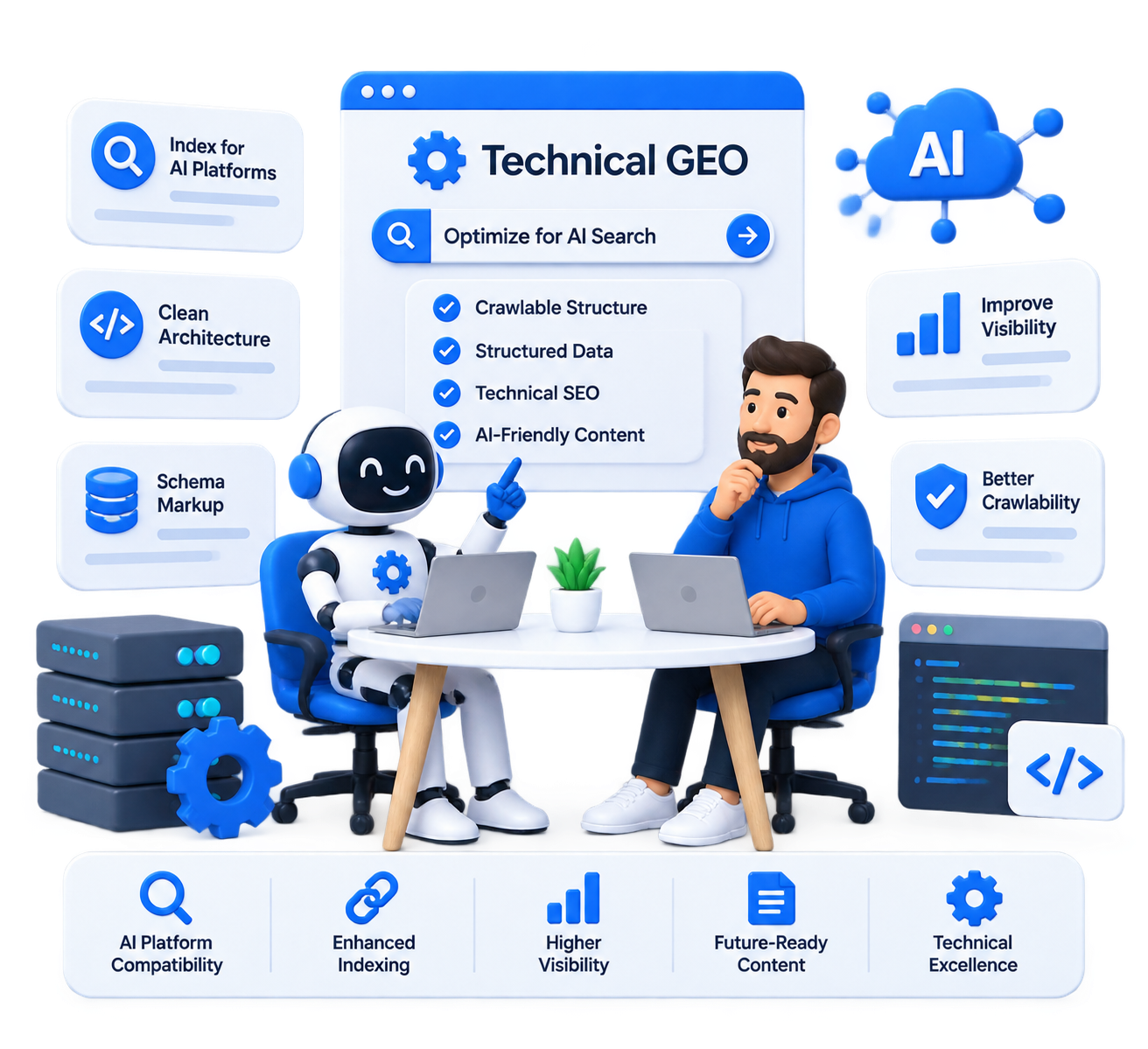
WebSpero’s Technical GEO Framework
We built this framework around what actually stops an AI crawler cold: access, rendering, and trust.
As your technical GEO partner, we run all six steps together instead of patching one issue at a time.
Step 1

AI Crawler Access Audit
- Check robots.txt for GPTBot, OAI-SearchBot, ClaudeBot, Claude-SearchBot, PerplexityBot, Google-Extended, and other AI crawlers.
- Confirm your CDN or WAF isn’t silently blocking published crawler IP ranges behind a clean robots.txt.
- Test response codes and response times using each crawler’s own user agent, not just a browser.
Step 02
Rendering & JavaScript Audit
- Identify which sections of your site only appear after JavaScript runs, since most AI crawlers stop at raw HTML.
- Move critical content, headings, pricing, and product details into server-rendered or static HTML.
- Flag single-page app sections and client-side-only components that need a rendering fix.
Step 03
Schema & Entity Markup
- Implement JSON-LD for Organization, Service, FAQPage, Article, and BreadcrumbList on priority pages.
- Standardize your business name, description, and contact details across the site, schema, and directories, since inconsistent data lowers AI trust in a source.
- Add author and leadership schema so AI systems attribute expertise to the right person.
Step 04
llms.txt & Crawl Map Setup
- Build and maintain an llms.txt file that points AI systems to your most important, most current pages.
- Pair it with a clean XML sitemap and canonical tags so there is one clear version of every page to index.
- Remove or redirect thin, duplicate, and orphaned pages that waste crawl budget.
Step 05
Site Speed & Server Optimization
- Improve server response time so AI crawlers don’t time out mid-fetch on a slow connection.
- Optimize Core Web Vitals: load speed, interactivity, and layout stability.
- Fix redirect chains and broken links that waste a crawler’s pass through your site.
Step 06
Monitoring & Regression Checks
- Review server logs to see which AI crawlers are actually visiting, how often, and what they read.
- Re-audit after every major site or template change, since one new script can quietly break crawler access again.
- Report on crawl success rate, schema coverage, and render parity every month.
This technical work feeds directly into our broader Generative Engine Optimization process. See the full method in our GEO E-Book
Why Choose WebSpero for Technical GEO
Technical GEO Specialists
We test crawler access and rendering directly against GPTBot, ClaudeBot, and PerplexityBot, not just against theory.
Full-Stack Fix, Not Just a Report
Our development team implements the rendering fixes, schema, and redirects ourselves, so nothing waits on your dev backlog.
Built Into a Full GEO Framework
Technical GEO plugs directly into our content and citation-building work, so fixes and content ship together.
Transparent Reporting
Every report shows crawl success rate, schema coverage, and render parity, not a vague overall health score.
AI Search Case Studies
Real results from brands whose sites we made readable and citable for AI-powered search.


See Why Clients Trust Our Technical Work
We’ve made it our mission to lead by example

Kimi Verma, CEO
The clients have seen a significant increase in traffic with numbers growing into the hundreds. WebSpero is strategizing on how to take pre-existing high-traffic clients even higher. Their team is communicative and effectively follows through on directions. They took over our entire SEO division. This includes auditing sites, fixing onsite problems, improving site speed, optimizing site navigation and layout, optimizing content for conversion, fixing duplicate content and much more.
Ben Macrae, Manager
The business has seen a great improvement in backlinks and domain referrals, rankings and organic traffic. WebSpero’s communication has been great, as they keep the client updated at all times. The team’s responsiveness and expertise make them a joy to work with.
Diego Margalef, Therapist
WebSpero Solutions delivers effective digital marketing services that continue to achieve satisfying results, which enables ongoing collaboration. The team provides industry expertise and produces reports regularly to ensure transparency. They seek feedback frequently to improve their performance.
Frequently Asked Questions
01. Which AI crawlers should I actually allow on my site?
It depends on your goal. Search and retrieval bots, such as OAI-SearchBot, PerplexityBot, and Claude-SearchBot, are what make you eligible to be cited in an AI answer, so most brands keep those allowed. Training crawlers, such as GPTBot and Google-Extended, feed a model’s future training data instead of live answers, so some brands choose to block those while keeping retrieval bots open. We map this decision to your specific goals during the crawler access audit.
02. Do I need an llms.txt file if I already have a robots.txt and sitemap?
They serve different jobs. Robots.txt controls access, and your sitemap lists every URL. An llms.txt file is a short, curated pointer to the pages you most want an AI system to read and trust, similar to a highlights reel rather than a full index. It is an emerging standard, not yet universally supported, but it costs little to set up and pairs well with the other two.
03. Will technical GEO fixes affect my Google rankings?
Generally in a positive way. Faster server response, cleaner schema, and better crawl access help Googlebot too, since Google AI Overviews inherits Googlebot’s own rendering. The one distinct piece is a robots.txt or WAF change scoped specifically to AI crawler user agents, which we always separate from any rule that touches Googlebot or Bingbot.
04. My site is a JavaScript-heavy single-page app. Can it still work for GEO?
Yes, but it needs a rendering fix first. The usual approach is server-side rendering or pre-rendering for the pages you most want AI systems to cite, so the crawler receives finished HTML instead of an empty shell. Our development team scopes this alongside the rest of the technical GEO audit rather than as a separate project.
05. How long does technical GEO optimization take to show results?
Crawler access and rendering fixes are usually live within one to two weeks of the audit. Because most AI engines retrieve content live rather than waiting for a monthly recrawl, a fixed page can start getting read and cited within days of going live. A full technical GEO pass across a larger site typically wraps within 30 to 45 days.
Is Your Site Even Readable By AI Crawlers?
Most sites we audit are blocking, timing out, or hiding content from at least one major AI crawler without knowing it. Get a free technical GEO audit and see exactly what GPTBot, Perplexity, and ClaudeBot can read on your site today.