
Digital Marketing Updates (June 22–26, 2026): Carousel Captions, Luxury AI Gaps, the 97% Playbook & CTR Splits
 Vishal Thakur
Published: June 29
Vishal Thakur
Published: June 29
Vishal Thakur
Published: June 29
Vishal Thakur
Published: June 29
Instagram expands live commerce globally, luxury brands disappear in AI search, a vegan food founder rewrites who she’s talking to, Zomato bets on agility, and desktop CTR diverges from mobile.
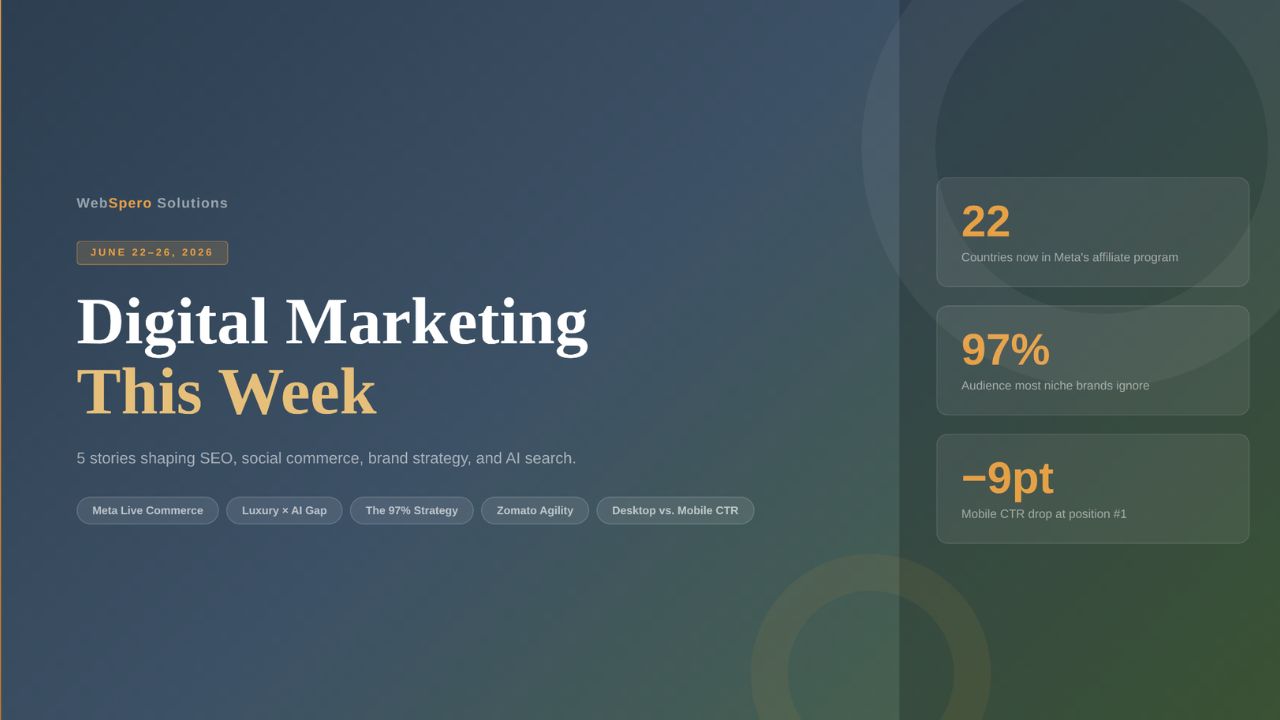
Here’s everything that happened this week, and what it means for your marketing strategies.
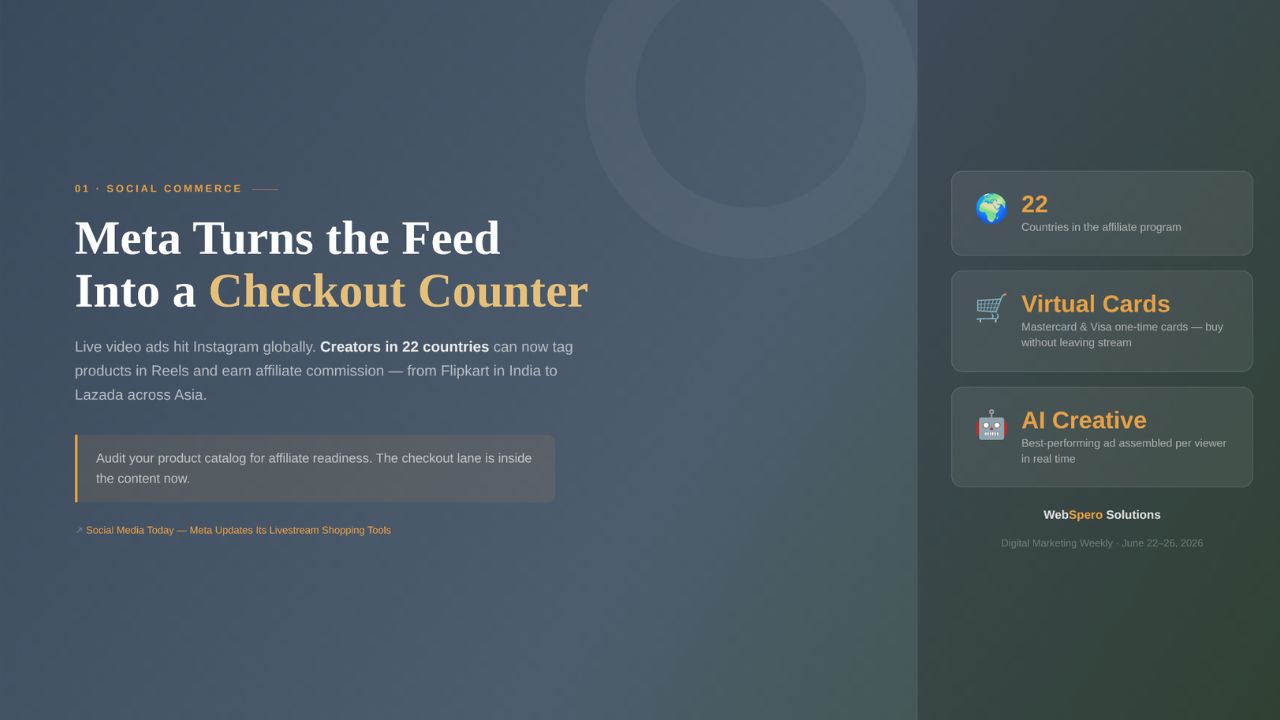
Meta’s latest update isn’t a feature tweak. It’s a structural bet that social media’s next phase is primarily commercial, and that the gap between watching content and buying something should be near zero. The company expanded live video ads to Instagram globally and pushed new in-stream shopping tools on Facebook that allow marketers to surface a curated product shelf during a broadcast, letting viewers browse, price-check, and buy without ever leaving the stream.
The affiliate layer got substantially broader this week. Creators in 22 countries can now tag products directly in Reels and Feed posts and earn commission through those links — not just in the US market where this first launched. New regional partners added to the affiliate program include Flipkart in India, Mercado Libre across Brazil and Mexico, and Lazada for creators across Asia. For brands operating in these markets, creator-led commerce just became a viable paid channel, not a niche experiment.
Two quieter updates carry real weight. First, Meta is rolling out virtual card support via Mastercard and Visa — shoppers can use a temporary one-time card number rather than sharing actual card details with sellers. The friction reduction for first-time buyers on live broadcasts could be significant. Second, Meta’s AI now assembles the best-performing ad creative for each individual viewer in real time from the advertiser’s uploaded product data and assets. The human brief becomes the raw material; the system handles composition.
For brands running social media marketing strategies, the implication is immediate: affiliate infrastructure, product catalog hygiene, and livestream creative strategy all need to be on the planning table now, not after the feature fully matures.
| KEY TAKEAWAY
If you haven’t audited your product catalog for affiliate readiness or tested a livestream format in the last six months, you’re building a strategy around a platform that no longer looks the way you remember it. The checkout lane is inside the content now. |
Source: Meta Updates Its Livestream Shopping Tools — Social Media Today
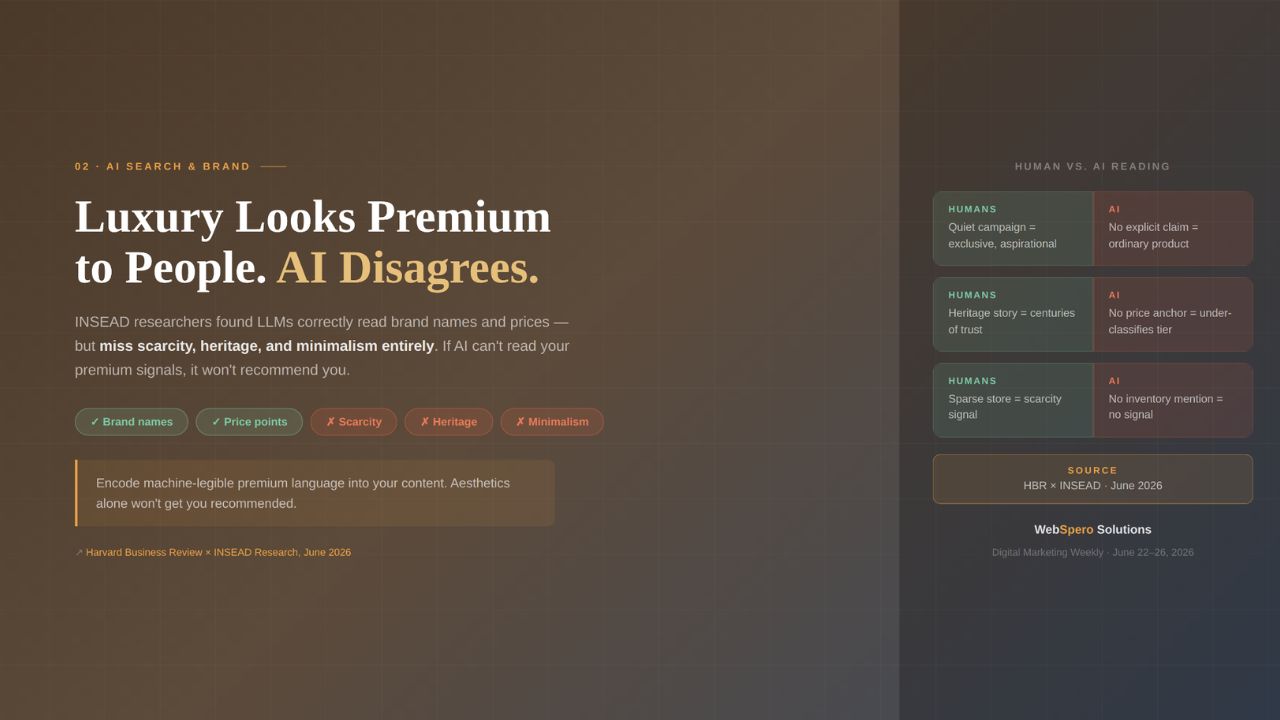
A study published in Harvard Business Review this week crystallizes a problem that has been quietly compounding since AI Overviews and LLM-powered discovery tools became the first stop for consumer research. INSEAD researchers found that large language models reliably interpret the explicit markers of luxury, such as brand names, stated price points, overt claims of quality, but systematically misread the signals that actually drive premium perception in human consumers: scarcity, heritage, artistic association, minimalism, and spatial context.
The downstream consequence is not theoretical. As AI agents increasingly sit between a consumer’s intent and a brand’s content, a luxury brand that communicates primarily through atmosphere — the understated campaign, the quiet craftwork detail, the implication of exclusivity — gets misread, misclassified, and undersurfaced. In GEO terms, if the machine doesn’t understand what makes you premium, it won’t recommend you to someone who’s looking for exactly that.
The paper’s prescription is operationally specific: test AI perceptions across product, price, promotion, and placement. Audit how individual models value your brand. Encode precise, machine-legible luxury language into owned content, earned media, and third-party coverage. The aesthetic still matters for human audiences. But the language layer that surrounds it now has to do double duty — communicating premium status to people who feel it and to models that read it.
This sits at the core of what Generative Engine Optimization addresses: structuring content so AI systems correctly interpret authority, relevance, and brand positioning. Luxury is simply the sharpest stress test of a problem every brand will eventually face.
| KEY TAKEAWAY
If your brand’s premium positioning lives only in how it looks and feels, AI will price you down every time it mentions you. Audit how the models that mediate your customers’ decisions actually describe your brand, and then close the gap in language, not just design. |
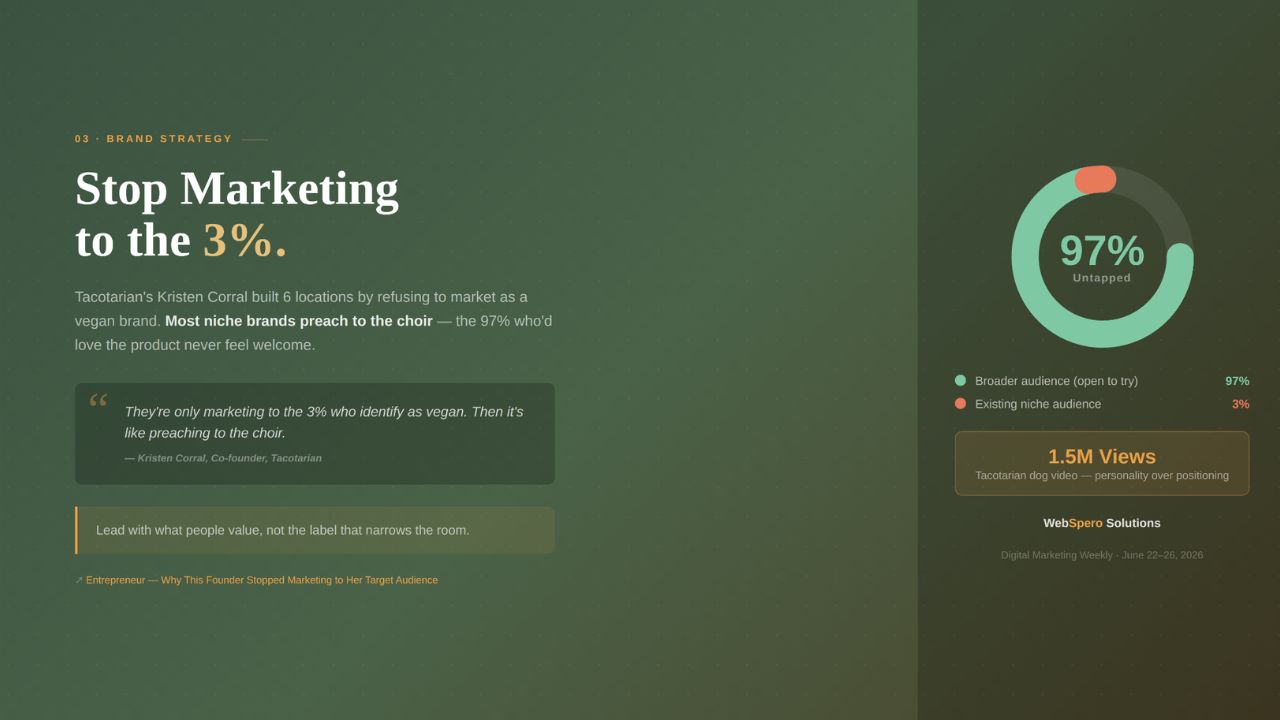
Kristen Corral co-founded Tacotarian — a plant-based Mexican restaurant group in Las Vegas in 2018, and built it into a six-location brand spanning Las Vegas and San Diego. The thing she didn’t do was market it as a vegan restaurant. The story she tells in an interview with Entrepreneur this week captures something most niche brands get wrong from the first campaign they ever run.
Corral’s argument is structural: most vegan restaurants market to the roughly 3% of consumers who actively identify as vegan or vegetarian. That creates a self-limiting loop, as you’re preaching to a choir that was already walking in. The more overtly identity-driven the brand, the more it signals to everyone outside that 3% that the place isn’t for them. The 97% who might genuinely enjoy the food never get past the door.
Tacotarian’s approach inverted this. Bright rooms, margaritas, familiar Mexican dishes, and founder-forward content that led with personality rather than positioning. A video featuring Corral’s dog pulled 1.5 million views. A simple screenshot pulled from a video outperformed a polished campaign. The product is still entirely plant-based. The brand just doesn’t lead with that.
For any brand operating in a defined niche — specialty food, sustainable products, wellness, B2B software — the question worth asking is whether the label you lead with is winning converts or filtering them out. The 97% who don’t yet know you aren’t hostile. They’re just waiting to feel welcome enough to try.
| KEY TAKEAWAY
Lead with what people already value — great food, great service, a real personality, and definitely not the label that narrows your room. The audience you’re not marketing to is almost always larger than the one you are. Make the door wider. |
Source: Why This Founder Stopped Marketing to Her Target Audience — Entrepreneur
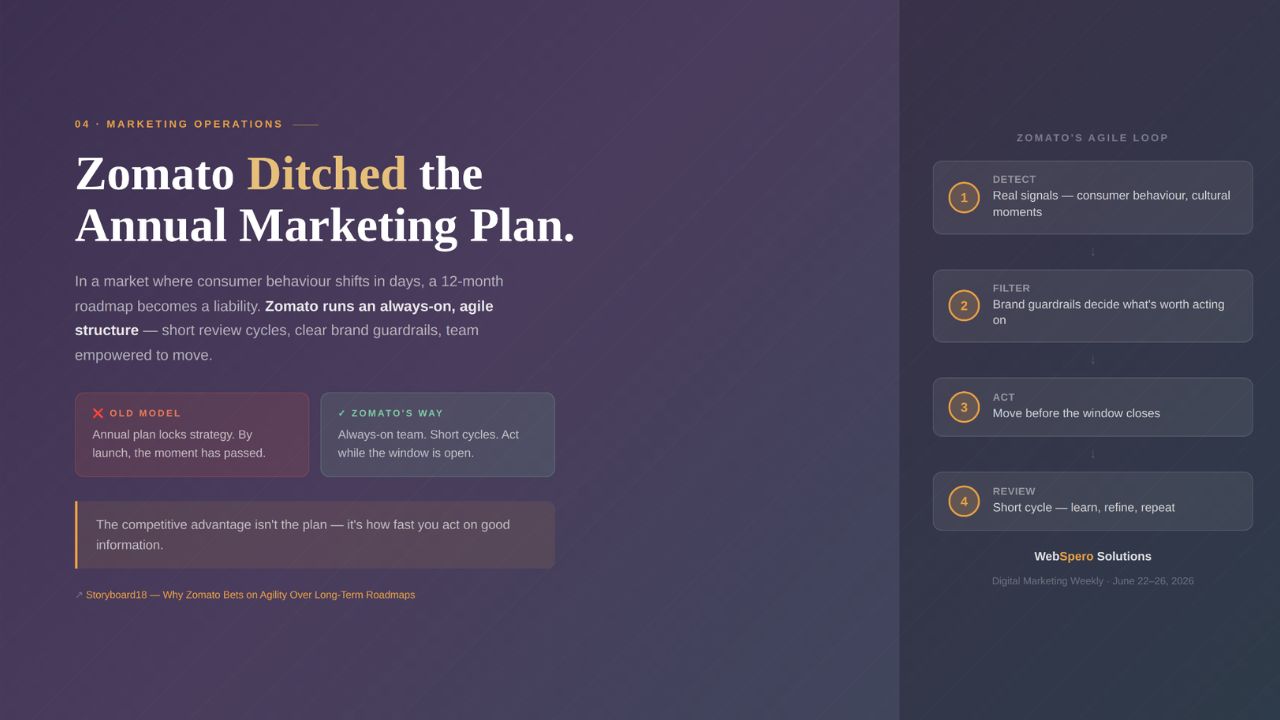
Zomato’s marketing leadership shared a principle that sounds counterintuitive until the reasoning lands: the company does not build annual marketing plans. In a market where consumer behavior, competitor moves, and cultural moments can shift in days rather than quarters, a twelve-month roadmap becomes a liability before it becomes an asset.
What Zomato runs instead is an agile, always-on structure that keeps the team close to real signals and empowered to act on them while the window is still open. The annual planning process, in their view, creates an illusion of strategic clarity while actually reducing a brand’s ability to respond. By the time a pre-approved campaign launches, the moment has passed.
This sits alongside a broader pattern visible in brands that have maintained cultural relevance over the last five years. The marketing calendar as a fixed artifact gets replaced by a standing team with clear brand guardrails, the authority to move quickly, and a framework for evaluating which opportunities are worth taking. Planning doesn’t disappear — it becomes continuous rather than annual.
For brands building a content strategy, this is a useful reframe. The editorial calendar is a tool, not a commitment. The brands with the most visible content presence right now are producing work that responds to what’s actually happening, not what they predicted six months ago would happen.
| KEY TAKEAWAY
Agility isn’t the absence of strategy; it’s a different kind of discipline. Set clear brand principles, empower the team to move, and build short review cycles rather than long approval chains. The competitive advantage isn’t the plan. It’s how fast you can act on good information. |
Source: We Don’t Build Annual Marketing Plans: Why Zomato Bets on Agility — Storyboard18
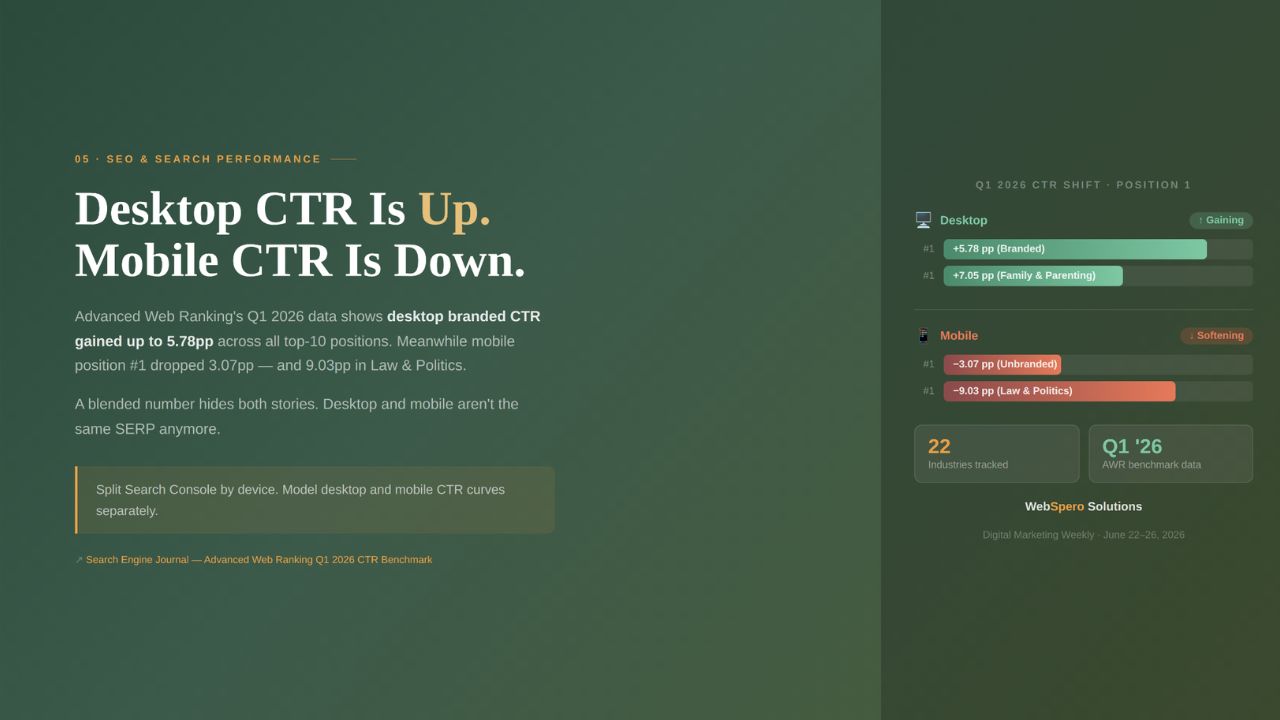
Advanced Web Ranking released its Q1 2026 CTR benchmark data this week, and the headline finding cuts against the prevailing narrative in organic search performance. While the recent story has been one of broad CTR erosion driven by AI Overviews, the Q1 data shows the picture is more nuanced by device: desktop click-through rates gained broadly across positions, while mobile rates weakened at the top.
The specifics are worth tracking. On desktop, branded search CTR grew across all top-ten positions — gains ranged from 1.99 to 5.78 percentage points. Unbranded desktop also improved. On mobile, the top-ranked position for unbranded queries dropped by 3.07 percentage points, and in the Law, Government & Politics sector, the mobile position-one drop was 9.03 points, which is a meaningful shift for any site relying on that device profile.
The Family & Parenting sector on desktop saw the largest single-position gain at 7.05 percentage points for the first-ranked result. These aren’t uniform industry stories; the device split holds broadly across all 22 industries measured, but the magnitude differs considerably depending on the query type and sector.
What this means for reporting is structural: a single blended CTR figure now actively obscures what’s happening at the device level. An account where the desktop is recovering while the mobile is softening will show a flat or mildly positive aggregate number that tells neither story accurately. SEO reporting that doesn’t segment by device is not just incomplete; it’s potentially misleading in both directions at once.
| KEY TAKEAWAY
If you’re measuring SEO as one number across every device, you’re missing where user behavior is actually changing. Build separate device benchmarks, track them separately, and optimize accordingly. Desktop and mobile are not the same audience experiencing the same SERP anymore. |
Source: Google Desktop CTR Climbs While Mobile Dips, Report Finds — Search Engine Journal
We publish a weekly roundup of the most important updates in SEO, paid search, content strategy, and AI-driven marketing — every week, no noise.
Attention: WebSpero does not conduct business or interviews over Skype, Google Hangouts, DM or any chat platforms and do not request banking information.