
Why Semantic SEO is The Future of Search Rankings
 Gursharan Singh
Published: July 10
Gursharan Singh
Published: July 10
68% of Google searches now end without a click. Google's Knowledge Graph holds 500 billion entity facts. Here's why optimizing for meaning and not only keywords is the only durable strategy left.
Let's be direct: semantic SEO is not a rebrand of keyword optimization. It's a fundamentally different model for how content earns visibility — one that mirrors how Google actually processes queries rather than how we historically assumed it did.
Traditional SEO assigned one primary keyword to one page and measured success by that keyword's rank. Semantic search optimization maps an entire topic space, builds interconnected content clusters, and measures success by topical authority across a concept network. That architectural difference is why semantic SEO compounds in value over time while keyword-only approaches plateau.
The core mechanism is entity recognition. Google doesn't see "best running shoes"; it sees a query about a product category (entity type: Consumer Good) associated with attributes like performance, price tier, and brand, each of which links to other entities in its Knowledge Graph. Content that explicitly maps those entity relationships signals topical mastery.
Think of it this way: Google has been building a map of meaning for over a decade. Semantic SEO is the practice of making sure your content is on that map, and not just appearing in a keyword search. The distinction is the difference between being cited and being indexed.
Here is the quick one-on-one comparison:
| Keyword-First SEO (Old Model) | Semantic SEO (Current Model) |
|---|---|
| One keyword → one page | Topic cluster → interconnected pages |
| Optimization = keyword density & exact match | Optimization = entity relationships & intent |
| Success metric: keyword rank | Success metric: topical authority + citation |
| Content is standalone | Content compounds across a network |
| Google relationship: string-matching | Google relationship: concept-matching |
| Authority from backlinks alone | Authority from entity signals + E-E-A-T |
Semantic search isn't a single feature Google switched on. It's the cumulative result of over a decade of infrastructure changes, each pushing the engine further from string-matching toward concept-matching.
Understanding why semantic search optimization has become non-negotiable, the following timeline explains it:
How each algorithm update shifted search from keyword-matching to meaning-matching.
Knowledge Graph launches (2012), followed by Hummingbird (2013), affecting over 90% of searches. This was the actual starting point of Google's shift to a semantic search engine. String-matching is replaced with intent- and entity-aware processing.
Google's first machine-learning ranking component. Maps ambiguous or never-before-seen queries to concepts and vectors rather than literal words. It laid out the foundation of modern semantic analysis for SEO.
Bidirectional Encoder Representations from Transformers. Google reads query words in both directions simultaneously — for example, "math books for adults" is now understood as fundamentally different from "math books." Context, not position, determines meaning.
Multitask Unified Model, reported as ~1,000× more powerful than BERT. Handles multimodal, multilingual, multi-intent queries. Scoped to specific features, but signals the scale of semantic understanding Google is moving toward.
Content quality signals are formalized. Experience, Expertise, Authoritativeness, and Trustworthiness become ranking differentiators, and not just guidelines. Named, credentialed authorship becomes measurably important.
AI Mode — powered by Gemini 3 Flash — processes over 1 billion queries a month with a 93% zero-click rate. Uses query fan-out: one user question triggers ~16 parallel sub-searches, synthesized into a single cited answer. This affected classic ten-blue-links traffic on the first page of Google's search.
The pattern is unmistakable: every major update since 2013 has moved Google closer to understanding what content means rather than what keywords it contains. In 2026, the engine behind search has a transformer-based AI reasoning system. Building content for keyword density is like bringing a printed map to a GPS race.
Here's the number that should change how every SEO team measures success this year: 68% of all US Google searches ended without a click in the first four months of 2026. That's up from 60.45% in 2024, the fastest acceleration of the trend in a decade, per SparkToro/Similarweb data.
But this isn't a new story. Zero-click search was first rigorously documented by Rand Fishkin in 2019 at roughly 50%, driven by Knowledge Panels (2012) and Featured Snippets (2014). Generative AI didn't invent this structural shift; it just accelerated it to the point where ignoring it is no longer a viable strategy.
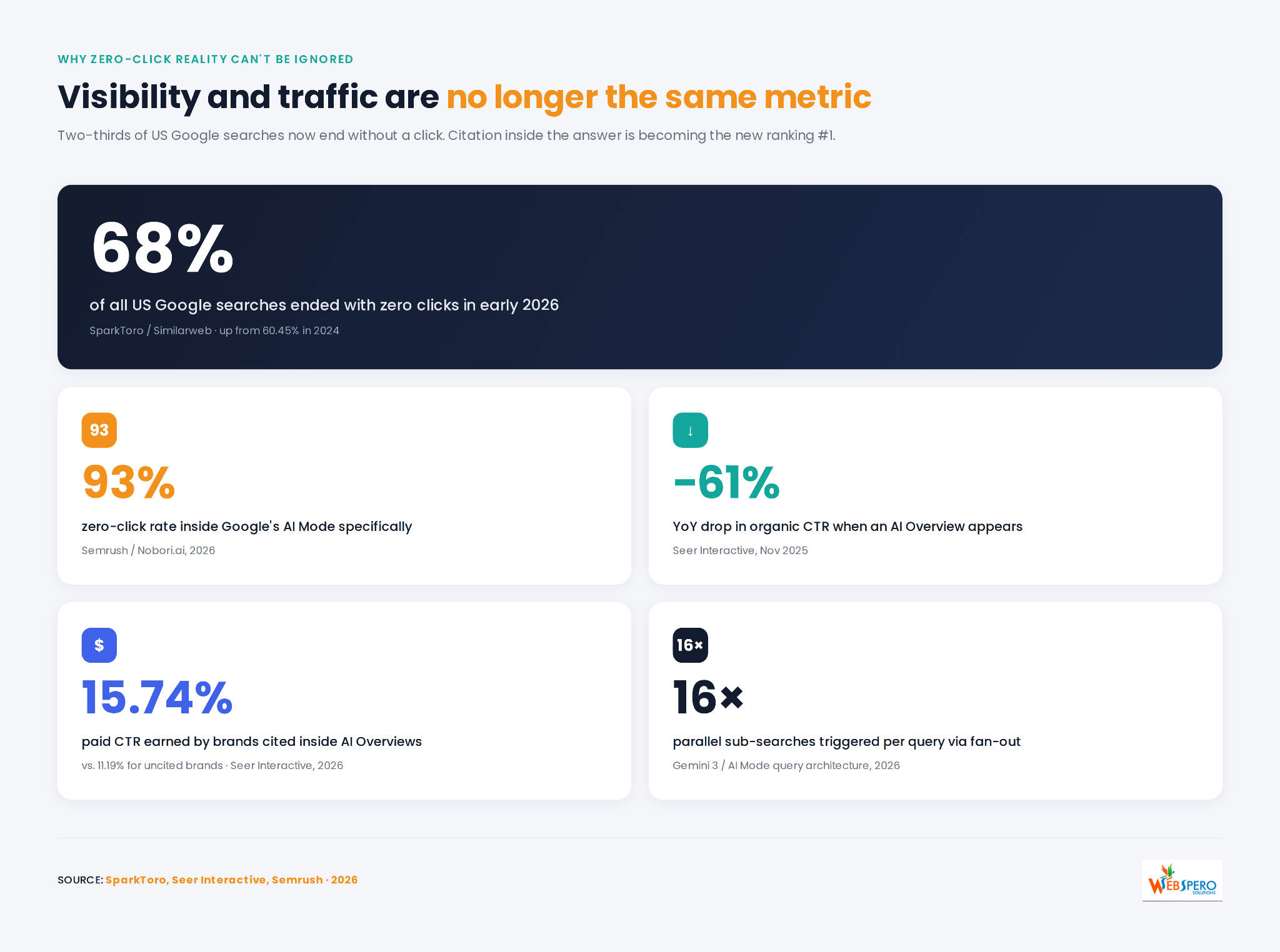
The right takeaway isn't "SEO is dead." It's that visibility and traffic are no longer the same metric. A page can rank, get cited inside an AI Overview, and shape how an AI engine answers a question, while generating zero direct visits. Semantic SEO is how you optimize to be the entity a system trusts, not just the link a user clicks.
There's also a nuance worth internalizing: brands cited inside AI Overviews earned a 15.74% paid CTR on those same queries, versus 11.19% for uncited brands. Being mentioned in the answer, even without a click-through, still compounds into brand trust and downstream conversion. That's the case for semantic search optimization as a brand investment, not just an organic traffic play.
The term "semantic keywords in SEO" is often reduced to "add synonyms." That's a shallow reading. The actual importance of semantic keywords in SEO is that they're the surface evidence of entity relationships; they tell Google which concept space a piece of content belongs to, and which other entities it should be associated with.
Consider how Google's Knowledge Graph handles the query "seals." Pure keyword matching returns everything: Navy SEALs, the musician Seal, wax seals, seal-coating driveways. Semantic analysis resolves ambiguity by cross-referencing query context and behavior; most users searching "seals" mean the semi-aquatic mammal. The engine doesn't guess; it consults its entity graph. Your content needs to be mapped into that graph clearly enough that Google knows which "seals" you're writing about without ambiguity.
This is why topical authority built through pillar-and-cluster architecture outperforms any individual keyword play. When a site publishes a comprehensive pillar page on retirement planning, linked to deep-dive cluster pages on 401(k)s, Roth IRAs, RMDs, and contribution limits, Google doesn't see a collection of keyword-targeted pages. It sees a site that has mapped the entity space of retirement planning, including the relationships between entities. That's what signals topical mastery to a semantic search engine.
Establish the single broad concept your content is going to own before doing anything else.
Search it on Google and record all entities that surface in Knowledge Panels, People Also Ask, and Related Searches.
For example, "401(k)" → contribution limits, employer match, tax treatment.
Connect each entity and attribute to the others it naturally overlaps with.
Explicitly cover each entity, attribute, and relationship, not one page trying to rank for one keyword.
The importance of semantic keywords in SEO, then, is architectural: they're the connective tissue that helps search engines place your content accurately in an entity graph. Use them to signal relationships, not to inflate density.
When we audit content for clients, the most common gap isn't missing keywords; it's missing entity context. Pages that cover a topic without mapping the surrounding entity space force search engines to guess. In 2026, with AI Overviews pulling from entity graphs at scale, that guesswork gap costs rankings you can't see in a standard keyword rank report.
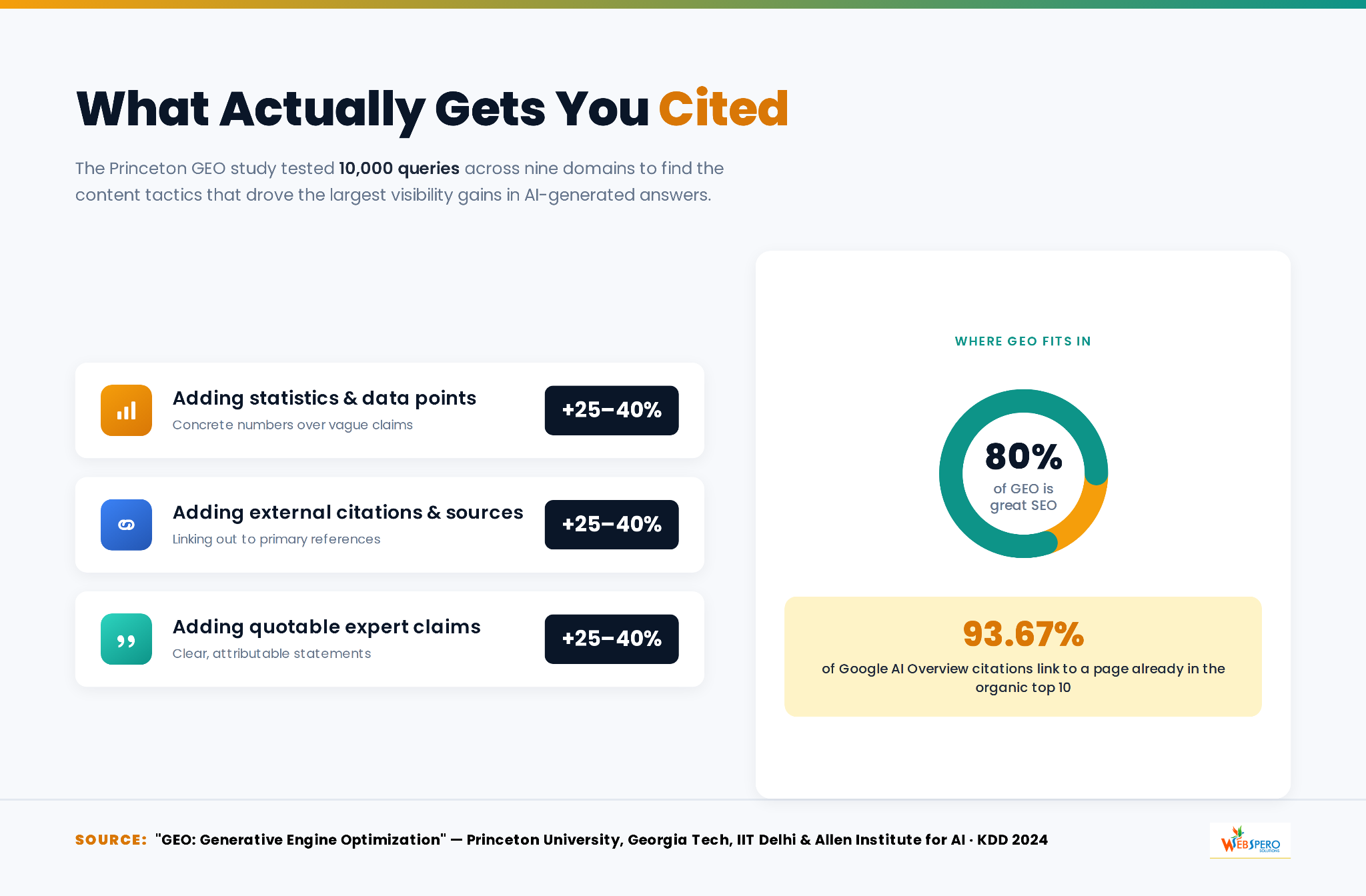
In 2024, a team from Princeton University, Georgia Tech, IIT Delhi, and the Allen Institute for AI published what is currently the most rigorous academic study on AI citation optimization. Their paper "GEO: Generative Engine Optimization" introduced the GEO-bench benchmark: 10,000 diverse queries across nine domains, tested against multiple content-modification tactics across several AI engines.
The headline finding: targeted GEO methods improved content visibility in generative-engine answers by up to 40%. For pages already ranking around position 5, the improvement reached 115%. Pages ranking #1 saw little added benefit, as they were already being cited. The biggest gains came from the middle of the pack.
There's a critical caveat from subsequent research worth mentioning: a 2025 follow-up benchmark (C-SEO Bench) found that most prompt-engineering tricks and conversational SEO tactics don't help, and some actively hurt. Plain source relevance and quality remain the dominant factors. GEO isn't a shortcut. It's a refinement layer on top of fundamentally strong content.
Write content that contains citable facts, link to primary sources, and make your key claims quotable and specific. That's what LLMs pull from when synthesizing answers. It's also, not coincidentally, what makes great editorial content.
For deeper context on how AI citation intersects with organic strategy, see our guide on GEO and AI search optimization.
A working semantic SEO strategy isn't a checklist; it's a complete architectural decision. The following steps are ordered deliberately: each one builds on the previous. Skipping entity mapping and going straight to schema, for example, is like adding signage to a building that hasn't been designed yet.
Before writing a word, define the core topic and map every entity Google associates with it. Search the topic, record Knowledge Panel entities, People Also Ask results, and Related Searches. These are your content boundaries and your gaps.
One comprehensive pillar page covers the broad topic. Multiple cluster pages go deep on each entity and subtopic. Internal links create the relationships that signal topical authority. No orphaned pages; every cluster connects back to the pillar.
Use entity-associated terms, related concepts, and semantic co-occurrence patterns, not synonym stuffing. Aim for keyword density under 4% across all n-gram variations. Tools like Semrush's SEO Content Template surface co-occurrence patterns from top-ranking competitor pages.
Deploy JSON-LD schema appropriate to your content type: Article, FAQPage, HowTo, Organization, BreadcrumbList. Schema is the clearest signal available for entity disambiguation, as it tells Google which parts of your content represent which entities. Validate with Google's Rich Results Test.
Credentialed, named authors with verifiable expertise are a documented differentiator in both classic SERPs and AI-citation selection. Add author schema, link to author profiles, cite primary sources, and document first-hand experience. E-E-A-T isn't a one-time fix; it compounds across a content library over time.
With two-thirds of searches now ending without a click, traditional CTR and traffic metrics miss a large part of the visibility picture. Track AI Overview appearance, brand mention frequency, citation share in AI answers, and query-level impression trends in Search Console alongside classical ranking data.
One thing we've consistently seen at WebSpero: the teams that implement steps 1 and 2 before worrying about schema and keyword density outperform those that start with tactics. Entity mapping is a strategy. Everything else is execution.
E-E-A-T, which stands for Experience, Expertise, Authoritativeness, Trustworthiness, was formalized as a Google quality framework in 2023, but its roots go back to the Medic update in 2018. What's changed in 2026 is that these signals are no longer just quality guidelines for human raters; they're increasingly the criteria AI systems use to decide whose content to surface in synthesized answers.
The GoodFirms 2026 survey of 100+ digital marketing practitioners across 20+ countries found that while 86.5% still say ranking #1 matters (primarily for commercial-intent content), 65% named AI-driven search changes as their single biggest challenge, and only 14% currently track AI-citation visibility as a metric. That measurement gap is where opportunity lives for teams that move first.
On the structural data side: schema markup bridges the gap between raw page content and Google's internal entity model. Deploying the right schema types — Article for editorial content, FAQPage for Q&A sections, Organization for brand entity disambiguation, HowTo for process content — makes it dramatically easier for both Google's indexing layer and AI systems to classify what a page represents and who created it.
86.5% of marketers say ranking #1 still matters, but they consistently qualify that it's mainly true for commercial-intent queries. For informational queries, AI Overviews now answer the question before a user ever reaches the organic results. The implication is a two-mode content strategy: citation optimization for informational content and click-through optimization for transactional content.
Semantic analysis for SEO happens at multiple levels, and schema is the most explicit, controllable layer. Don't treat it as an SEO add-on to implement after launch; treat it as part of the content design process from the start.
The zero-click and AI Overview picture isn't uniform. Industry-level data reveals significantly different strategic implications depending on your vertical, and the differences are large enough to change which optimization approach you should prioritize.
| Vertical | Key Data Point | What It Means |
|---|---|---|
| B2B Tech | 82% AI Overview rate | Up from 36% a year prior — informational B2B content is now almost entirely a citation play, not a click play |
| Health & Medical | 43% AI Overview rate | High stakes for misinformation; E-E-A-T and credentialed authorship matter most here |
| E-commerce / Shopping | ~3.2% AI Overview rate | Down from ~29%; Google scaled back after AI answers underperformed on purchase conversion. Classic CTR optimization still wins here |
| Informational Queries | 74% zero-click rate | Informational content functions as a citation/brand asset in 2026, not a traffic driver |
| Transactional Queries | 31% zero-click rate | Users still want to compare before buying, so meaningful click opportunity remains |
| AI Referral Conversion | ChatGPT: 14.2–15.9% · Claude: up to 16.8% | AI-referred traffic converts at 8–9× the rate of average Google organic — quality over volume |
The practical read: if you're in B2B tech, health, or producing primarily informational content, your semantic SEO strategy should be built around topical authority, citation optimization, and E-E-A-T signals with clicks as a secondary metric. If you're in e-commerce, the classic performance optimization playbook still applies, supplemented by entity-based brand signals.
Also worth noting: AI-referred visitors convert at 14–17% versus roughly 1.76% for average Google organic traffic. The volume is lower today, but the quality signal is already remarkable. Brands that establish early citation authority in AI systems will have a structural advantage as that referral volume scales.
Search hasn't died; it's just split. Half the game is still winning the click; the other half is earning the citation. Semantic SEO is how you play both: mapping entities instead of chasing keywords, building schema as infrastructure instead of an add-on, and measuring citation share alongside traffic.
The brands moving first, while only 14% of marketers track AI-citation visibility, will own the entity graph before it gets crowded. That's not a trend to watch. That's the strategy to build now.
Traditional SEO optimizes for keyword matching: you research keywords, write content with those words, and aim to rank. Semantic SEO optimizes for meaning and intent. Instead of targeting keywords, you map entities (things Google recognizes), their attributes, and relationships. You then build a content network (pillar + clusters) that demonstrates topical authority and relationships. This semantic search approach wins because Google now understands meaning, not just keywords, and AI Overviews reward content that covers entities comprehensively. For semantic keywords in SEO, this means you're writing for understanding, not repetition.
Start with semantic search optimization: search your core topic on Google and look at Knowledge Panels, People Also Ask, Related Searches, and Rich Snippets. These reveal the entities and questions Google associates with your topic. You can also use tools like Semrush's Keyword Magic Tool or Ahrefs to surface related topics. List each entity and its attributes, then map relationships between entities. For example, if your core topic is "project management," related entities might be "Agile," "Scrum," "stakeholder management," and "resource allocation," each with specific attributes and relationships. This semantic analysis in the SEO process reveals your content gaps.
Yes, but reframed. Instead of "What keywords do we want to rank for?", ask "What semantic keywords in SEO would users search for when exploring this entity and its relationships?" Keyword research now informs entity mapping rather than page-by-page targeting. You're looking for search intent and user needs, not just volume and competition. A semantic SEO strategy uses keywords to understand user language and intent, then builds pillar-and-cluster content that addresses that intent through entities and relationships, not one-to-one keyword targeting.
Schema markup is your interface layer between human-readable content and machine-readable meaning. When you add Article, Organization, FAQPage, or HowTo schema, you're explicitly telling Google "this content is about X entity with these attributes." Without schema, Google has to infer meaning from text alone, and it often gets it wrong. With schema, you remove ambiguity. For semantic search optimization, schema is infrastructure — it's how you signal entity relationships at machine scale. The importance of semantic keywords in SEO increases with schema depth — structured signals compound; unstructured content doesn't.
AI Overviews are Google's AI-generated summaries that cite sources. They've become the primary result for informational queries, as 68% of searches now end without a click. Semantic SEO strategy is directly optimized for citation in AI Overviews because semantically rich, well-structured content is more likely to be cited. Your semantic search optimization should include "citable" material: specific claims, statistics, frameworks, and original research that LLMs want to quote. Content built with entity relationships and E-E-A-T signals is more citation-worthy. Semantic analysis in SEO now means optimizing for both ranking and citation visibility.
Traditional metrics (organic traffic, ranking position) are incomplete for semantic SEO. You should track: (1) Entity ranking — positions for pillar topics and related entities; (2) Topical authority — how many semantically related queries you rank for; (3) Citation visibility — appearances in AI Overviews, Knowledge Panels, and People Also Ask; (4) E-E-A-T signals — author mentions, credentialed byline visibility, brand mentions across the web; (5) Zero-click data — how often your content appears as an answer without a click. Citation frequency is as important as click-through rate. Your semantic SEO strategy should include dashboards for both metrics.
Attention: WebSpero does not conduct business or interviews over Skype, Google Hangouts, DM or any chat platforms and do not request banking information.