
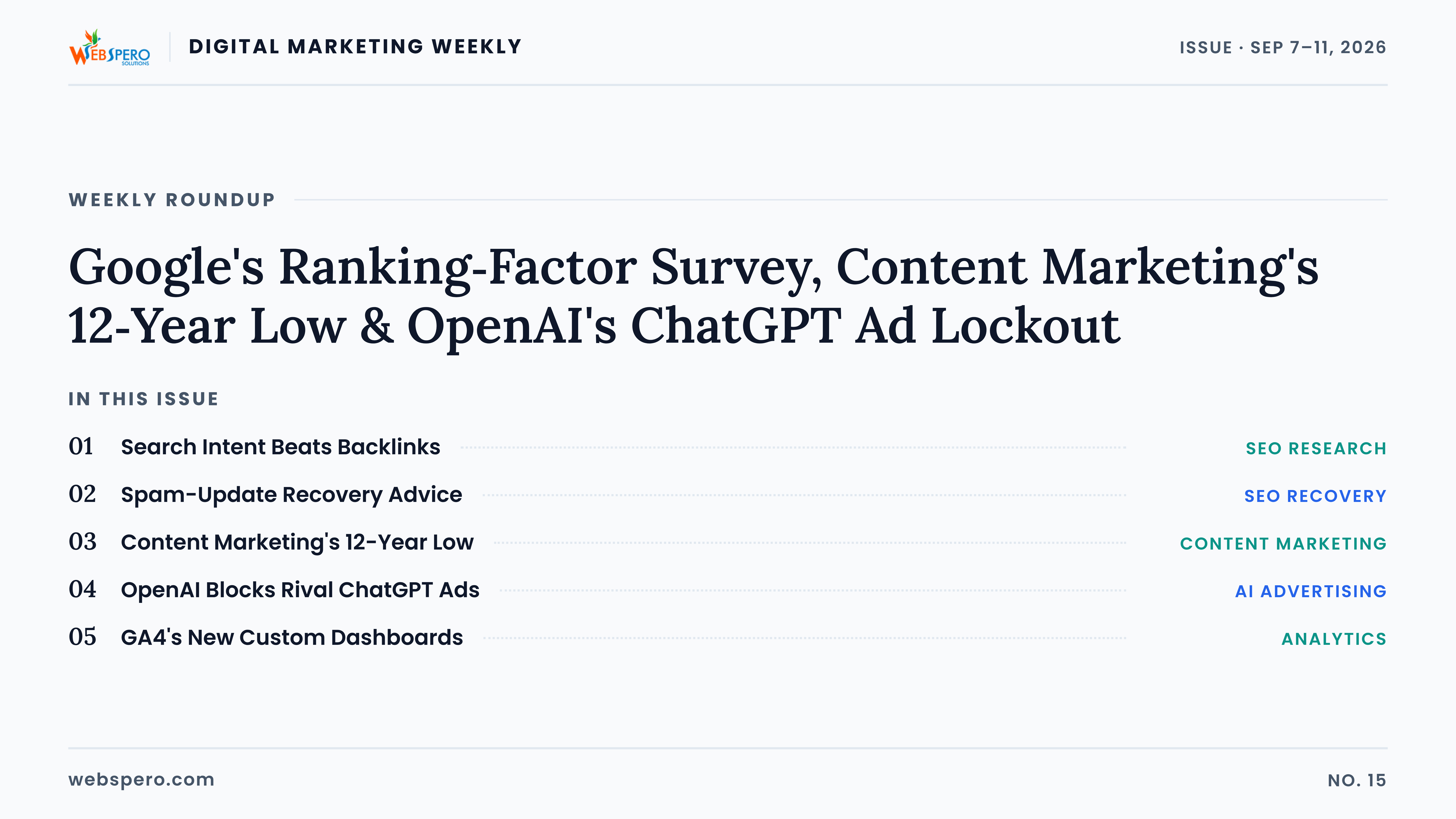
Digital Marketing Updates (September 7-11, 2026): Google’s Ranking-Factor Survey, Content Marketing’s 12-Year Low & OpenAI’s ChatGPT Ad Lockout
 Vishal Thakur
Published: September 14
Vishal Thakur
Published: September 14
Vishal Thakur
Published: September 14
Vishal Thakur
Published: September 14
A new survey of 131 SEO professionals puts search intent and backlinks ahead of everything else in perceived ranking power, content marketing performance just hit its lowest point in 12 years even as AI adoption tops 92%, a well-known Google penalty specialist is warning against rushed fixes after the August spam update, OpenAI is reportedly locking rival AI tools out of ChatGPT’s ad platform, and Google Analytics shipped a drag-and-drop dashboard builder.
 Here’s everything that happened this week and what it means for your marketing strategy.
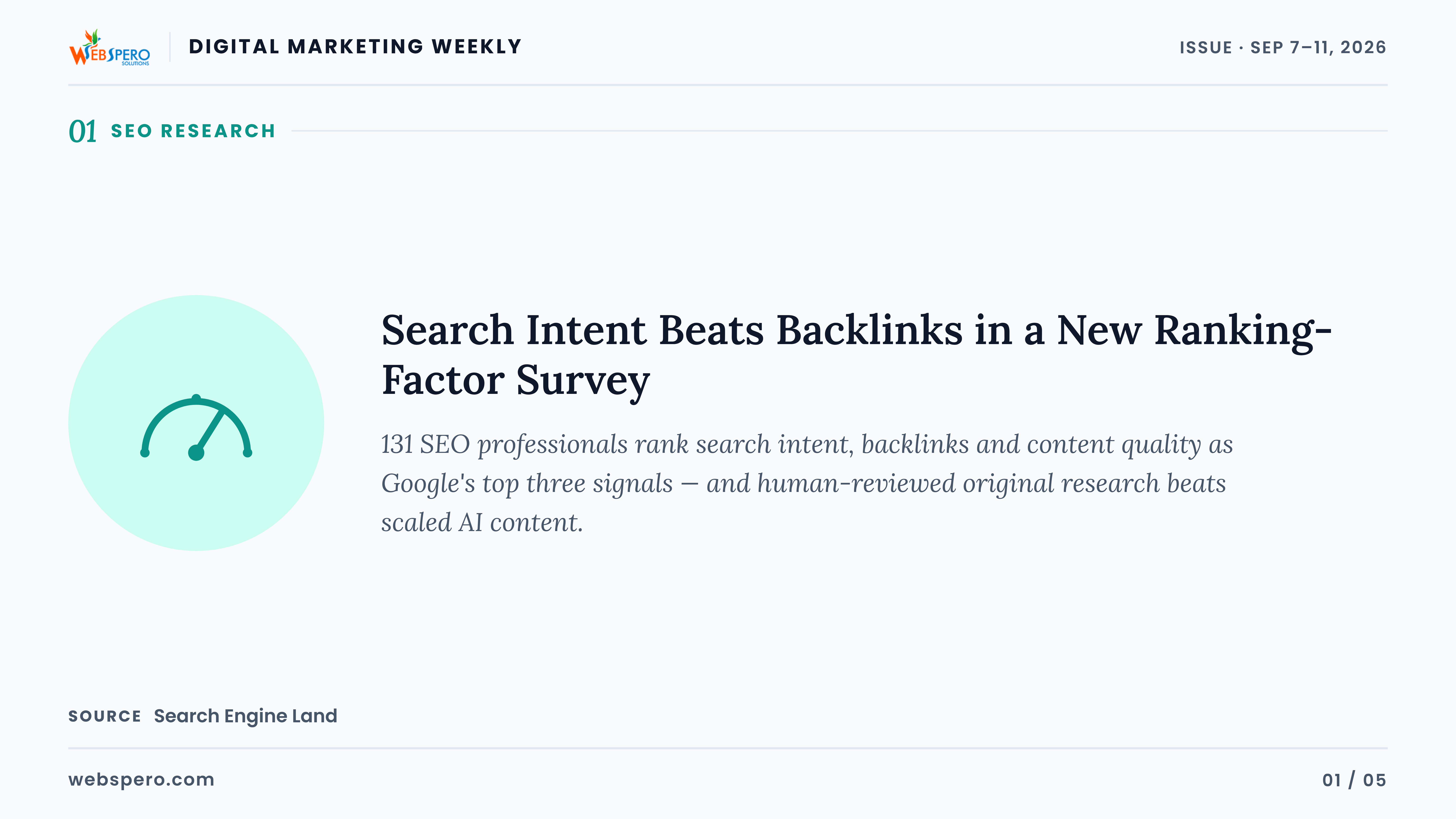
Zyppy’s 2026 Google Ranking Factors Expert Survey collected 13,665 ratings across 103 potential ranking factors from 131 SEO professionals, and the results put search intent match at the top of the list. Respondents said satisfying the searcher’s underlying goal, not just matching keywords, is what separates pages that rank from pages that don’t, with information gain flagged as increasingly important when several pages already answer the same query.
Backlinks came in second at 54.8% of respondents naming them a top-three factor, just behind relevance’s 57.1%, despite Google’s own Gary Illyes previously saying links aren’t among the top three signals internally. Content quality ranked third, and within that category original research and first-party data scored far better than scaled AI content with little added value — AI-assisted content only rated well when it had substantial human review behind it.
| KEY TAKEAWAY
Search intent, backlinks and content quality remain the three factors SEO professionals trust most. If you’re producing AI content at scale without human review or original data behind it, this survey is a signal to slow down and add real value, not just volume. |
Source: Google’s top ranking factors, according to 131 SEO professionals — Search Engine Land
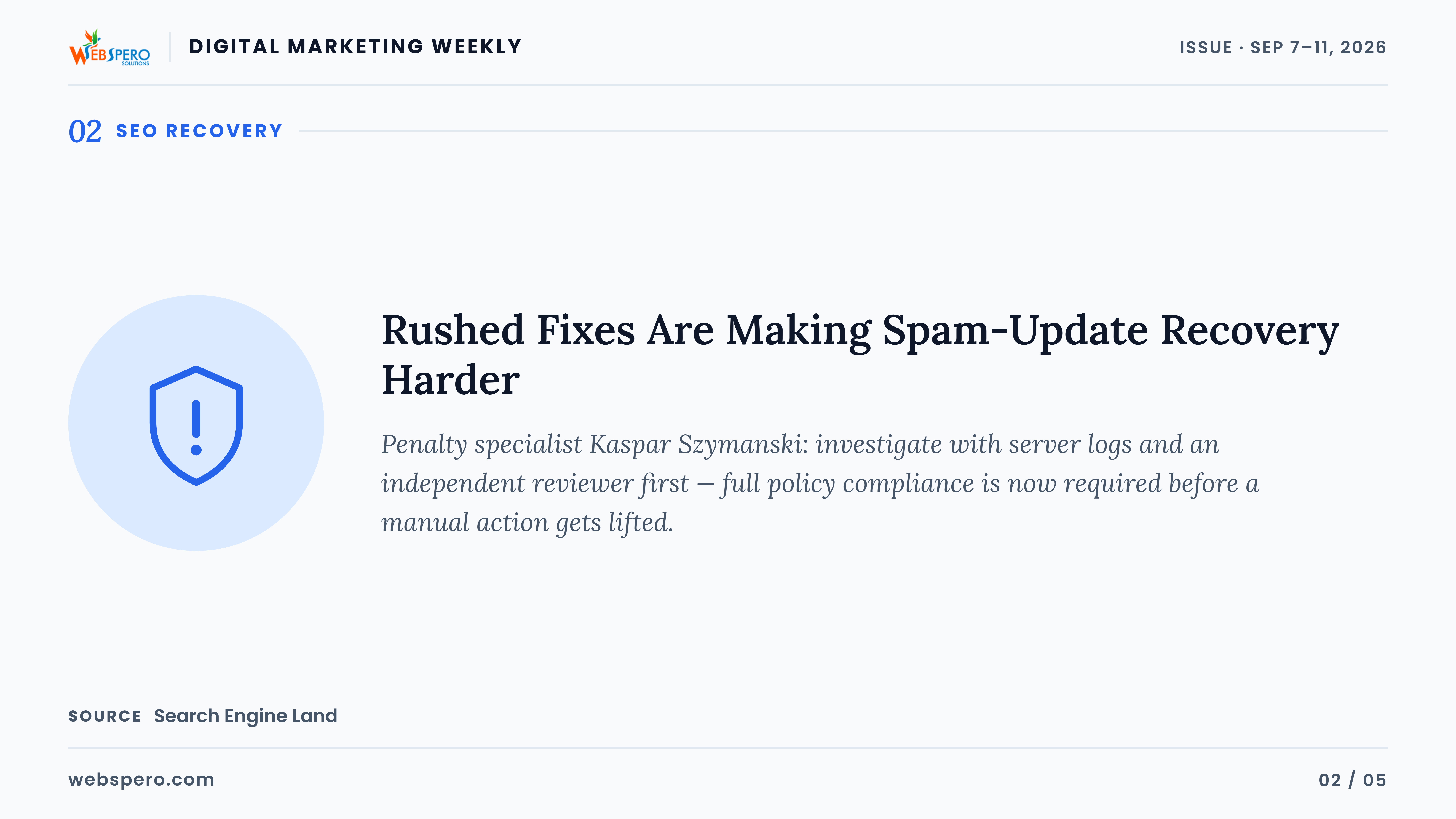
Google’s August 2026 spam update has left a number of previously well-performing sites with significant visibility drops, and according to Search Brothers founder Kaspar Szymanski, the businesses making things worse are the ones reacting too fast. Deleting content wholesale or filing for reconsideration before fully addressing what Google flagged can lead to rejection, and each rejection makes the next attempt harder and more expensive.
Szymanski’s advice: crawl the site and analyze server logs to see what bots were doing right before rankings dropped, bring in an independent third party rather than the in-house team to investigate (there’s an obvious conflict of interest otherwise), and understand that simply fixing the issue named in Search Console is no longer enough — full compliance with Google’s Spam Policies is now required to get a manual action lifted. He also recommends against relying on Google Search for more than half of total traffic, given how quickly a policy shift can put revenue at risk.
| KEY TAKEAWAY
If you were hit by the August spam update or a manual action, resist the urge to make quick fixes and reapply immediately. Investigate with server logs and an independent reviewer first, fix the underlying compliance issue fully, and treat traffic diversification as a standing priority, not a post-penalty scramble. |
Source: Caught by Google’s spam update? Don’t make recovery harder — Search Engine Land
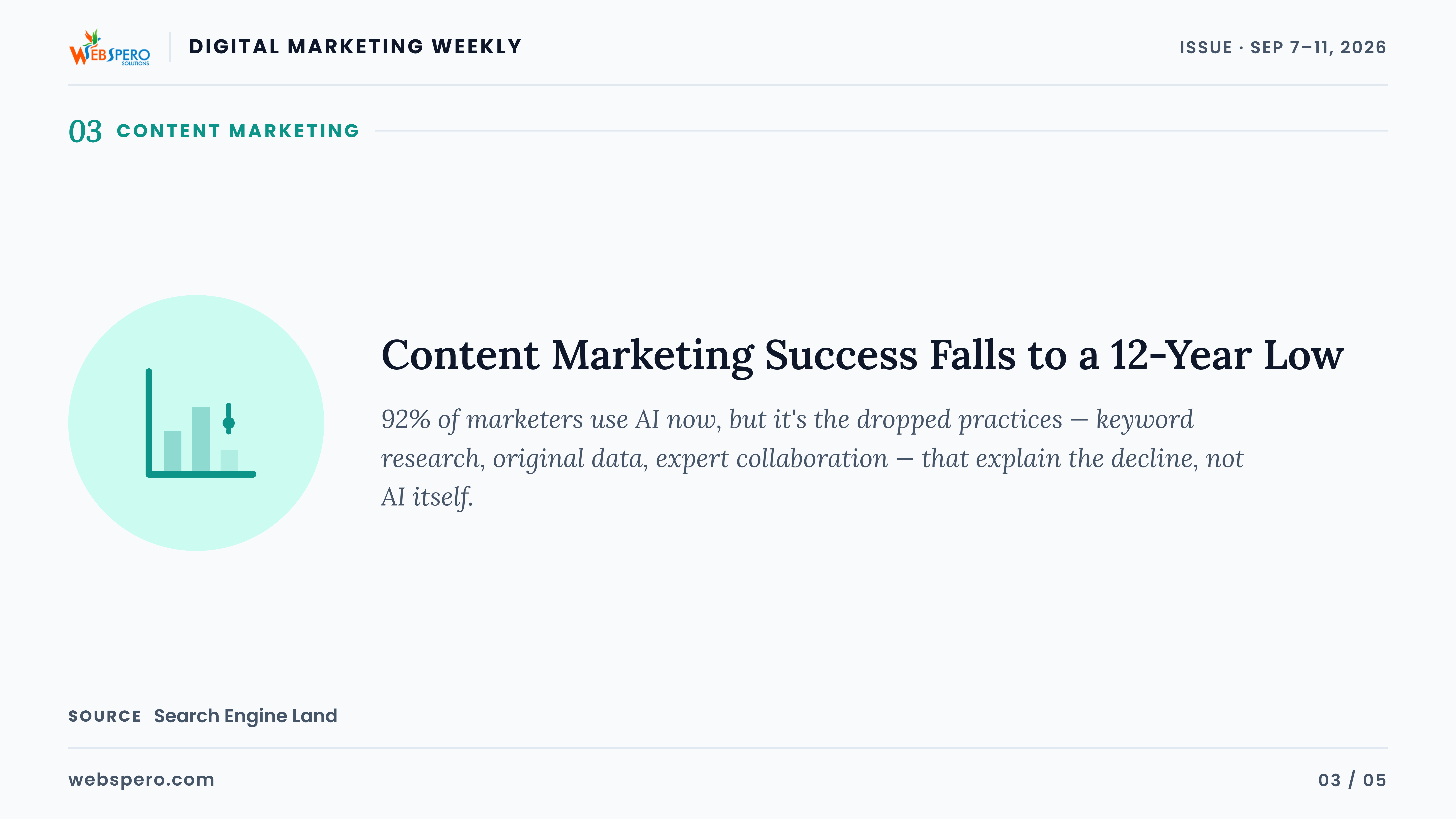
Orbit Media’s latest annual blogging survey of 1,042 content marketers found that just 14% reported their blogs delivered “strong results,” the lowest figure in 12 years and nearly half the 26% reported back in 2022. AI adoption, meanwhile, reached 92.4% — but using AI showed no relationship with stronger results one way or the other.
The report points to marketers abandoning the practices most linked to success: influencer collaboration, original research, keyword research, paid content promotion, formal human editing and consistent use of analytics all became less common over the past year. Influencer collaboration in particular showed the strongest link to strong results (marketers who did it regularly were 2.6x more likely to report success), yet adoption fell from 25% in 2017 to just 7% today. AI did cut production time — the average post now takes 3 hours 20 minutes versus over 4 hours in 2022 — but that time savings hasn’t translated into better outcomes.
| KEY TAKEAWAY
Faster content production isn’t the same as better content performance. The proven practices — keyword research, original research, expert collaboration and human editing — still separate top performers from everyone else, and cutting them to save time is showing up in the results. |
Source: Content marketing success falls to 12-year low: Survey — Search Engine Land
OpenAI has reportedly updated its advertising policies to stop campaigns for competing standalone image- and audio-generation products from running inside ChatGPT, according to a report from The Information. The change was communicated directly to advertising partners rather than announced publicly, and Adobe — which had been promoting Acrobat Studio and its Firefly image generator through OpenAI’s initial ad pilot — is among the advertisers affected.
Video-generation tools can still advertise on the platform for now, and the restriction lands as OpenAI expands its own competing image and voice capabilities inside ChatGPT. The move isn’t unusual for a major platform protecting its own products, but it raises a real question for marketers: as ChatGPT grows into a serious advertising channel, categories adjacent to OpenAI’s own roadmap may become off-limits with little warning.
| KEY TAKEAWAY
If your paid strategy leans on ChatGPT ads, check whether your product category overlaps with anything OpenAI is building in-house. Restrictions are being communicated privately to advertisers first, not announced, so relationships with your rep matter more than usual right now. |
Source: OpenAI reportedly blocks rival AI tools from advertising in ChatGPT — Search Engine Land
Google Analytics rolled out Dashboards, a grid-based canvas that lets teams drag dimensions and metrics directly onto a single customizable report instead of building and checking separate reports one at a time. Six visualization types are available at launch — scorecards, tables, line charts, bar charts, donut charts and funnel charts — and published dashboards can be pinned directly to the Reports navigation for anyone with access to the property.
There are limits worth knowing before you build: standard properties can include up to 15 cards per dashboard (30 for premium properties), dashboards are shared across the whole property rather than kept private to one user, and API support, segments and card-level comparisons aren’t supported yet. Anyone with an Editor or Administrator role can create and publish one.
| KEY TAKEAWAY
GA4’s new Dashboards feature can replace the multi-report shuffle most teams do for weekly check-ins. Build one property-wide view of your core KPIs now, but plan around the 15/30-card limit and remember published dashboards are visible to everyone on the property, not just you. |
Source: Google Analytics launches customizable Dashboards — Search Engine Land
We publish a weekly roundup of the most important updates in SEO, paid search, content strategy, and AI-driven marketing — every week, no noise.
Attention: WebSpero does not conduct business or interviews over Skype, Google Hangouts, DM or any chat platforms and do not request banking information.