
GEO CASE STUDY
Found When It Matters: 175% AI Mentions Growth for Crossroads ME
How a Maine addiction and behavioral health treatment center nearly tripled its AI mention count and grew citations by 67%, ensuring it appears when people ask AI for addiction treatment, eating disorder care, and behavioral health support.
Client
Crossroads ME
Niche
Addiction & Behavioral Health Treatment
Duration
6-Month Campaign
+175%
AI mentions growth

+175%
AI mentions growth
+67%
Citations growth
The Client
Crossroads ME: Addiction and Behavioral Health Treatment for Women in Maine
Crossroads is Maine’s addiction and behavioral health treatment center, offering gender-responsive programmes for women seeking recovery from substance use, eating disorders, and co-occurring mental health conditions. Operating since 1974, Crossroads provides residential treatment, partial hospitalisation, intensive outpatient care, dual diagnosis programmes, medication-assisted treatment, and sober living across multiple Maine locations. The organisation is CARF accredited and serves women and mothers, including a residential programme for women with children. When someone asks an AI where to find addiction treatment or behavioral health support in Maine, the providers cited in that response are the ones that receive the call. For a treatment center whose reach depends on connecting with people at the moment they decide to seek help, AI visibility is a direct pipeline to admissions.
THE CHALLENGE
Proven Treatment Outcomes, Absent From the Searches That Drive Admissions

Low AI Presence Despite Programme Depth
Crossroads entered the campaign with an AI visibility score of 28 out of 100. Despite decades of operation, CARF accreditation, and a broad programme offering spanning addiction, eating disorders, and dual diagnosis, the organisation was not appearing consistently when people asked AI for behavioral health or addiction treatment options in Maine. The citation infrastructure to surface Crossroads at those query moments was too thin to match its actual service depth.
Treatment Content Not Structured for AI Retrieval
Behavioral health providers typically publish programme descriptions, accreditation credentials, and general service overviews. AI systems cannot cite that content as a direct answer to a specific treatment query. Crossroads needed content rebuilt around what people actually ask AI when they or someone they love is considering treatment, covering the specific programme types, treatment approaches, and conditions the organisation addresses.
Addiction Treatment Queries Span Multiple Condition Types
People searching for behavioral health care ask AI across a wide range of conditions and treatment modalities: alcohol and drug addiction, eating disorders, dual diagnosis, PTSD, women-specific programmes, and mother-child residential options. Without citation-ready content mapped to each of these query types, Crossroads was absent from the majority of relevant searches even when it had the programme to help.
Competing With National Directories for AI Citation
The addiction treatment category is dominated in AI responses by large national treatment directories and aggregator platforms with extensive citation histories. A regional treatment center building AI visibility from a modest baseline needed a targeted strategy to earn citations in the specific Maine-focused and gender-specific treatment queries where local provider authority carries more weight than directory scale.
Our Approach
GEO for Behavioral Health: Building the Citation Presence That Gets Crossroads Found When People Decide to Seek Treatment
Our strategy for Crossroads was built on one insight: in the addiction and behavioral health category, AI citations follow condition-specific and programme-specific content. People do not ask AI for a treatment center in the abstract. They ask about the specific condition they are dealing with or the specific type of programme they need. We focused on building Crossroads’s AI presence at the programme and condition level, not at the organisation description level.
Treatment Query Intent Mapping
We mapped the AI query landscape across the treatment and recovery intents most relevant to Crossroads’s programme offering: alcohol and drug addiction treatment, eating disorder care, dual diagnosis support, PTSD and anxiety programmes, women-specific residential treatment, mother-child rehab, IOP and PHP pathways, and medication-assisted treatment. Each cluster was assessed against Crossroads’s existing citation footprint to identify where query volume was highest and organisational coverage was lowest.
Condition-First Content Structured for AI Citation
We rebuilt Crossroads’s content around the specific questions people ask AI when they or a family member is considering treatment. Each page was written to answer one condition or programme query with a specific, actionable response pointing clearly to how Crossroads can help. This gave AI retrieval systems the extractable, query-matched content needed to cite Crossroads as a direct answer rather than a general provider reference.
Citation Seeding Across Behavioral Health Verticals
We identified the editorial and resource properties AI platforms draw from when answering addiction treatment and behavioral health queries in Maine and executed a placement programme to earn citations across them. Priority went to properties with demonstrated influence on AI recommendation outputs in the substance use, eating disorder, and women’s health categories where Crossroads’s programmes are most directly relevant.
The Impact
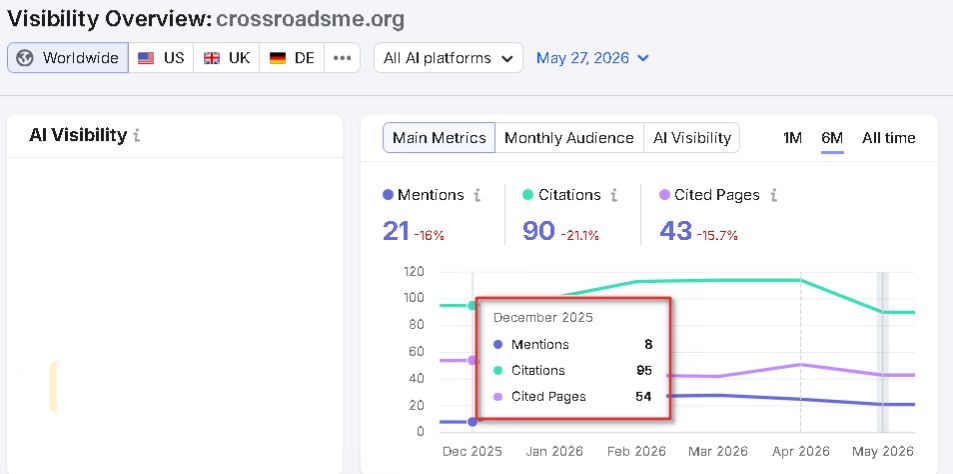
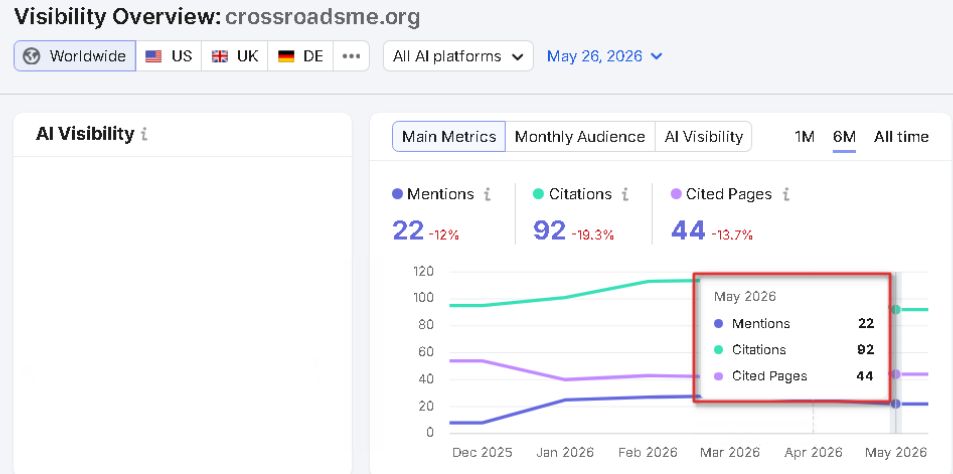
175% AI Mentions Growth: Crossroads Now Appears When People Ask AI for Addiction Treatment in Maine
+175%
AI mentions growth (8 to 22)
+67%
Citations growth (55 to 92)
“Crossroads now holds citation presence across the condition and programme queries where admissions decisions begin, giving the organisation a compounding AI visibility channel that reaches people at the moment they are ready to ask for help.”
Actionable Insights
What Behavioral Health and Addiction Treatment Providers Can Learn From This Campaign
AI Is Where Treatment Decisions Begin
When someone is ready to seek help for addiction or a behavioral health condition, they increasingly ask AI before calling a provider or visiting a directory. Treatment centers that appear in those responses reach people at the highest-intent moment in the admissions journey. Providers absent from that layer lose ground to competitors regardless of the quality of their programmes or outcomes data.
Programme Overviews Do Not Earn AI Citations
AI systems cite content that answers a specific query with a specific answer. A treatment center’s accreditation page and general services overview are not citable in that way. Providers that want AI visibility need content written at the condition and programme level, structured to answer the exact questions people ask AI when they are looking for the type of care the organisation provides.
Local and Specialist Authority Outperforms Aggregators
National treatment directories dominate broad addiction queries in AI responses. At the programme-specific and geography-specific level, providers with precise, locally grounded content earn citations that directories cannot supply because their content is too general. Specialist and regional treatment centers have a genuine authority advantage at that level of specificity that GEO converts into admissions-driving AI visibility.
AI Visibility Scales Reach Without Scaling Ad Spend
Behavioral health providers face significant restrictions on paid advertising, making organic and AI-driven channels disproportionately valuable. Every new AI citation is a potential admissions inquiry from someone who would otherwise not have found the organisation. GEO builds a compounding visibility asset that reaches people across every relevant query, without the cost or compliance exposure of paid channels.