
SHOPIFY CASE STUDY
Beej Origin: A Premium Shopify Storefront Built Around Smarter Variant Logic
How a premium Shopify storefront was rebuilt, featuring a custom Online Store 2.0 section library, a redesigned variant selection interface, variant-specific content rendering, and hidden-variant logic, all manageable from the Shopify Theme Customizer.

Project Context
Client
Beej Origin
Niche
Shopify E-Commerce · Organic & Wellness
The Tech Stack
- Shopify Online Store 2.0
- Liquid
- HTML5
- CSS3
- JavaScript (ES6)
- JSON Templates
- Shopify Metafields
- Shopify Theme Customizer
- Shopflo Checkout
"We wanted a Shopify store that felt as premium as our products, let our variants tell the right story, and gave our team full control from the admin without relying on a stack of apps."
The brief was pragmatic. Beej Origin needed a storefront that matched its premium organic positioning, a variant experience that surfaced the right product detail at the right moment, a way to keep certain variants out of collection browsing without deleting them, and a theme the team could manage on their own from day one.

Beej Origin Team
Premium Organic Products

HOW WE BUILT IT
A Structured, Section-First Build Process
Beej Origin needed changes across the section architecture, the variant system, hidden-variant logic, and third-party checkout compatibility. We treated each area as its own workstream, agreed the design and content model up front, and shipped in section-sized increments so the team could review as we went.

DISCOVERY
A working session with the Beej Origin team to understand the brand positioning, the product catalogue, the variant complexity, and how the
team wanted to manage content going forward.

REQUIREMENT ANALYSIS
Broke the brief into workstreams: custom section library, variant selector redesign, variant-specific content rendering,
hidden-variant logic, and Shopflo checkout compatibility testing.

DESIGN DIRECTION
Defined the visual system for a premium organic brand: clean layouts, restrained typography, and a variant interface that matched the product photography instead
of Shopify’s generic default.

SECTION ARCHITECTURE
Designed reusable Online Store 2.0 sections with configurable settings, giving the team full control from the Theme Customizer
without a code change.

VARIANT SYSTEM DEVELOPMENT
Rebuilt the default Shopify variant picker as a custom JavaScript-driven selector tied to product metafields, with variant-specific content
rendering built into the same layer.

HIDDEN VARIANT LOGIC
Built a tag-driven convention that suppresses flagged variants from collection and product cards while keeping them fully purchasable on
the product page.

CHECKOUT INTEGRATION
Integrated and tested the Shopflo third-party checkout against every new variant and cart interaction to confirm nothing in the new
storefront logic disrupted the purchase flow.

QA & LAUNCH
Cross-browser and cross-device QA across every custom section, the variant selector, and the checkout flow before deploying the storefront to the live store.
Custom Online Store 2.0 Section Library
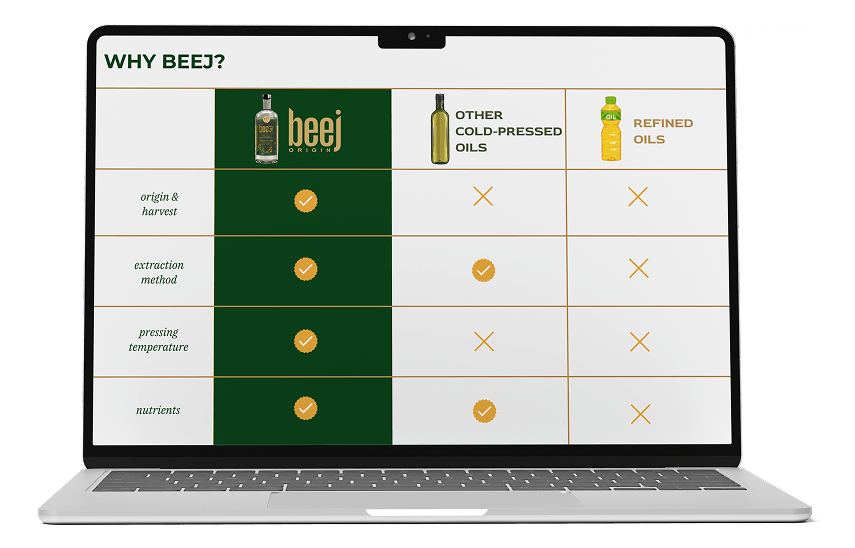
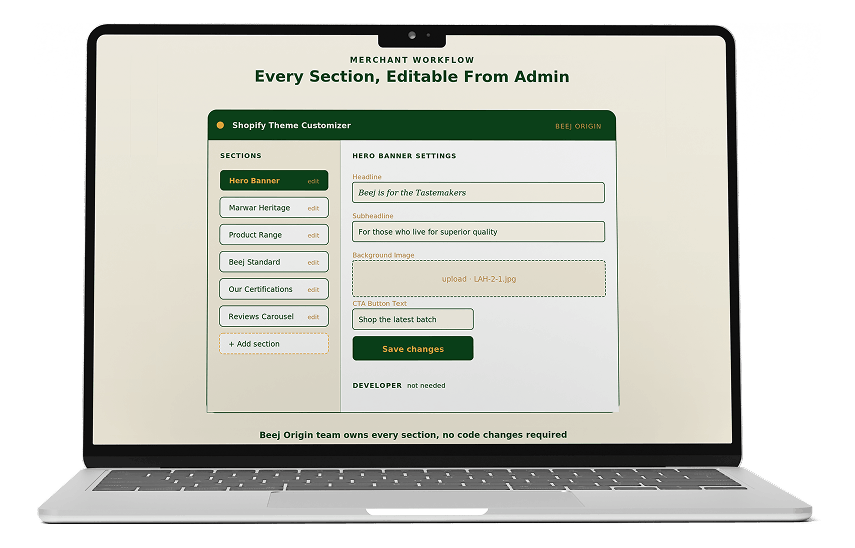
Every homepage section was rebuilt as a reusable, configurable Online Store 2.0 block. The Beej Origin team can rearrange, add, or edit sections directly from the Theme Customizer, with no developer needed for routine homepage changes.
Redesigned Variant Selection Interface
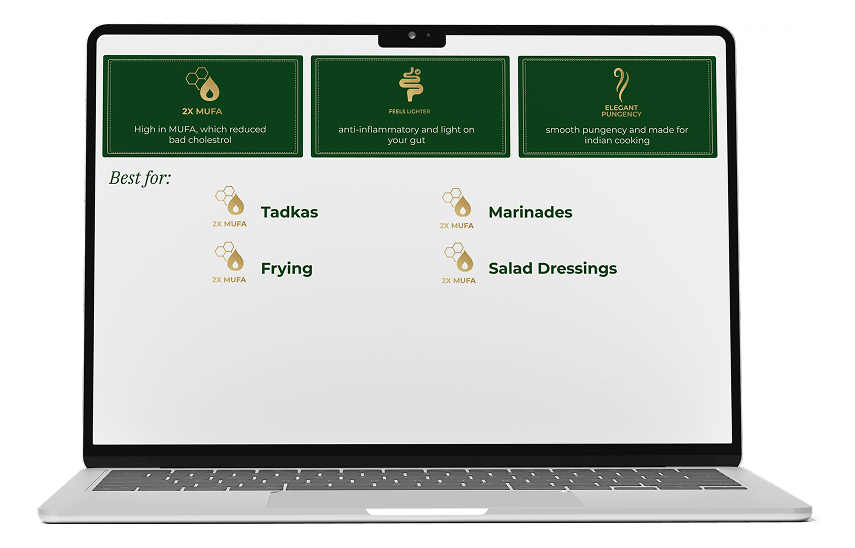
Shopify’s default swatch and dropdown picker was rebuilt as a custom JavaScript-driven selector wired to product metafields. The result is a variant picker that matches Beej Origin’s premium visual identity instead of the generic theme default.

Variant-Specific Content Rendering
Conditional Liquid blocks pull variant-specific copy and specifications from metafields and update in place the moment a customer changes their selection, with no page reload, no generic fallback text, just the information relevant to the exact variant in view.
Hidden Variant Logic for Collection & Product Cards
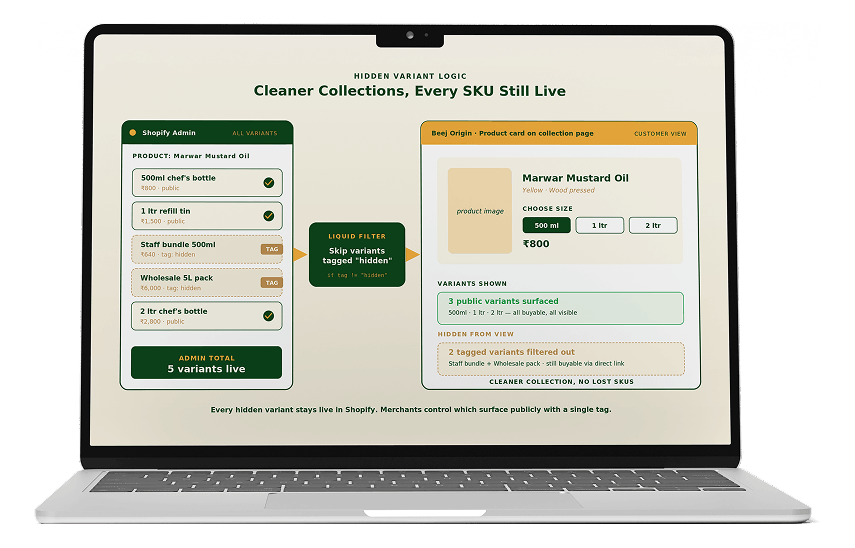
Some Shopify variants exist for internal reasons (staff bundles, coming-soon SKUs, wholesale packs), but shouldn’t appear on public collection pages. We built a tag-based rule in the theme: any variant tagged as “hidden” gets skipped when the storefront renders product cards, but the variant stays live in Shopify and remains purchasable via direct link. Cleaner collection pages for shoppers, no lost SKUs for the team.
Merchant-Friendly Theme Customization
Section settings, variant content, and homepage layout are all managed from the Shopify Theme Customizer. The Beej Origin team edits copy, imagery, and layout without a developer touching the theme code.
Performance-Optimized, Mobile-First Storefront
Every section and template was built mobile-first and tuned for speed, with SEO-friendly markup carried through collection, product, and homepage templates so the storefront loads fast and stays discoverable.

WHAT TO EXPECT FROM US
Transparent Build Process and Clean Delivery for Shopify Projects
If you are building or rebuilding a Shopify store and weighing agencies, here is what working with our team actually looks like.

Architecture before design.
Every project begins with an architecture map. We establish catalog relationships, variant data models, and conversion paths before a single design mockup is created. The structure is decided before the visuals are.

Native Liquid execution.
Core functionality like custom variant pickers and hidden-SKU logic is engineered natively into the theme. We do not reach for third-party apps that add bloat and degrade page speed for things Liquid can already handle.

Clean code standards.
Theme files follow strict, modular conventions built on JSON templates. Whether it is your internal team or an outside developer picking this up later, the code is straightforward to read and extend.

Content autonomy.
Stores are built around Shopify Metafields and Metaobjects. Your merchant team can update dynamic variant content, FAQs, and marketing copy directly, without touching a line of code.

Rigorous viewport auditing.
Every build is validated across desktop, tablet, and mobile screen resolutions, under real network conditions, before it ever reaches client review. Nothing gets approved on a single screen size.

Milestone transparency.
Projects move through structured review gates at every phase. You always have clear visibility into what has shipped, what is in progress, and what comes next — no surprises at the end.

Complete asset handover.
At delivery you receive full repository access, Liquid definitions, CSS/JS logic, and documentation. Everything is transferred with no proprietary lock-ins, so the store is genuinely yours.

Direct access, no account layers.
You work directly with the people building your store, not a rotating cast behind an account manager. Questions get answered by someone who actually knows the codebase.