
GEO CASE STUDY
Found Before the Filing: 76% Citations Growth for Trademark Engine
How a trademark filing platform built its citation presence across the IP research and registration queries business owners bring to AI before they ever open a filing form.
Client
Trademark Engine
Niche
Legal / IP Services
Duration
6-Month Campaign
+76%
Citations growth
+76%
Citations growth
+57%
Cited pages growth
The Client
Trademark Engine: Trademark Filing Made Accessible for Business Owners
Trademark Engine is a US-based legal services platform that helps business owners, entrepreneurs, and creators register trademarks without the cost of a traditional IP attorney. It operates in a category where the decision to file is almost always preceded by an AI or search research phase — people ask what a trademark is, whether they need one, and how to file before they ever reach a service provider. Platforms that appear in those pre-decision AI responses are the ones that capture filing intent at its earliest and most valuable point.
THE CHALLENGE
A Filing Platform Absent From the Research Phase That Precedes Every Filing

Low AI Visibility Score at Baseline
Trademark Engine entered the campaign with an AI visibility score of 20 out of 100. The platform was not appearing consistently in AI responses to trademark research queries, meaning the highest-intent audience was being routed elsewhere before ever reaching a filing decision.
Content Positioned for Conversion, Not AI Citation
The existing content was structured around driving users to file rather than answering the procedural and definitional questions that precede filing intent. AI systems cite content that answers specific questions directly. Conversion-oriented copy does not satisfy that requirement, regardless of how well it ranks in traditional search.
Trademark Research Queries Span Many Distinct Intents
Business owners ask AI about trademarks across a wide range of distinct intents: what qualifies for protection, how to conduct a trademark search, what classes to file under, how long the process takes, and what happens if a mark is refused. A platform without citation-ready content across each stage is absent from most of the journey, even when it has the service to deliver.
Competing Against Established Legal Information Properties
The trademark information category is heavily occupied by legal directories, law firm blogs, and government IP resources with deep citation histories. Breaking into AI citation outputs in this category required a targeted content programme focused on the specific procedural intents where service-provider authority carries more weight than institutional breadth.
Our Approach
GEO for IP Services: Building Trademark Engine's Citation Presence Across the Filing Journey
Our strategy for Trademark Engine was built on one insight: in the legal services category, AI citations follow procedural clarity. Business owners do not ask AI for a trademark filing service — they ask AI how trademarking works, step by step, at each stage of the decision. We focused on building Trademark Engine’s citation presence at the procedure and question level, not at the service description level.
Trademark Journey & Landscape Mapping
We mapped user queries across every stage of the trademark lifecycle, including eligibility, search, class selection, timeline, office actions, and renewals. Each cluster was evaluated against Trademark Engine’s citation footprint to prioritize high-volume areas with the largest content gaps.
Procedural Content Architecture
We restructured content to address the exact procedural questions business owners ask AI tools. Every page delivers a clear, accurate, step-level response designed for AI extraction and citation, balancing direct answers with seamless filing paths to preserve commercial intent.
Citation Seeding Across Core Verticals
We targeted high-authority editorial and resource properties that AI platforms reference for intellectual property queries. Through a targeted placement program, we earned citations across key legal, small business, and entrepreneurship channels.
Search Footprint Optimization
We systematically expanded Trademark Engine’s authority across high-intent search clusters. By optimizing brand visibility within AI recommendation outputs, we maximized organic placement across the entire trademark registration ecosystem.
The Impact
76% Citations Growth: Trademark Engine Now Appears Where Filing Decisions Begin
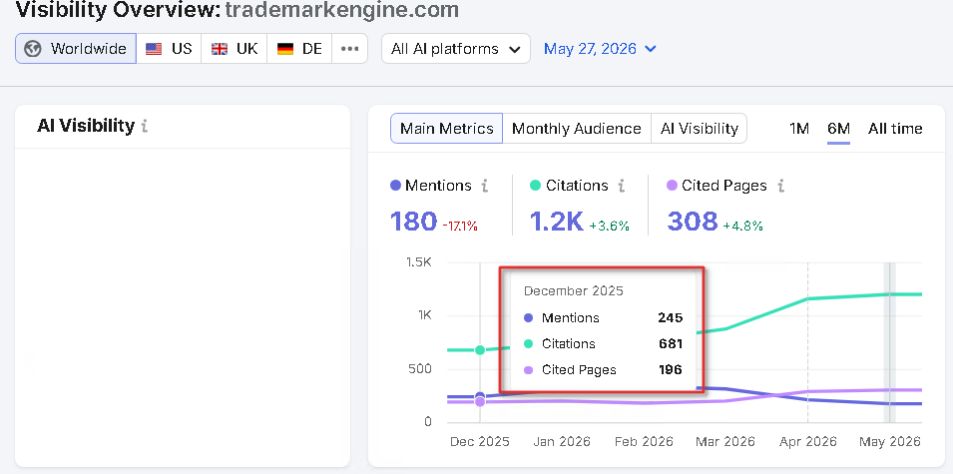
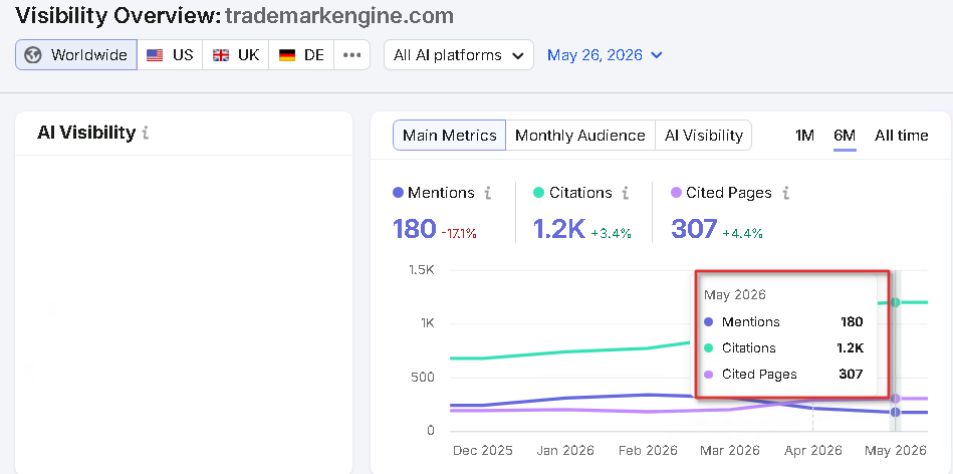
+76%
Citations growth (681 to 1,200)
+57%
Cited pages growth (196 to 307)
“Trademark Engine now holds citation presence across the procedural questions where trademark filing decisions are made, giving the platform a compounding AI visibility channel that intercepts business owners at the research phase, before they have chosen a filing service.”
Actionable Insights
What Legal and IP Service Platforms Can Learn From This Campaign
AI Citations Follow Procedural Clarity
In legal and IP categories, AI systems cite content that explains a process accurately and specifically, not content that describes a service. Platforms that produce step-level answers to the procedural questions their audience asks AI earn the citations that matter, while service-description pages earn almost none.
The Research Phase Is the Conversion Opportunity
Business owners who ask AI how to file a trademark are not yet committed to a provider. Platforms that appear in those research responses shape the decision before any competitor has had the chance to. GEO captures that pre-decision intent at the stage where platform preference is still open.
Cited Page Breadth Covers the Full Journey
Trademark decisions do not happen in a single query. Business owners move through eligibility, search, filing, response, and renewal over weeks or months. Platforms with cited pages across the full journey appear at every stage of that process, compounding their visibility advantage over providers whose citation presence is limited to one phase.
Specialist Authority Beats Directory Breadth
General legal directories dominate broad IP queries in AI outputs. At the filing-specific and procedure-specific level, platforms with precise, process-grounded content earn citations that generalist resources cannot provide because their content is too broad to answer the specific question. Specialist platforms have a genuine authority advantage at that specificity level that GEO converts into AI visibility.