
Digital Marketing Updates (June 8–12): OpenAI Lockdown, SEO Authority, PMax
 Vishal Thakur
Published: June 15
Vishal Thakur
Published: June 15
Vishal Thakur
Published: June 15
Vishal Thakur
Published: June 15
OpenAI drew a security perimeter. Google drew an authority line. And the rules for getting cited by AI or winning in paid search shifted just enough that ignoring any of it is a mistake.
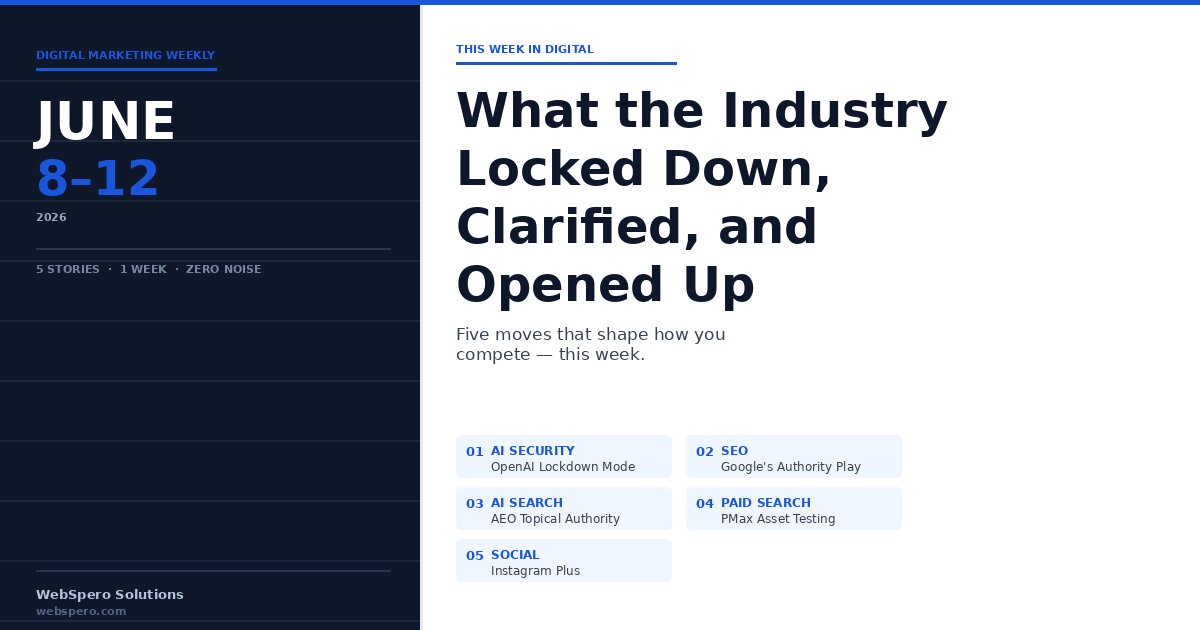
Here’s what happened between June 8 and 12, and what it means for you.
OpenAI rolled out Lockdown Mode across eligible Free, Plus, Pro, and self-serve Business accounts this week, which is an optional security setting that limits web browsing, Deep Research, Agent Mode, and outbound connections to reduce the risk of prompt injection attacks. It doesn’t stop malicious instructions from entering a conversation, but it cuts off the exit route attackers need to move your data out.
The feature was built for people and organizations that handle sensitive information. Enterprise clients, legal teams, research groups, and anyone using AI to process confidential data now have a structural control, not just policy guidelines, to reduce exposure. OpenAI is clear this isn’t for everyone, and the tradeoff is real: fewer capabilities in exchange for tighter containment.
The broader implication isn’t the feature itself. It’s what it signals. Prompt injection is now a serious enough vulnerability that the largest AI company in the world has shipped a dedicated defense. For businesses already integrating AI into their workflows, this week’s release is a useful moment to audit which tools connect to the web on your behalf — and whether those connections are actually necessary.
| KEY TAKEAWAY
Businesses that combine AI automation with deliberate data security controls will scale more effectively than those treating security as an afterthought. If your team uses ChatGPT to handle sensitive client, financial, or legal data, Lockdown Mode is worth evaluating now, and clearly not after an incident. |
Source: TechCrunch
Google published new Search Central documentation this week that positions its own guidelines as the definitive reference point for SEO, AEO, and GEO. The guidance doesn’t say don’t use third-party tools, but it says think critically about any tool or service that implies Google approval, because Google doesn’t evaluate or endorse them.
The most pointed language targets vendors and services that invoke Google’s name to imply authority. Google stated plainly that third-party tools don’t have access to its internal ranking data — meaning any score, prediction, or forecast from those tools is the tool’s own model, not Google’s signal. For teams that have built optimization workflows around third-party data, that’s worth sitting with for a moment.
What the guidance does affirm is Google Search Console as the first-party source of actual performance data. The subtext of the entire document is that the most reliable path through the noise of SEO advice, including the rapidly expanding space of AI search optimization, runs through Google’s own documentation.
“Most vendors selling SEO or GEO tools will quietly imply Google endorsement, through language, through branding, through the way they frame their scores. Google just made it explicit: that endorsement doesn’t exist. What this really does is raise the bar for how agencies should communicate. If your advice can’t be traced back to Google’s own documentation or your own tested experience, it shouldn’t be positioned as fact.”
Gursharan Singh, Co-founder & MD, WebSpero Solutions
| KEY TAKEAWAY
This isn’t “don’t trust agencies.” It’s “don’t trust vendors who claim to speak for Google.” Good SEO advice, per Google, either cites its official documentation or qualifies itself as opinion based on experience. Hold your own tool stack to that standard. |
Source: Search Engine Journal
A well-documented analysis of how AEO agencies build topical authority for AI search systems surfaced this week, and the distinction it draws is worth understanding clearly: topical authority is not content volume. It is the result of covering a subject so completely and connecting those ideas so coherently that an AI system treats your site as a dependable reference rather than one source among many.
AI search systems don’t just need relevant content; they also need content they can extract, verify, and combine with other information to synthesize an answer. That changes the criteria significantly. A page that ranks well in traditional search can still be invisible in AI-generated responses if its key claims are buried, its structure is ambiguous, or its coverage of surrounding concepts is thin.
The practical focus of effective AEO work is information architecture: topic mapping before content calendars, content clusters with clear internal hierarchies, direct answers near the top of sections, and entity depth across author bios, definitions, and cited examples. Consistency and freshness are also live signals, and AI systems respond to whether a source stays current, not just whether it was once comprehensive.
“We see this constantly. A brand has fifty blog posts and zero citations in AI-generated answers. The content exists, but the AI just can’t use it. The content isn’t structured for extraction, the claims aren’t verifiable, and the topic coverage has obvious gaps. Publishing isn’t the same as being findable by AI. The brands getting cited are the ones who’ve built a content ecosystem, not just a blog.”
Gursharan Singh, Co-founder & MD, WebSpero Solutions
| KEY TAKEAWAY
If AI can’t read your expertise, it won’t cite you. Stop treating SEO as a publishing cadence and start building a structured content ecosystem, one where a machine can trace the edges of your knowledge, verify your claims, and trust what it finds. |
Source: The AI Journal
Google announced new asset experiments for Performance Max campaigns this week, giving advertisers a structured way to evaluate creative decisions before applying them at scale. The new tools allow teams to compare entirely different asset groups, measure the impact of adding individual assets, test seasonal content against evergreen creative, and even evaluate assets generated through Google’s own Asset Studio.
PMax has always automated campaign optimization across Google’s inventory, but the creative side has largely been a black box. You could change assets and watch performance shift without being able to attribute what actually caused it. The new experiments are designed to change that, providing a controlled environment where creative decisions can be validated with data before committing budget to them.
The addition of a second success metric is particularly useful for advertisers managing competing objectives. Rather than declaring a single KPI winner, teams can evaluate how a creative change affects efficiency and volume simultaneously. Experiment management is also being consolidated onto a single Experiments page alongside conversion lift studies, which reduces the operational overhead of running multiple tests in parallel.
| KEY TAKEAWAY
Creative is one of the biggest levers in PMax, and until now it has been the hardest to test cleanly. If you run Performance Max campaigns, set up your first asset experiment before making your next creative change. The data you collect will compound across future decisions. |
Source: Search Engine Land
Instagram announced Instagram Plus this week, a new subscription tier designed to give creators deeper access to insights, more profile customization options, and enhanced Story features. The announcement positions Plus as a meaningful step up from the standard creator experience, not a cosmetic tier but a substantive one, built around the features that serious creators have been asking for.
The deeper analytics access is the piece most likely to change how creators make decisions. Profile customization extends the ability to differentiate on a platform where identity increasingly drives discovery. And the Story enhancements add capability to a format that remains one of the highest-engagement surfaces on the platform despite being over a decade old.
For brands working with creators, Instagram Plus adds another dimension to influencer evaluation. Creators who invest in the platform’s paid tier signal a level of seriousness about their work and data. For agencies managing creator partnerships, it’s worth tracking which creators adopt it and what they do with the additional insight access.
| KEY TAKEAWAY
The creators who use Instagram Plus effectively won’t just gain better analytics; they’ll make faster, more defensible decisions about what content to produce and how to build their audiences. For brands building creator programs, this tier is a signal worth paying attention to. |
Source: About Instagram
We publish a weekly roundup of the most important updates in SEO, paid search, content strategy, and AI-driven marketing — every week, no noise.
Attention: WebSpero does not conduct business or interviews over Skype, Google Hangouts, DM or any chat platforms and do not request banking information.