
Digital Marketing Updates (June 15–19, 2026): AI Relationships, Meta AI Mode & URL Structure
 Vishal Thakur
Published: June 22
Vishal Thakur
Published: June 22
Vishal Thakur
Published: June 22
Vishal Thakur
Published: June 22
AI is changing the rules in real estate relationships, Meta just turned every public Facebook post into a potential AI answer, and local SEO’s vanity metrics are finally being exposed.
Here’s what happened this week, and what it means for how you market.
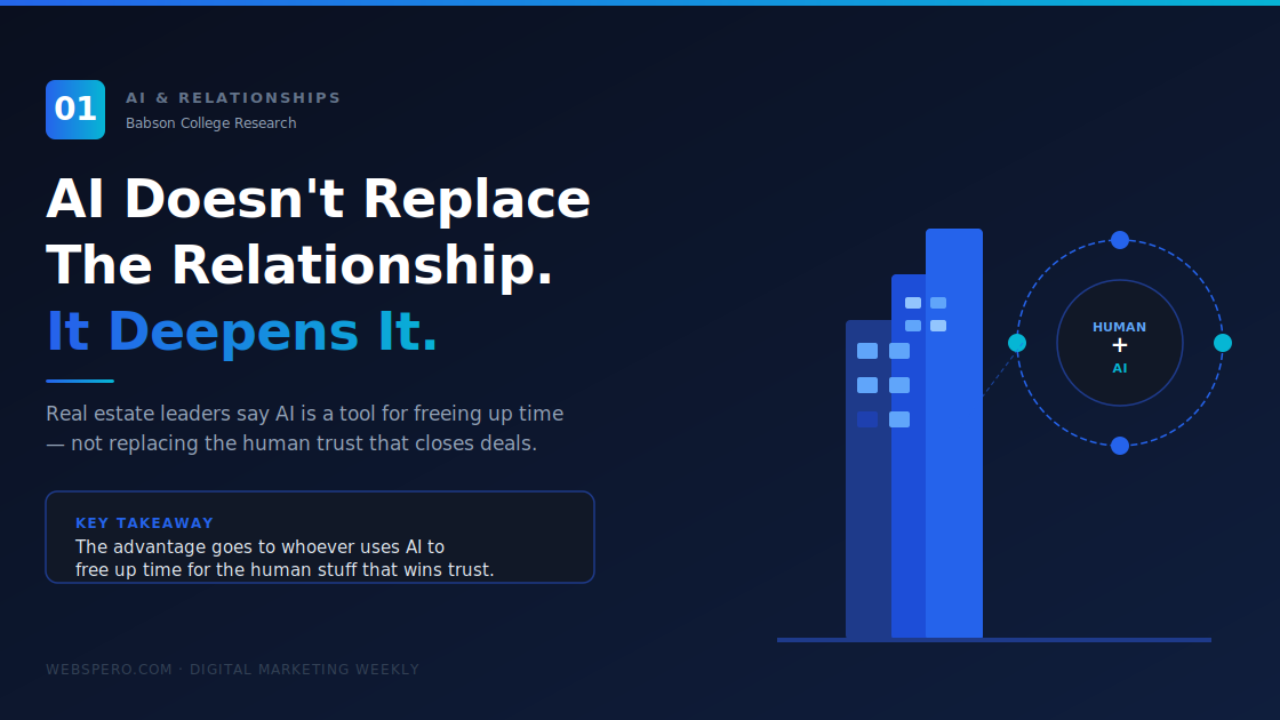
At Babson’s annual commercial real estate summit, industry leaders arrived expecting to debate AI adoption, and left with something more useful: a reminder of what AI cannot do. The consensus from a panel of executives and founders was clear and consistent: the firms generating the most value from AI are not the ones that have automated client interaction. They are the ones who have automated the noise around it.
Property professionals are using AI to handle document analysis, market-data synthesis, CRM updates, and report drafting — all the work that used to eat into meeting prep and follow-up. That reclaimed time goes directly into relationship quality: more thoughtful touchpoints, more personalized communication, faster responses on the things that matter to clients. The advantage, panelists argued, is not AI itself but what you do with the hours it gives back.
For marketers, the lesson runs parallel. AI-assisted content research, audience analysis, and campaign reporting create capacity. The question is whether that capacity gets poured back into the human-layer work — the conversations, the creative instincts, the genuine empathy in messaging that no algorithm can replicate.
| KEY TAKEAWAY
AI earns its place when it frees you to do the human work better. Audit your own workflows, and find the tasks that AI can absorb, and protect that reclaimed time for strategy, relationships, and creativity. |
Source: How the Real Estate Industry Is Embracing Artificial Intelligence — Babson Thought & Action

Meta has introduced an AI Mode on Facebook that does something most marketers haven’t fully processed yet: it reads your public posts, synthesizes them alongside content from other sources across Meta’s platforms, and uses that synthesis to answer questions from users in real time. The posts you publish today are no longer just feed content. They are raw material for AI-generated answers.
This mirrors what has already happened in Google’s AI Overviews and ChatGPT Search, but with one critical difference. Facebook has a social graph that Google does not. When Meta’s AI summarizes an answer, it can weigh the source’s authority on the platform, its engagement signals, and its contextual relevance to the person asking. A brand that publishes vague, engagement-bait content will not surface in those answers. A brand that publishes specific, useful, clear information consistently will.
The practical implication is a shift in how social content should be written. Optimizing for reach is still relevant, but every public post now carries a secondary audience: the AI layer reading it to extract answers. That means specificity over cleverness, clear claims over open-ended questions, and genuine expertise over manufactured virality.
| KEY TAKEAWAY
Write every public Facebook post as if it might become the answer to someone’s question. Lead with the specific claim, support it clearly, and cut anything that only serves the algorithm rather than the reader. |
Source: Meta Introduces AI Mode on Facebook, Leveraging Public Content Across Its Platforms — Firstpost
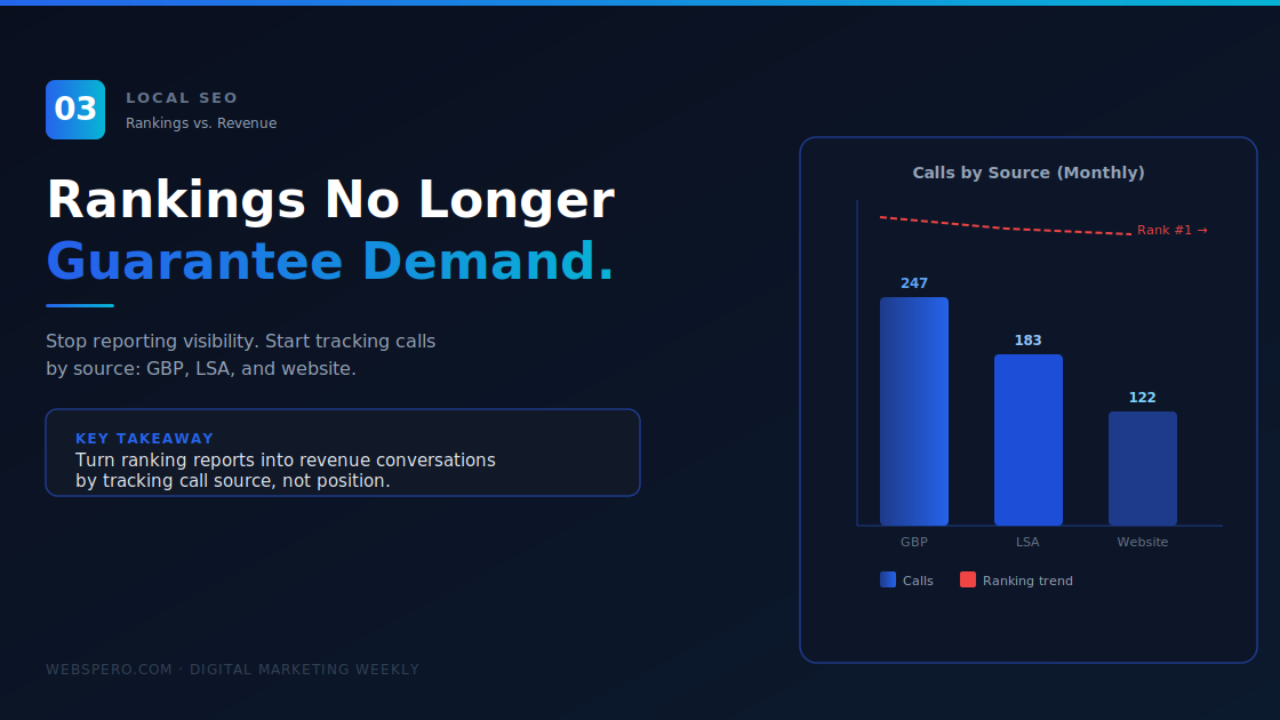
There’s a version of a local SEO report that looks great on paper and means almost nothing in practice. Rank position one. Impressions up thirty percent. Clicks stable. Calls down eighteen percent. If you’ve been in local search long enough, you’ve seen this pattern, and the HackerNoon analysis this week puts a name to why it happens: the decoupling of rankings and customer acquisition.
What’s driving the gap is a structural change in how local search results are presented. AI-generated summaries, expanded map packs, Local Services Ads, and zero-click answers are absorbing the attention that rankings used to capture. A business sitting in position one for a high-intent query might still lose the inquiry to an LSA ad above it or a direct call-to-action embedded in an AI overview. Rank is no longer a reliable proxy for visibility, and visibility is no longer a reliable proxy for demand.
The fix is straightforward but requires changing the reporting conversation with clients. Calls tracked by their source — Google Business Profile, Local Services Ads, and website direct are the only metric that closes the loop between search performance and real-world revenue. Ranking reports that don’t surface this distinction are, at best, incomplete.
“A rank-one position means nothing if the call goes to the LSA ad sitting above it. The only number that closes the conversation with a client is calls by source, in my opinion, that’s the one that turns an SEO update into a revenue conversation.”
— Gursharan Singh, Co-founder, WebSpero Solutions
| KEY TAKEAWAY
Restructure local reporting around call source attribution — GBP calls, LSA calls, website calls tracked separately. That’s the data set that connects your SEO effort directly to revenue and makes the value of your work visible to clients. |
Source: Why Local SEO Metrics No Longer Explain Customer Acquisition — HackerNoon
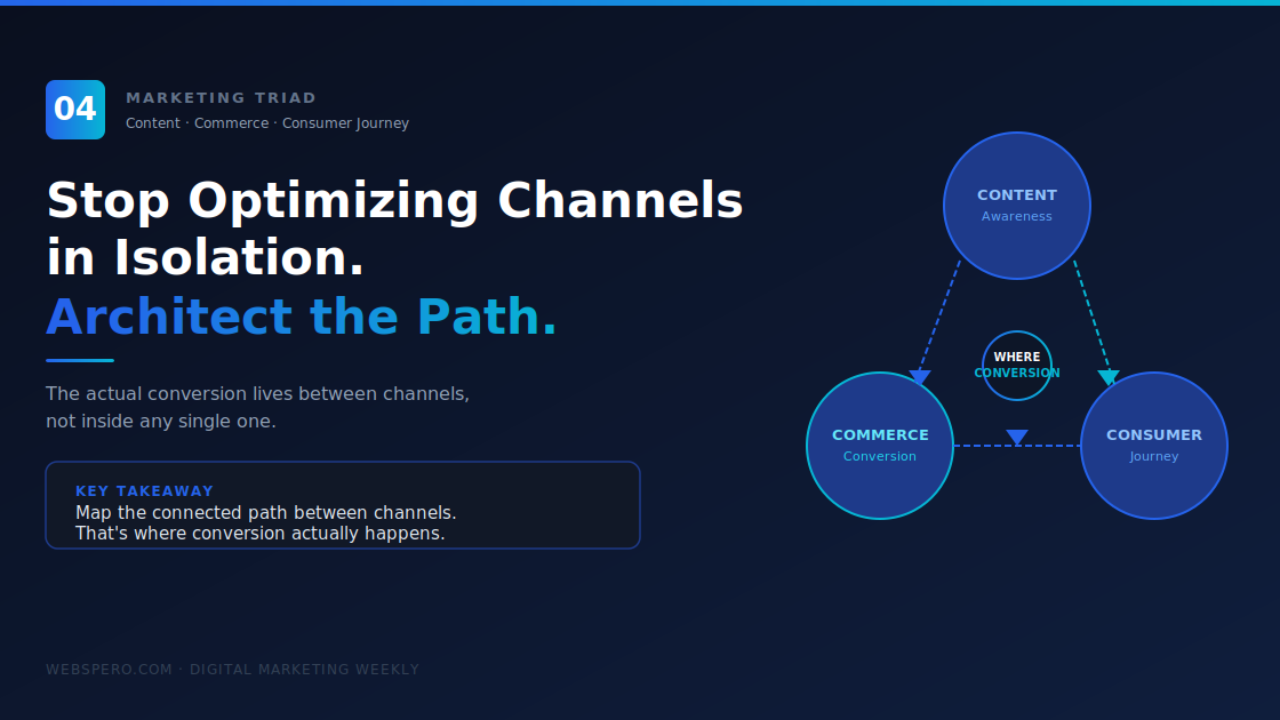
A framework gaining traction among brand strategists this week reframes the core problem of modern marketing: we have been measuring channels when we should be mapping journeys. The marketing triad — content, commerce, and the consumer journey only works as a system when the handoffs between its three nodes are intentional. Most organizations optimize each node well. Very few design the connective tissue that moves a person from one place to the next without friction.
What this looks like in practice: a content piece that earns attention but has no pathway into a commerce moment wastes its reach. A product page that converts well but was never reached through a coherent content journey leaves acquisition costs high. A consumer journey mapped carefully but disconnected from either content strategy or commerce infrastructure produces awareness without demand. The conversion, the analysis argues, consistently lives not inside any single channel but in the quality of the transition between them.
For brands, this is a prompt to rethink how cross-channel performance is measured. Optimizing cost-per-click on paid without understanding where that traffic goes, what it finds there, and whether the next touchpoint was designed — that is optimizing a node. Architecting the path between content, commerce, and the consumer experience is the fuller work, and it is where real competitive advantage is being built right now.
| KEY TAKEAWAY
Map your funnel as a connected path, not a set of independent channels. Identify the handoff points between content and commerce and ask whether each one is designed or accidental. The designed handoffs are where conversion improves. |
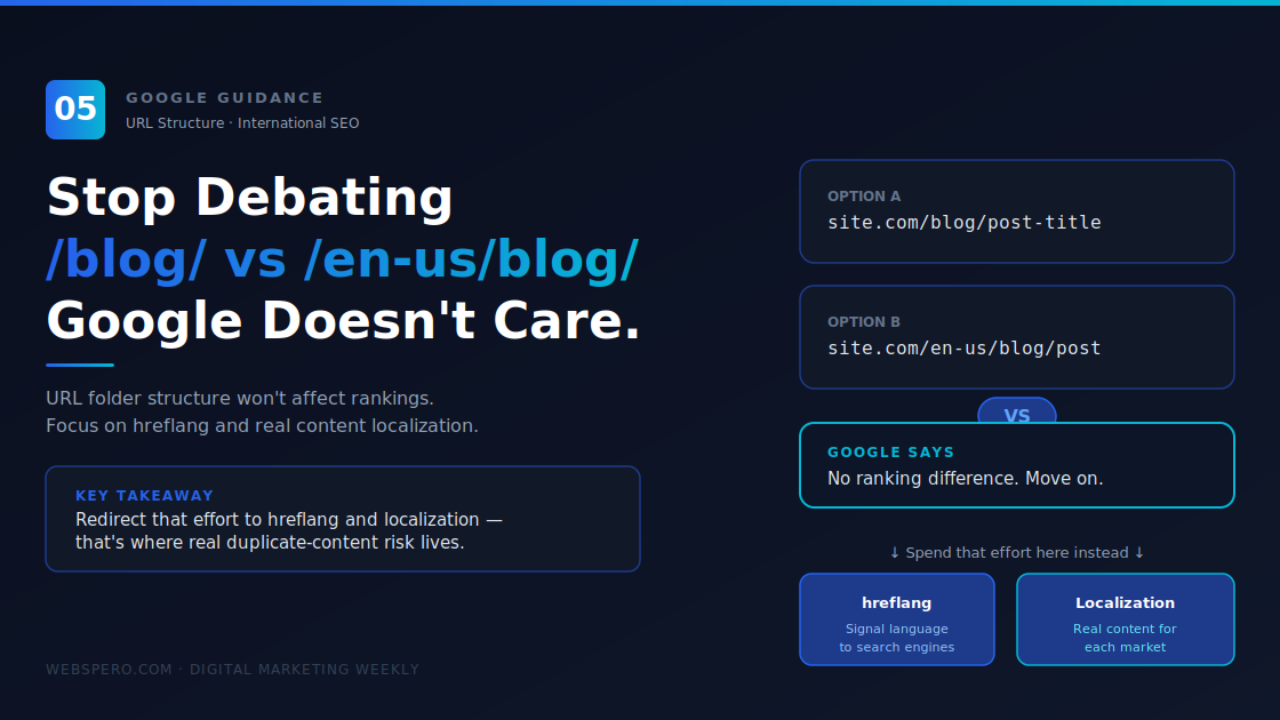
Google’s John Mueller answered the URL subfolder debate this week with the directness the question deserved: the structure of your URL folders, whether you nest content under /blog/, /us/blog/, or /en-us/blog/, has no meaningful impact on how Google ranks it. The search engine evaluates what the page says, how well it says it, and how authoritative the domain behind it is. The folder names are, in Google’s own framing, largely irrelevant to that evaluation.
The reason this matters is not just that one specific question is now settled. It’s that the SEO community has spent genuine time and client budget debating and restructuring URL patterns in the belief that the architecture was being read as a signal. For international sites in particular, the fear was that having /en-us/ in the URL somehow communicated regional intent more powerfully than the content itself. It doesn’t.
What does communicate regional intent, carry ranking signal, and introduce genuine duplicate-content risk if handled poorly: hreflang implementation and the actual depth of content localization. These are the areas where international SEO effort creates real value. The redirect chains and restructuring projects justified by URL folder theory were solving a problem that, as of this week, Google has confirmed does not exist.
| KEY TAKEAWAY
End any audit or restructuring work tied to URL subfolder patterns. Redirect that effort to hreflang validation and content localization. Those are the levers with a confirmed signal value for international search performance. |
Source: Google: US Site Folders Won’t Affect SEO Rankings — SE Roundtable
We publish a weekly roundup of the most important updates in SEO, paid search, content strategy, and AI-driven marketing — every week, no noise.
Attention: WebSpero does not conduct business or interviews over Skype, Google Hangouts, DM or any chat platforms and do not request banking information.