
Digital Marketing Updates (August 24-28, 2026): Google’s Spam Update Fallout, Local SEO Categories & ChatGPT Ads Automation
 Vishal Thakur
Published: August 31
Vishal Thakur
Published: August 31
Vishal Thakur
Published: August 31
Vishal Thakur
Published: August 31
Google’s August spam update turned out to be far more disruptive than usual, a new study says specific Google Business Profile categories can be worth double-digit rank positions, Google will start billing for some missed Local Services Ads calls, ChatGPT Ads just got a lot more automated, and a new study shows AI brand loyalty splits sharply by generation.
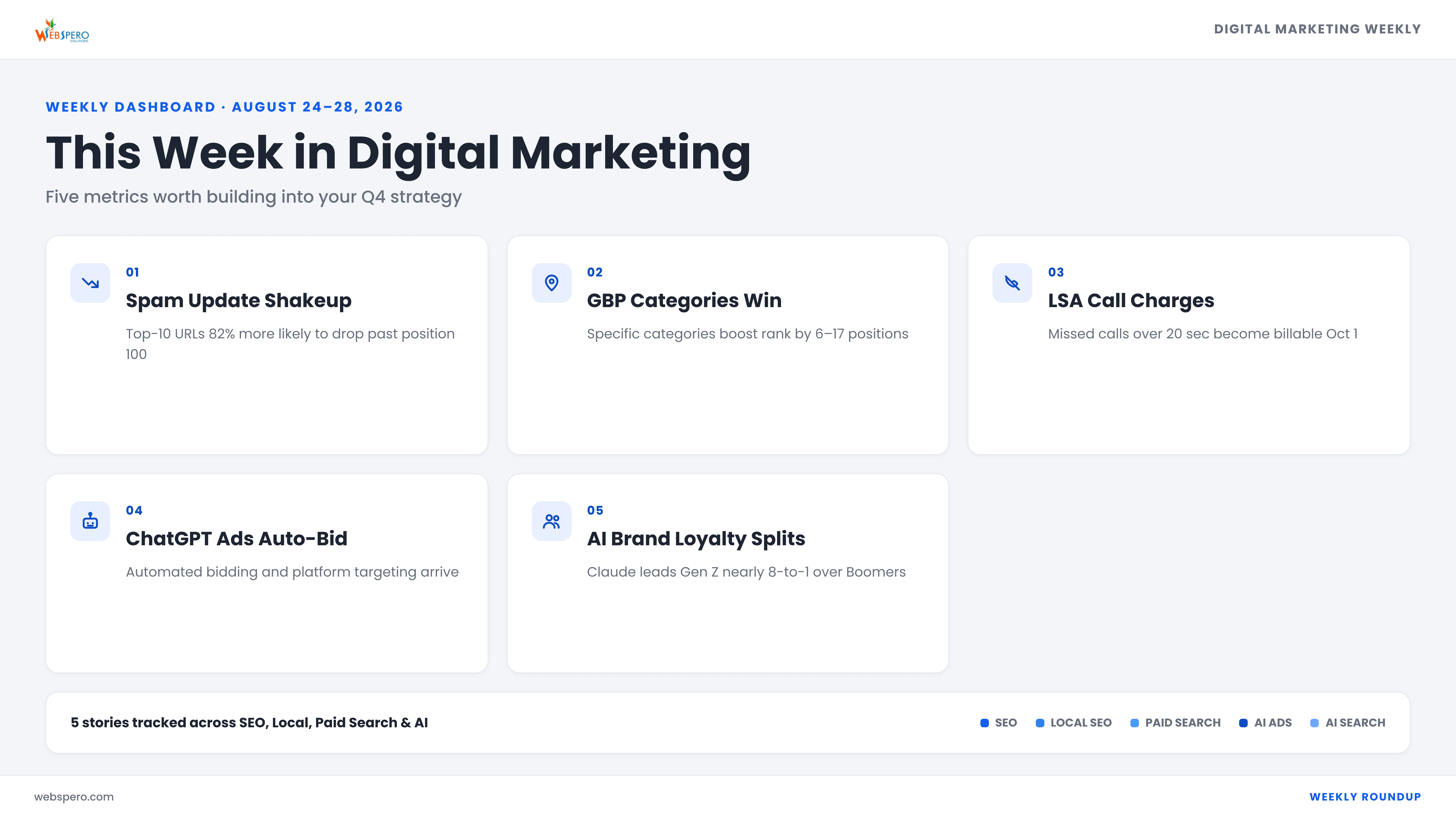
Here’s everything that happened this week and what it means for your marketing strategy.
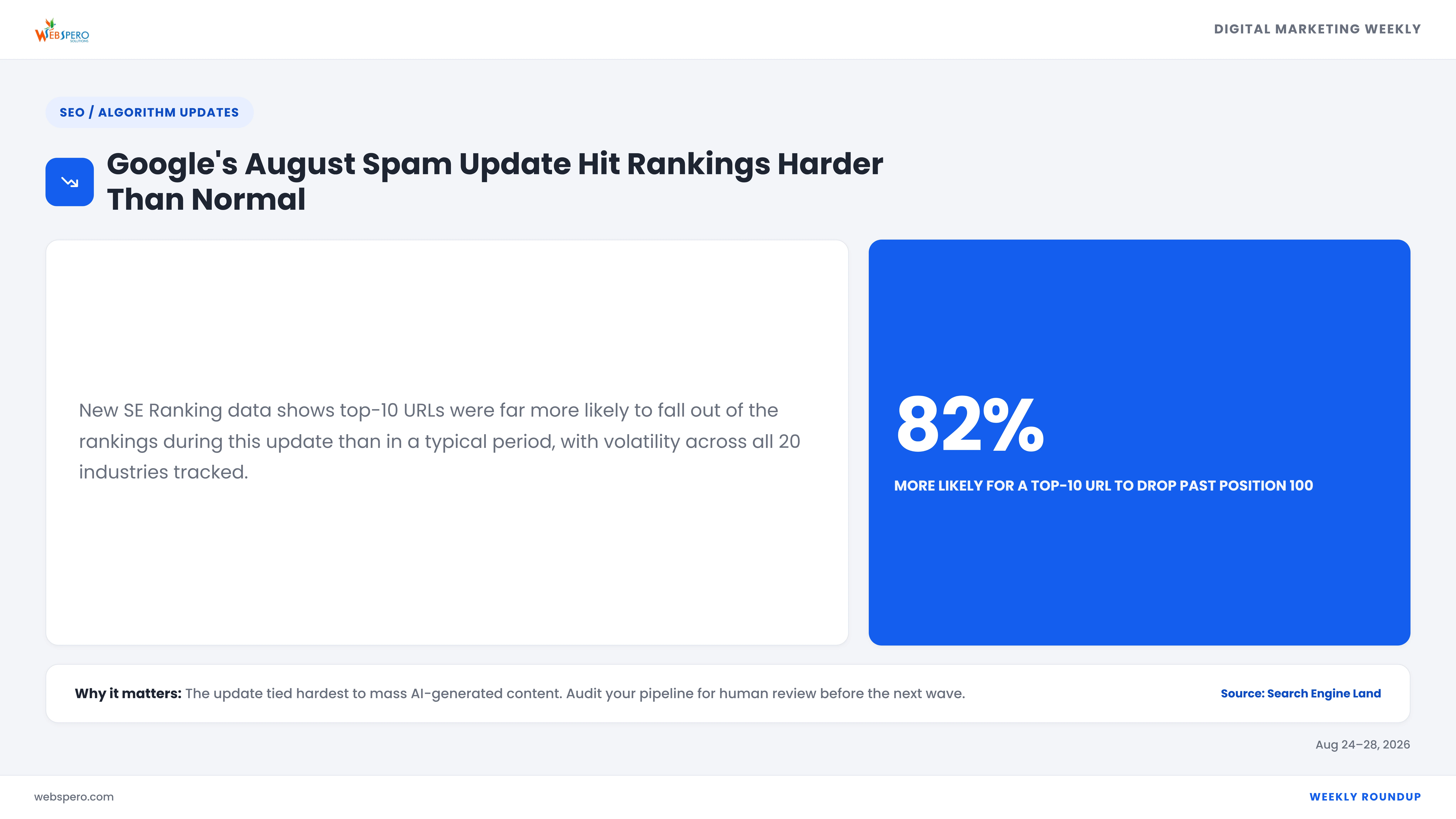
New data from SE Ranking, shared with Search Engine Land, shows Google’s August 2026 spam update caused meaningfully more disruption than typical search volatility. A top-10 URL was about 1.8 times more likely to fall beyond position 100 during the update than during a normal period — 16.71% of previously top-10 URLs dropped past position 100, compared to 9.2% in a July baseline check.
The volatility wasn’t isolated to a few niches. All 20 industries SE Ranking tracked saw significant movement, ranging from 74.64% top-10 volatility in real estate to 85.55% in fashion and beauty, with YMYL categories like healthcare and real estate holding relatively steadier. At the same time, the percentage of URLs breaking into the top 3 that hadn’t previously cracked the top 20 rose 12%, meaning this wasn’t just a story of losses — a real reshuffle happened.
Other reporting this month has tied the update specifically to mass AI-generated content, not AI-assisted content that gets human review. Sites relying on fully automated, template-driven publishing appear to have taken the brunt of it.
| KEY TAKEAWAY
The August update disrupted rankings nearly twice as hard as normal churn, and it hit mass AI-generated content the hardest. If you’re using AI in your content pipeline, make sure a human is actually editing the output, not just publishing it. |
Source: Google’s August 2026 spam update hit rankings harder than normal — Search Engine Land
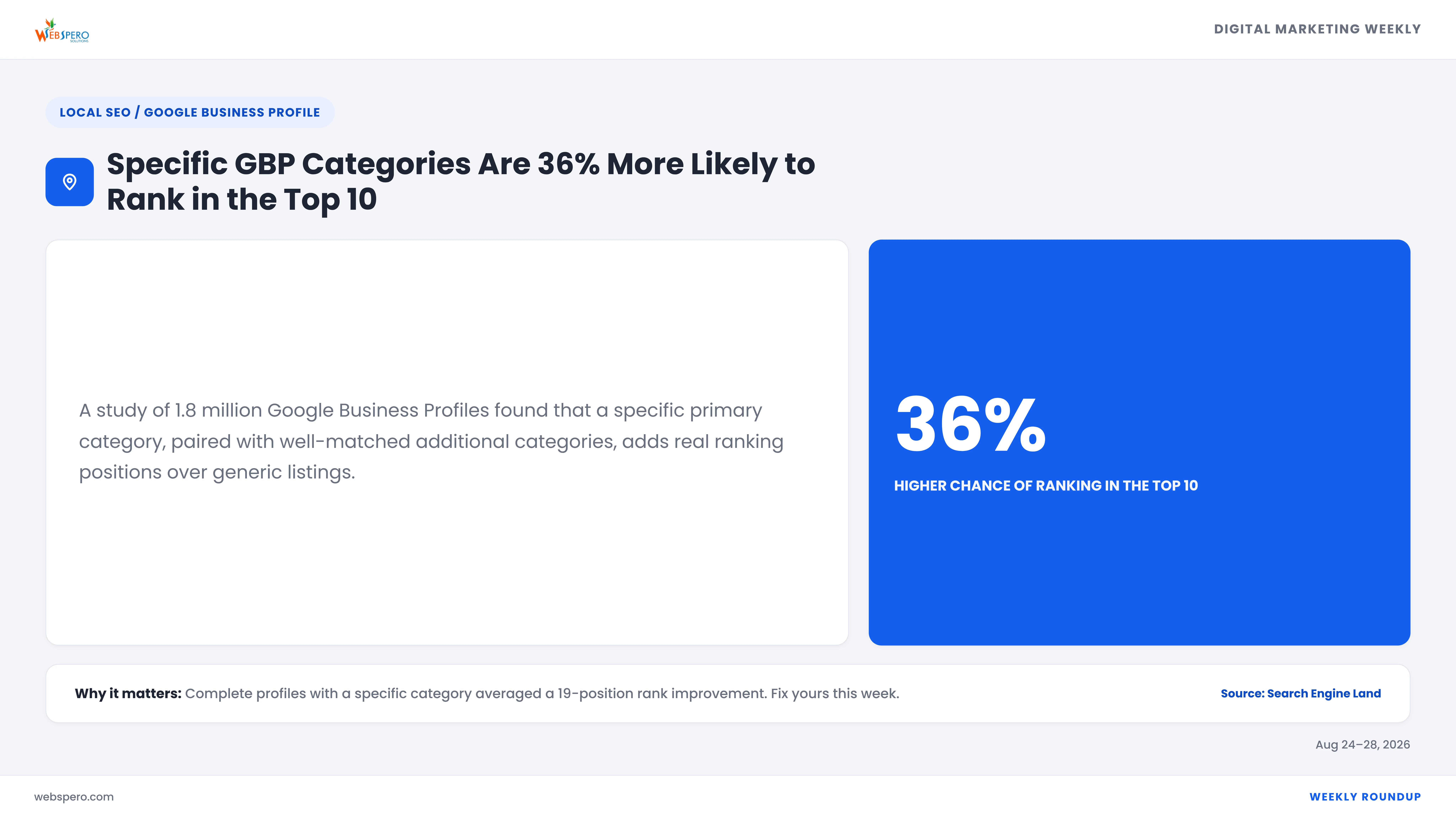
A Whitespark study of 1.8 million Google Business Profiles found that businesses using a specific primary category, like “Personal injury attorney” instead of just “Attorney,” have a 36% higher chance of ranking in the top 10 than those using generic categories.
Pairing a specific primary category with well-matched additional categories improved rankings by 6 to 17 positions in the study. Vague categories, like “Service established,” showed no ranking benefit at all. Profile completeness mattered just as much: businesses with a fully filled-out profile, including website, description, hours, and photos, saw an average 19-position improvement and were three times more likely to land in the top 10.
| KEY TAKEAWAY
Stop choosing a broad Google Business Profile category to capture more searches. Get specific with your primary category, add well-matched secondary categories, and complete every field. These are small, low-cost changes with an outsized ranking impact. |
Source: What 1.8 million Google Business Profiles tell us about local SEO success — Search Engine Land
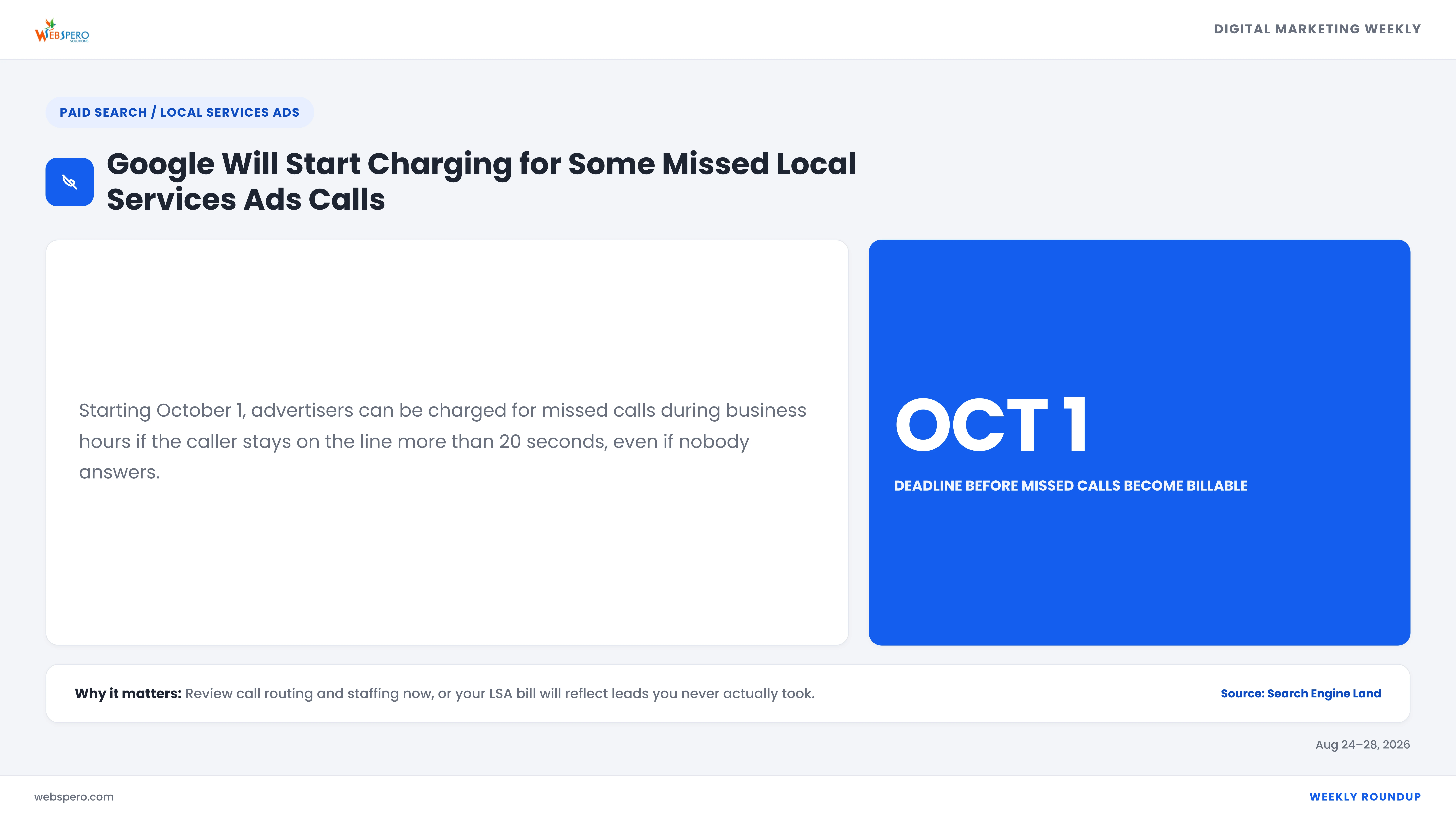
Starting October 1, Google is changing how it bills Local Services Ads (LSA) leads. Advertisers can now be charged for missed calls during business hours if the caller stays on the line for more than 20 seconds, even if nobody answers. Certain follow-up calls can also become billable if they meet Google’s criteria for a valid lead.
Google is adding an exception for businesses that require callers to press a key to reach the right department, along with new protections against automated and spam calls. But for businesses that simply let calls ring out during busy periods, this is a direct new cost.
| KEY TAKEAWAY
An unanswered call held for 20+ seconds is about to cost you money. Review your call routing and staffing before October 1, or your LSA bill will reflect leads you never actually took. |
Source: Google Local Services Ads will charge for some missed calls starting Oct. 1 — Search Engine Land
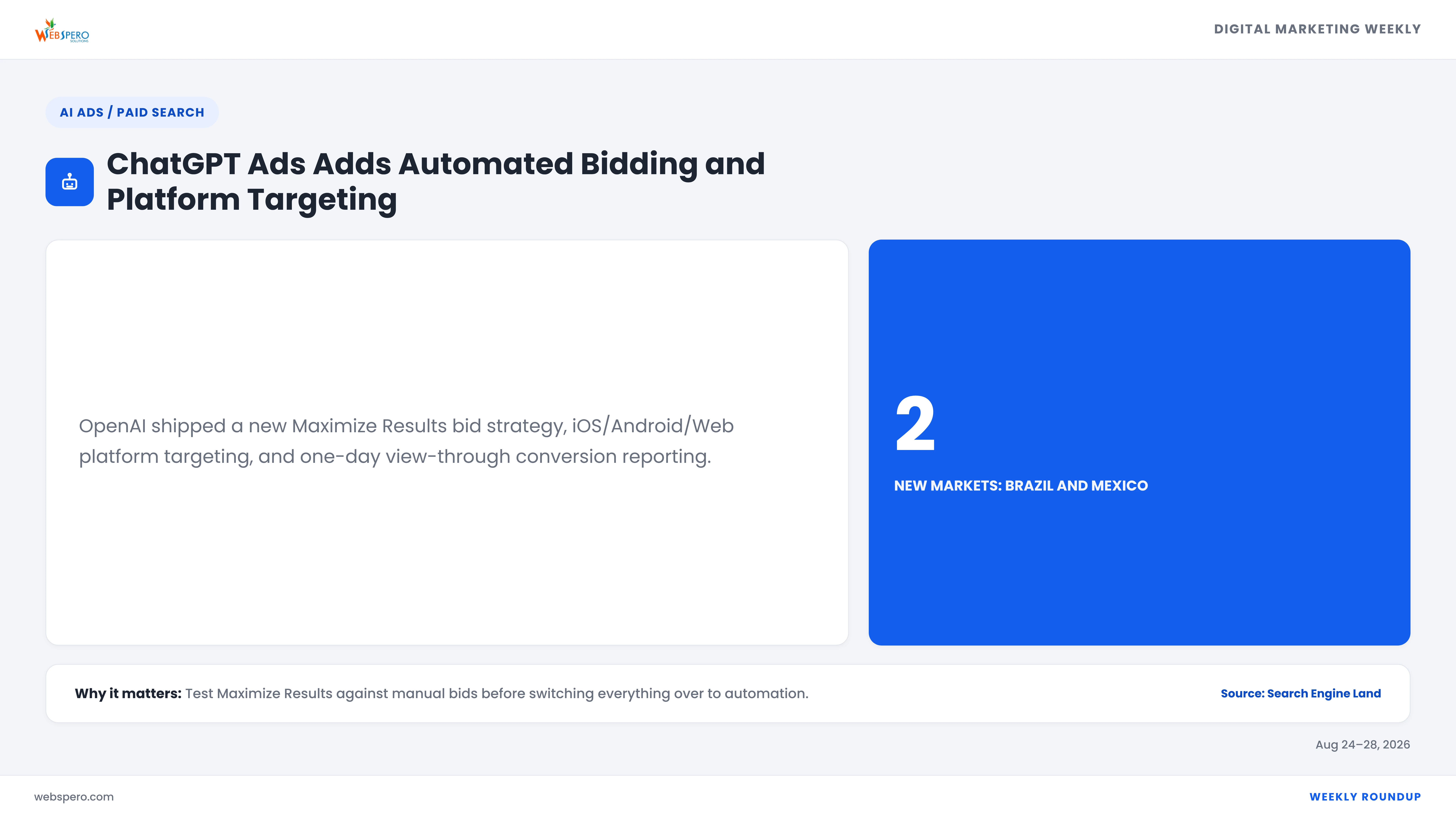
OpenAI rolled out a batch of new ChatGPT Ads tools this week, alongside an expansion into Brazil and Mexico. A new “Maximize results” bid strategy lets advertisers pick a campaign goal and hand bid decisions over to ChatGPT Ads entirely. A new “Eligible platforms” setting lets advertisers target iOS app, Android app, or Web specifically. ChatGPT Ads Manager also now reports one-day view-through conversions at the campaign, ad group, and ad level, and a new WorkMagic integration lets brands compare ChatGPT Ads performance against other channels while feeding conversion data back to OpenAI.
| KEY TAKEAWAY
ChatGPT Ads now has real automated bidding and platform-level targeting. Test “Maximize results” against your current manual bidding before switching everything over, and watch how much of your reported performance is coming from newly visible view-through conversions. |
Source: ChatGPT Ads adds automated bidding, platform targeting — Search Engine Land
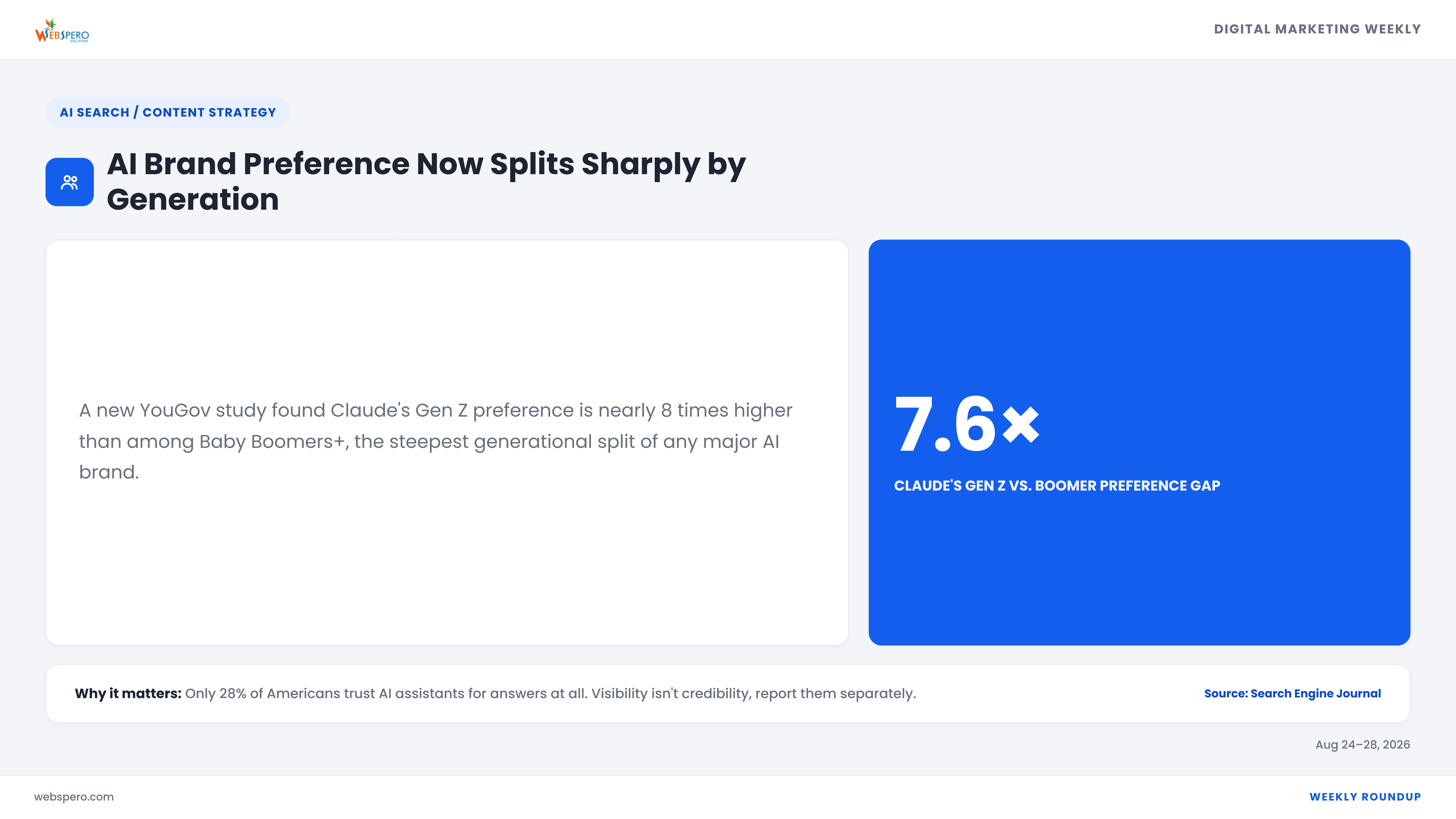
A new YouGov study found that Claude is preferred by 10.6% of Gen Z AI users, compared to just 1.4% of Baby Boomers+, the steepest generational gap of any major AI brand and roughly a 7.6-to-1 split. ChatGPT leads every generation outright, from 44.4% among Gen Z down to 24.5% among Boomers+. Copilot, Siri, and Alexa all skew in the opposite direction, performing better with older users than younger ones.
The study also found that AI-as-search-engine use holds steady at 38–40% across every generation, but AI-as-production-tool use is where generations diverge sharply: Gen Z uses AI to generate ideas at more than three times the rate of Boomers. Separately, only 28% of Americans say they trust AI assistants for answers at all, a reminder that preference and trust are not the same metric.
| KEY TAKEAWAY
Claude’s Gen Z lead and ChatGPT’s across-the-board dominance measure momentum, not trust, and only 28% of Americans trust AI assistants for answers at all. Don’t treat AI visibility numbers as a substitute for AI credibility in your GEO reporting. |
We publish a weekly roundup of the most important updates in SEO, paid search, content strategy, and AI-driven marketing — every week, no noise.
Attention: WebSpero does not conduct business or interviews over Skype, Google Hangouts, DM or any chat platforms and do not request banking information.